
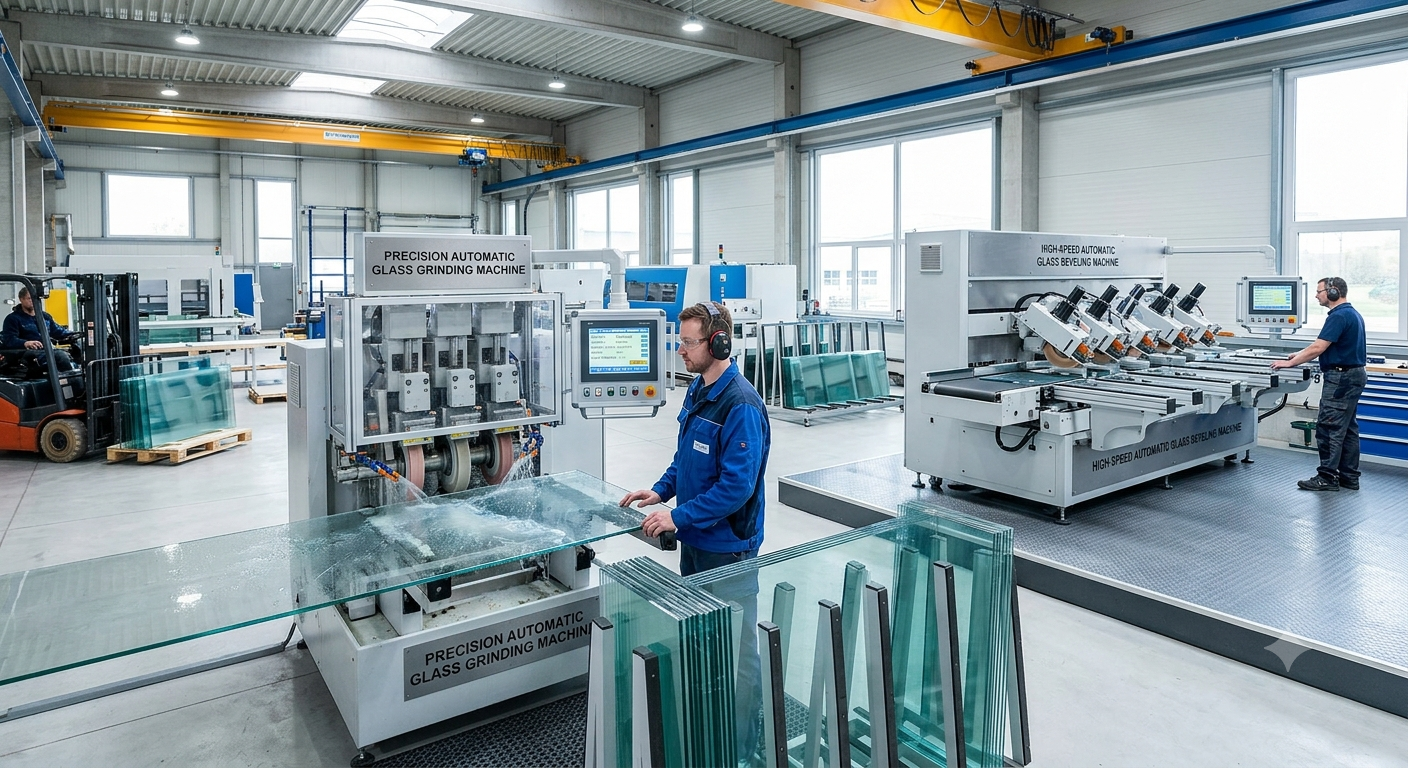
The glass processing industry has changed significantly with the introduction of advanced automation, precision engineering, and computer-controlled machinery. Among the most important technologies used today are the glass grinding machine and glass beveling machine. These machines help manufacturers transform raw or cut glass sheets into accurately finished products with smooth edges, precise dimensions, and attractive decorative profiles.
From architectural glass and furniture panels to automotive components and shower enclosures, modern glass products require more than simple cutting. Edges must often be polished, shaped, beveled, or finished to meet demanding safety and aesthetic standards. Choosing the right equipment can therefore improve production efficiency while reducing material waste and manual labor.
What Is a Glass Grinding Machine?
A glass grinding machine is industrial equipment designed to remove sharp, rough, or uneven edges from glass. After cutting, glass edges may contain small chips or irregularities that can create safety risks and affect the final appearance. Grinding machines use abrasive wheels or belts to process these edges with controlled precision.
Depending on the machine configuration, grinding can be performed on straight edges, shaped profiles, or specific sections of a glass component. Advanced systems can also combine grinding and polishing operations in a continuous production process.
Key Functions of Glass Grinding Equipment
A modern grinding machine may perform several important operations:
- Removing sharp edges after cutting
- Eliminating minor chips and surface imperfections
- Preparing edges for further polishing
- Producing consistent edge dimensions
- Improving workplace safety
- Supporting high-volume automated production
Grinding is often the first stage in creating a professionally finished glass edge. The exact process depends on the glass thickness, product design, required finish, and production volume.
What Is a Glass Beveling Machine?
A glass beveling machine is specialized equipment used to create an angled or sloped edge along the surface of glass. Unlike basic edge grinding, beveling produces a deliberate decorative or functional profile.
Beveled glass is widely used in premium interior applications because the angled edge can reflect light and create an elegant visual effect. It is commonly found in mirrors, furniture glass, decorative panels, doors, and architectural installations.
A beveling machine typically uses multiple processing stages to achieve accurate shaping and smooth finishing. Depending on the equipment, these stages may include rough grinding, fine grinding, polishing, and sometimes additional finishing processes.
Why Beveled Glass Is Popular
Beveled edges offer several advantages:
- Enhanced decorative appearance
- Improved light reflection
- Premium visual appeal
- Consistent edge geometry
- Greater design flexibility
- Suitability for customized glass products
The quality of beveling depends heavily on machine accuracy, abrasive selection, glass quality, and operator settings.
Glass Grinding Machine vs. Glass Beveling Machine
Although both machines process glass edges, their primary purposes are different.
| Feature | Glass Grinding Machine | Glass Beveling Machine |
| Main purpose | Edge removal and finishing | Creating angled decorative edges |
| Typical output | Smooth, safe edge | Sloped or beveled profile |
| Common applications | Architectural, automotive, furniture glass | Mirrors, decorative glass, premium interiors |
| Processing focus | Edge correction and smoothing | Profile creation and polishing |
| Design requirement | Functional and practical | Functional and decorative |
| Typical finish | Ground or polished edge | Beveled and polished edge |
In simple terms, grinding focuses primarily on making the edge smooth and safe, while beveling creates a specific angled profile that combines functionality with visual appeal.
How Does a Glass Grinding Machine Work?
The working process varies according to the machine design, but the general operation involves several steps.
1. Glass Loading
The glass sheet is positioned manually or automatically on the machine’s working surface. Modern equipment may use conveyor systems and vacuum handling technology to maintain stable movement.
2. Edge Grinding
Abrasive wheels contact the glass edge and gradually remove unwanted material. The grinding pressure and speed must be carefully controlled to prevent excessive chipping or thermal stress.
3. Fine Processing
After rough grinding, finer abrasive tools may be used to improve edge quality. This stage prepares the glass for polishing or final use.
4. Edge Inspection
The finished glass is inspected for dimensional accuracy, chips, cracks, and surface quality. Automated production lines may incorporate sensors or camera-based inspection systems.
How Does a Glass Beveling Machine Work?
The beveling process generally involves controlled material removal at a specific angle.
- The glass is securely positioned on the machine.
- The conveyor system moves it through the processing section.
- Grinding wheels create the required bevel angle.
- Additional wheels refine the bevel surface.
- Polishing tools improve transparency and shine.
- The completed product undergoes quality inspection.
The ability to maintain consistent bevel width and angle is particularly important when producing large quantities of identical glass components.
Important Features to Consider Before Buying
Selecting suitable glass processing equipment requires careful consideration of production needs. Businesses should evaluate the following factors:
Machine Precision
Precision directly affects edge quality and product consistency. Look for equipment with stable mechanical construction and accurate control systems.
Production Capacity
Manufacturers with high production volumes may require automated continuous-processing equipment, while smaller workshops may benefit from flexible machines designed for batch production.
Glass Thickness Range
Always confirm that the machine supports the thicknesses and dimensions required for your products.
Automation
Features such as automatic glass positioning, conveyor control, programmable settings, and digital monitoring can improve productivity and reduce human error.
Maintenance Requirements
Easy access to components, reliable spare parts, and straightforward maintenance procedures can help minimize downtime.
Applications Across Different Industries
Glass grinding machine and glass beveling machine technology is used across numerous sectors.
- Architectural glass manufacturing
- Interior decoration
- Furniture production
- Mirror manufacturing
- Shower enclosure production
- Automotive glass processing
- Retail display systems
- Door and partition manufacturing
- Decorative glass production
The growing demand for customized interiors and high-quality architectural finishes continues to increase the importance of precision glass processing.
Benefits of Modern Glass Processing Machinery
Advanced equipment offers several practical advantages compared with traditional manual processing.
Higher Productivity
Automated machines can process more glass within a shorter period, helping manufacturers meet demanding production schedules.
Consistent Quality
Computer-controlled settings help maintain uniform edge dimensions and finishing quality across multiple products.
Reduced Labor Dependency
Automation reduces the amount of repetitive manual work required during grinding and beveling operations.
Better Material Utilization
Accurate processing can reduce unnecessary material removal and minimize waste caused by inconsistent manual operations.
Improved Workplace Safety
By reducing direct handling of sharp glass edges, modern machinery can contribute to a safer production environment.
How to Choose the Right Machine
Before investing in equipment, manufacturers should follow a structured evaluation process:
- Identify the types and sizes of glass products being manufactured.
- Determine the required edge finish and bevel specifications.
- Calculate current and expected production volume.
- Compare manual, semi-automatic, and fully automatic systems.
- Check machine compatibility with existing production lines.
- Evaluate energy consumption and maintenance needs.
- Review technical support and spare-part availability.
- Request demonstrations or sample processing when possible.
A machine should be selected based on long-term production requirements rather than price alone.
Frequently Asked Questions
1. What is a glass grinding machine used for?
It is primarily used to smooth, shape, or finish glass edges after cutting, helping remove sharp edges and minor imperfections.
2. What does a glass beveling machine do?
It creates an angled edge on glass and can produce a smooth, polished bevel suitable for decorative and functional applications.
3. Can one machine perform grinding and polishing?
Many advanced systems combine grinding and polishing functions, depending on their configuration and processing capabilities.
4. Is beveled glass stronger than ordinary glass?
Beveling itself does not necessarily make glass stronger. Strength depends more on the glass type and whether it has been tempered or otherwise treated.
5. What industries use glass grinding equipment?
Architectural, automotive, furniture, mirror, interior design, and decorative glass industries commonly use grinding equipment.
6. Why is edge polishing important?
Polishing improves the visual appearance of glass and can create a smoother, higher-quality finished edge.
7. How does automation improve glass processing?
Automation can increase production speed, improve consistency, reduce repetitive labor, and support accurate processing parameters.
8. What should I check before purchasing a beveling machine?
Consider glass thickness, maximum dimensions, bevel specifications, production capacity, automation, maintenance, and technical support.
9. Can beveling be used for decorative glass?
Yes. Beveled edges are widely used in mirrors, furniture glass, doors, and premium decorative installations.
10. How can manufacturers reduce processing defects?
Using suitable abrasive tools, maintaining accurate machine settings, controlling processing speed, and performing regular equipment maintenance can help reduce defects.
https://newsgrow.blogspot.com/2026/06/glass-grinding-machine-and-glass_081504957.html