Silicone has become an essential material for industries that need flexibility, durability, chemical resistance, and reliable performance. From medical components and automotive seals to consumer products and industrial gaskets, silicone parts are used in applications where traditional plastics and rubbers may not deliver the required results.
Two manufacturing approaches that attract significant attention are low volume silicone molding and silicone rubber compression molding. Both methods can produce high-quality silicone components, but they serve different production needs. Understanding their advantages, limitations, and ideal applications can help product developers choose the right process while controlling costs and maintaining consistent quality.
What Is Low Volume Silicone Molding?
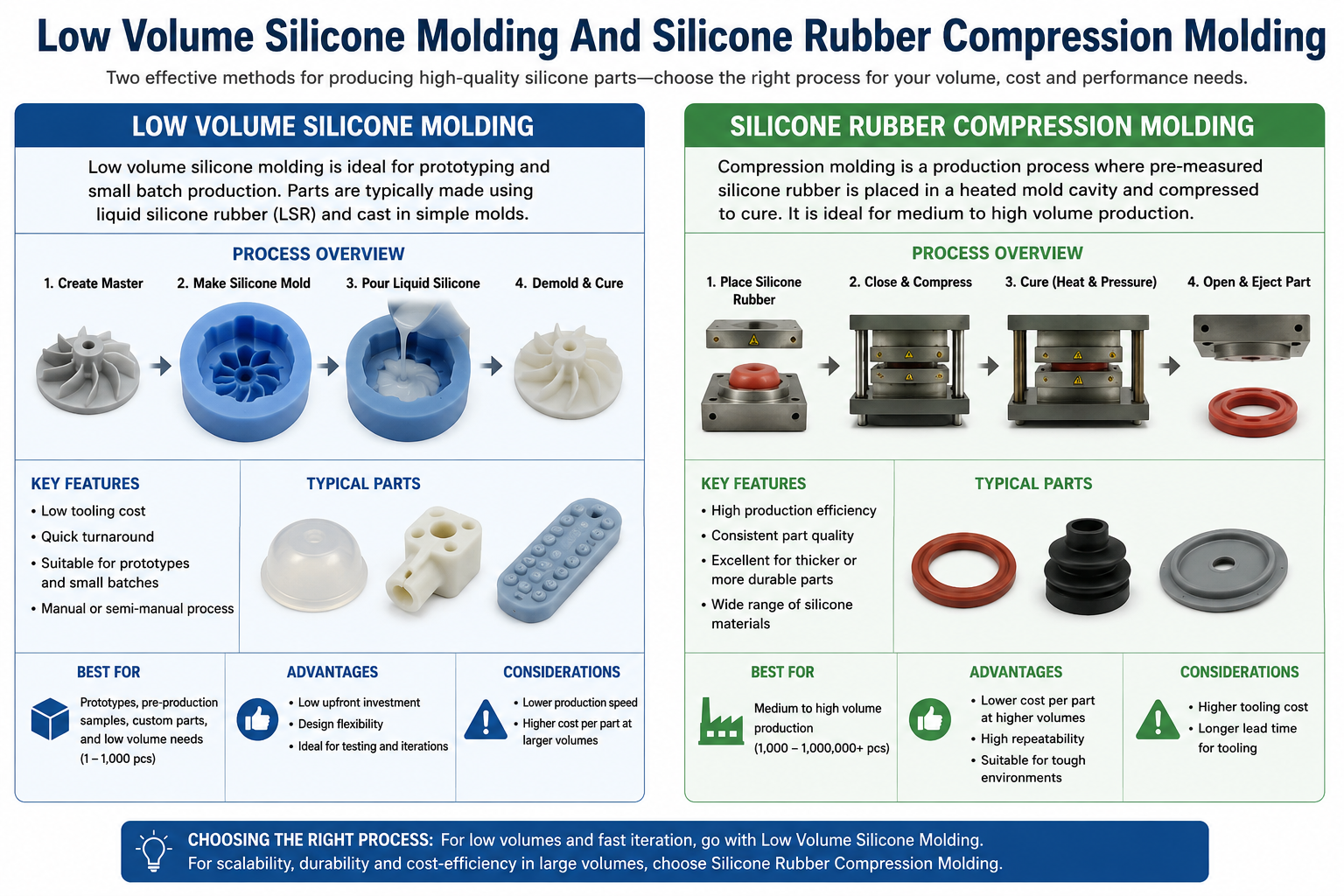
Low volume silicone molding is a manufacturing approach designed for producing a relatively small quantity of custom silicone parts. It is particularly useful during product development, prototyping, market testing, and specialized production runs.
Unlike high-volume manufacturing, low-volume production does not require manufacturers to immediately invest in expensive, highly optimized tooling designed for millions of components. Instead, manufacturers can select a practical tooling strategy that matches the required quantity and project budget.
Why Businesses Choose Low Volume Silicone Molding
Companies often need functional parts before committing to large-scale production. Low-volume manufacturing provides an opportunity to evaluate a product in real-world conditions.
Common advantages include:
- Lower initial tooling investment
- Faster product development cycles
- Greater flexibility for design changes
- Suitable for prototypes and pilot production
- Reduced inventory risk
- Opportunity to test customer response
- Practical for customized silicone components
This approach is especially valuable for startups and businesses launching new products because it allows them to validate designs before moving into mass production.
Understanding Silicone Rubber Compression Molding
Silicone rubber compression molding is a traditional molding process in which silicone rubber material is placed into a heated mold cavity. The mold is then closed, and controlled pressure and heat help the material conform to the desired shape and cure.
The process is relatively straightforward but requires careful control of several factors, including material preparation, mold temperature, pressure, curing time, and part design.
How the Compression Molding Process Works
A typical production cycle involves several key stages:
- Material preparation: Silicone rubber is measured and prepared according to the required formulation.
- Material placement: The silicone is positioned inside the mold cavity.
- Mold closing: The mold is closed under controlled pressure.
- Heat and curing: Temperature activates the curing process while pressure helps form the component.
- Mold opening: Once cured, the finished part is removed.
- Finishing: Excess flash may be trimmed, followed by inspection and quality control.
The result is a molded silicone component with the required dimensions and functional properties.
Low Volume Silicone Molding vs. Compression Molding
Although these terms are sometimes discussed together, they describe different aspects of manufacturing. Low volume silicone molding primarily refers to production quantity and project requirements, while compression molding describes a specific manufacturing technique.
| Factor | Low Volume Silicone Molding | Silicone Rubber Compression Molding |
| Primary focus | Small production quantities | Manufacturing method |
| Ideal use | Prototypes, testing, specialized runs | Functional silicone components |
| Tooling strategy | Flexible and quantity-dependent | Dedicated compression mold |
| Production scale | Low to moderate | Low to high, depending on tooling |
| Design flexibility | Generally high during development | Depends on mold design |
| Cost efficiency | Useful for limited quantities | Efficient for suitable production volumes |
| Applications | Prototypes and customized parts | Seals, gaskets, covers, and industrial parts |
The two approaches can also work together. For example, a manufacturer may use a low-volume strategy to produce an initial batch of parts using compression molding before increasing production after successful product validation.
Key Benefits of Silicone Rubber Compression Molding
Compression molding remains popular because it offers a practical balance between tooling investment, production capability, and material performance.
Excellent Material Performance
Silicone rubber can withstand challenging environmental conditions. Depending on the formulation, molded silicone components can offer resistance to temperature changes, moisture, UV exposure, and many chemicals.
Suitable for Complex Applications
Compression molding can produce various shapes and geometries, making it suitable for components used in automotive, electronics, healthcare, appliances, and industrial equipment.
Cost-Effective for Appropriate Volumes
For businesses that require recurring production, compression molding can become economical because the tooling can be reused for multiple production cycles.
Broad Industry Applications
Common applications include:
- Silicone seals and gaskets
- Medical and healthcare components
- Automotive parts
- Electrical insulation components
- Keypads and flexible buttons
- Industrial membranes
- Protective covers
- Consumer product components
Choosing the Right Silicone Molding Approach
Selecting the right process requires more than comparing production costs. Businesses should evaluate the entire product lifecycle.
Consider These Factors
1. Production Quantity
If only hundreds or a few thousand parts are needed, low-volume manufacturing may be more practical than investing heavily in mass-production tooling.
2. Product Complexity
Detailed designs may require specialized tooling and careful engineering. Mold geometry, part thickness, undercuts, and tolerances should be reviewed before production begins.
3. Material Requirements
Different silicone formulations offer different characteristics. The application may require high-temperature resistance, softness, durability, biocompatibility, or specific mechanical properties.
4. Budget and Timeline
A project with a short development window may benefit from a manufacturing strategy that reduces tooling lead time while maintaining acceptable quality.
5. Future Production Plans
A prototype project that is expected to become a high-volume product should be designed with future scalability in mind.
Quality Control in Silicone Manufacturing
Reliable silicone molding depends on consistent quality control throughout the manufacturing process. A professional manufacturer should evaluate material properties, mold condition, curing parameters, dimensional accuracy, and surface finish.
Important quality checks may include:
- Dimensional inspection
- Visual examination
- Hardness testing
- Tensile and elongation testing
- Compression set evaluation
- Flash inspection
- Material traceability
Strong quality management helps reduce defects and ensures that silicone components perform consistently in their intended environments.
Common Challenges and How to Address Them
Silicone molding can present challenges such as flash, incomplete curing, dimensional variation, air entrapment, and inconsistent surface quality.
These problems can often be reduced through:
- Proper mold design
- Accurate material measurement
- Controlled curing conditions
- Appropriate venting
- Regular tooling maintenance
- Detailed inspection procedures
Early communication between product designers and molding specialists is also essential. Design-for-manufacturing reviews can identify potential problems before tooling begins.
Frequently Asked Questions
1. What is low volume silicone molding?
It is a manufacturing approach for producing smaller quantities of custom silicone components, commonly used for prototypes, product testing, and specialized production.
2. What is silicone rubber compression molding?
It is a molding process in which silicone rubber is placed into a heated mold and compressed until it cures into the desired shape.
3. Is low volume silicone molding suitable for prototypes?
Yes. It is particularly useful for functional prototypes that need to replicate the properties of final silicone components.
4. Can compression molding produce custom silicone parts?
Yes. Custom molds can be engineered to manufacture silicone parts according to specific dimensions and design requirements.
5. Which industries use silicone molded components?
Automotive, medical, electronics, industrial equipment, consumer products, and appliance industries commonly use molded silicone parts.
6. Is silicone rubber durable?
Yes. Silicone rubber is known for flexibility, resilience, and resistance to various environmental conditions, although performance depends on the selected formulation.
7. How can manufacturers reduce silicone molding defects?
Careful material preparation, accurate mold design, controlled curing, proper venting, and thorough quality inspection can help reduce defects.
8. Is compression molding cost-effective?
It can be highly cost-effective when the production volume and component design justify the required tooling investment.
9. What affects the cost of silicone molding?
Tool complexity, material selection, part size, production quantity, tolerances, finishing requirements, and quality standards can all influence total cost.
10. How do I choose a silicone molding manufacturer?
Look for experience with your application, strong quality controls, engineering support, material expertise, and the ability to meet your production volume and specifications.
Read more –
https://newsgrow.blogspot.com/2026/06/silicone-compression-molding-and-low.html
https://newsgrow.blogspot.com/2026/06/low-volume-silicone-molding-and.html