The global manufacturing landscape is entering a new phase in which product developers are looking for production methods that combine precision, reliability, and cost efficiency. Against this backdrop, Silicone Compression Molding and low volume silicone molding are gaining attention among businesses developing medical devices, automotive components, consumer products, electronics, and industrial equipment.
Silicone has become an important material for manufacturers because it offers flexibility, temperature resistance, chemical stability, durability, and excellent sealing performance. As industries demand more specialized components and shorter development cycles, molding technologies capable of producing dependable silicone parts are becoming increasingly valuable.
The growing interest is not limited to large-scale production. Startups, engineering teams, and companies testing new products are also seeking practical ways to manufacture smaller quantities before committing to full-scale production. This is where low-volume manufacturing approaches can help reduce initial investment while supporting product validation.
Why Silicone Is Becoming a Preferred Engineering Material
Silicone rubber is widely used in applications where conventional materials may struggle to deliver long-term performance. Depending on the formulation, silicone can maintain useful properties across a broad temperature range while remaining flexible.
Key advantages include:
- Excellent resistance to heat and cold
- Strong flexibility and elasticity
- Reliable sealing capabilities
- Resistance to moisture and many environmental conditions
- Good electrical insulation
- Long service life
- Compatibility with complex component designs
These characteristics make silicone suitable for gaskets, seals, medical components, protective covers, keypads, valves, diaphragms, and custom molded parts.
Silicone Compression Molding Supports Consistent Production
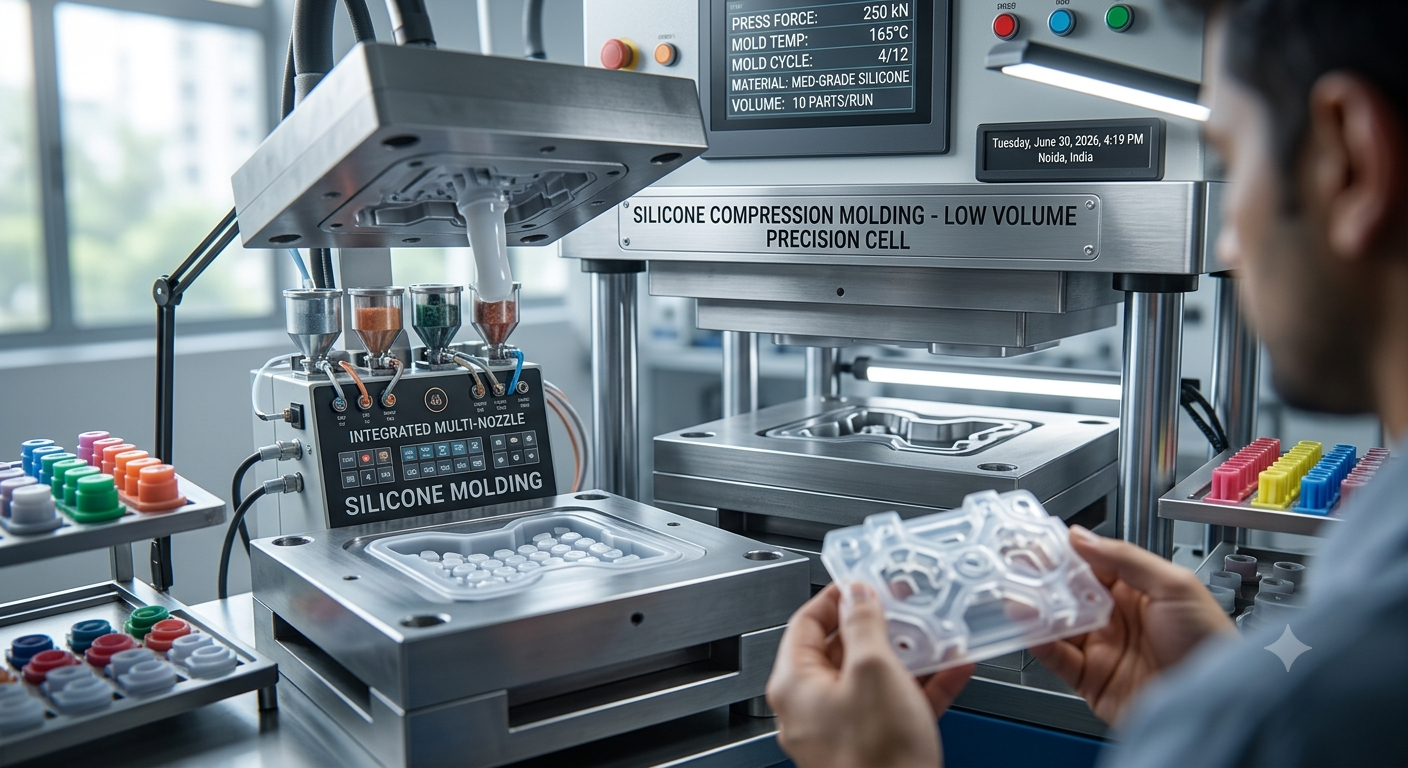
Silicone Compression Molding is a manufacturing process in which a measured amount of silicone material is placed into a heated mold cavity. The mold is then closed, applying pressure and heat that allow the material to flow into the cavity and cure into the required shape.
The process is particularly useful for producing custom silicone rubber parts with consistent dimensions and repeatable performance.
How the Process Works
A typical compression molding workflow includes several stages:
- Material preparation: Silicone material is selected according to the application’s performance requirements.
- Material loading: A controlled quantity of silicone is positioned inside the mold.
- Mold closing: The mold is closed under controlled pressure.
- Heating and curing: Heat activates the curing process and allows the silicone to form the desired shape.
- Demolding: Once cured, the finished component is removed from the mold.
- Inspection and finishing: Parts are checked for dimensional accuracy, surface quality, and functional requirements.
Factors That Influence Final Quality
Successful molding depends on several variables, including mold design, material selection, curing temperature, pressure, cycle time, and part geometry. Proper control of these factors can help manufacturers achieve consistent results and reduce defects.
Manufacturers may also consider flash control, venting, tolerance requirements, surface finish, and post-molding operations during product development.
Low Volume Silicone Molding Helps Reduce Development Risk
Not every product requires thousands of components at the beginning of its lifecycle. A new product may first need prototypes, engineering samples, pilot batches, or limited production quantities.
Low volume silicone molding provides a practical option for these situations. Instead of immediately investing in high-volume production, companies can manufacture a smaller number of silicone components for testing and market evaluation.
This approach can be particularly useful for:
- New product development
- Prototype validation
- Medical and laboratory equipment
- Specialized industrial products
- Custom consumer goods
- Replacement components
- Pilot production
- Market testing
The ability to manufacture smaller quantities can allow businesses to identify design problems before moving into larger production runs.
Key Benefits of Low-Volume Manufacturing
The major advantages include:
Lower initial commitment: Companies can avoid producing large quantities before demand is established.
Faster design validation: Engineers can evaluate physical parts under real-world conditions.
Greater flexibility: Design modifications can be introduced before large-scale manufacturing begins.
Reduced inventory risk: Businesses can produce closer to actual short-term requirements.
Better product development: Physical testing can reveal issues that may not be visible through digital simulations alone.
Comparing Silicone Compression Molding and Low Volume Silicone Molding
| Factor | Silicone Compression Molding | Low Volume Silicone Molding |
| Primary focus | Manufacturing process | Production quantity strategy |
| Typical use | Repeatable molded silicone parts | Prototypes, pilot runs, and smaller batches |
| Suitable for | Multiple industries | Startups, product developers, and specialized applications |
| Main advantage | Consistent part production | Reduced upfront production risk |
| Design flexibility | Depends on tooling | Often useful during development |
| Production scale | Can support repeated manufacturing | Designed around limited quantities |
It is important to understand that these concepts are not necessarily alternatives. A manufacturer may use compression molding as the actual production method while applying a low-volume strategy to produce an initial batch.
Industries Exploring Advanced Silicone Manufacturing
The demand for molded silicone components continues across multiple sectors.
Medical and Healthcare
Silicone is widely considered for medical and healthcare applications because of its flexibility and performance characteristics. Components may include seals, tubing-related parts, diaphragms, and specialized device components, subject to the applicable regulatory and material requirements.
Automotive
Automotive manufacturers use silicone components in demanding environments where temperature resistance and durability are important. Seals, gaskets, protective parts, and specialized connectors are examples of potential applications.
Electronics
Silicone can provide insulation, protection, and sealing in electronic products. Custom molded components may be developed for switches, connectors, protective covers, and other applications.
Consumer Products
From wearable products to household equipment, silicone is increasingly used where flexibility, durability, and tactile performance are desired.
What Manufacturers Should Consider Before Production
Choosing the right molding strategy requires more than selecting a material. Businesses should evaluate:
- Part dimensions and geometry
- Required material properties
- Expected production volume
- Tooling requirements
- Dimensional tolerances
- Surface finish expectations
- Regulatory or industry standards
- Quality inspection procedures
- Lead-time requirements
- Future scalability
A detailed discussion between the product designer and molding partner at the beginning of development can help prevent expensive changes later.
Frequently Asked Questions
1. What is Silicone Compression Molding?
It is a molding process that uses heat and pressure to cure silicone material inside a specially designed mold cavity.
2. What is low volume silicone molding?
It refers to producing smaller quantities of silicone components, often for prototypes, testing, pilot production, or specialized applications.
3. Is compression molding suitable for custom silicone parts?
Yes. It can be used to manufacture many custom silicone components when the tooling and process are properly designed.
4. Why choose silicone for molded components?
Silicone offers flexibility, durability, temperature resistance, sealing performance, and electrical insulation properties.
5. Can startups use low volume silicone molding?
Yes. Smaller production runs can help startups validate designs and demand before investing in larger-scale manufacturing.
6. Is low-volume molding only for prototypes?
No. It can also support limited production, replacement parts, specialized products, and pilot manufacturing.
7. What affects silicone molding quality?
Material selection, mold design, curing conditions, pressure, temperature, tolerances, and inspection processes all influence quality.
8. How can manufacturers reduce molding defects?
Careful tooling design, controlled processing parameters, suitable material selection, and thorough quality inspections can help reduce defects.
9. Can molded silicone parts be used in demanding environments?
Yes. Silicone is often selected for applications requiring flexibility and resistance to temperature and environmental conditions, depending on the specific formulation.
10. How should companies select a molding partner?
Companies should assess technical expertise, tooling capabilities, quality systems, material knowledge, production capacity, and experience with similar applications.
Read more –
https://newsgrow.blogspot.com/2026/06/silicone-compression-molding-and-low.html