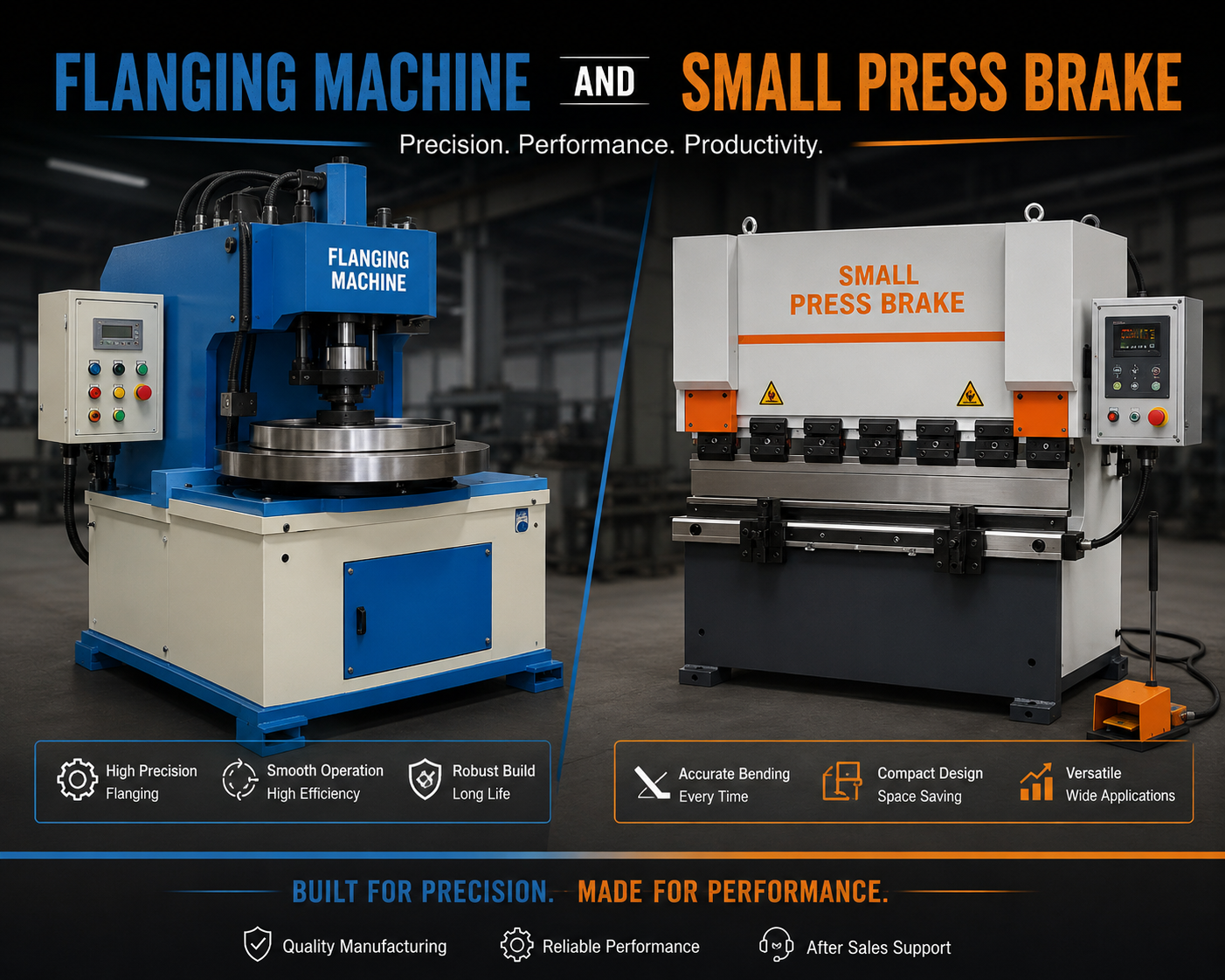
Metal fabrication has evolved significantly as manufacturers look for faster production, better accuracy, and more efficient equipment. Among the machines supporting this transformation, the flanging machine and small press brake have become valuable solutions for workshops, fabrication companies, and industrial manufacturers.
Although both machines are used for metal forming, they perform different operations and are suited to different production requirements. Understanding their capabilities, applications, and advantages can help businesses select the right equipment for their projects.
What Is a Flanging Machine?
A flanging machine is specialized equipment designed to create flanges or formed edges on metal components. A flange is typically a projecting rim, lip, or edge that can strengthen a part, provide a joining surface, or help connect two components.
Depending on the machine design, flanging operations may involve forming, bending, rolling, or shaping sheet metal into precise profiles. These machines are commonly used in industries where consistent edge forming is essential.
Common Applications of Flanging Machines
Flanging equipment can be found across various manufacturing sectors, including:
- Automotive component manufacturing
- HVAC and ductwork production
- Pressure vessel fabrication
- Metal container manufacturing
- Industrial equipment production
- Appliance manufacturing
- Aerospace component fabrication
- Sheet metal workshops
A high-quality flanging machine can help manufacturers achieve repeatable results while reducing manual labor and improving production efficiency.
What Is a Small Press Brake?
A small press brake is a compact machine used to bend sheet metal and metal plates into specific angles and shapes. It operates by applying controlled force through a punch and die system, allowing operators to create accurate bends.
Compared with large industrial press brakes, compact models are designed for smaller components, limited production spaces, and applications where extreme bending capacity is not required.
Why Choose a Small Press Brake?
A small press brake can be an excellent choice for businesses that need flexibility without investing in oversized machinery. Its compact footprint makes it suitable for smaller workshops, while modern controls can provide impressive bending accuracy.
Key advantages include:
- Space-saving design
- Lower initial investment
- Easier machine handling
- Efficient production of small components
- Suitable for prototyping and custom fabrication
- Reduced material handling requirements
- Flexible operation for different bending tasks
For businesses working with smaller metal parts, choosing a properly sized machine can improve productivity without unnecessary equipment costs.
Flanging Machine vs Small Press Brake
While both machines shape metal, their working principles and applications are different. Selecting between them depends largely on the required forming operation.
| Feature | Flanging Machine | Small Press Brake |
| Primary function | Creates flanges and formed edges | Produces precise bends |
| Typical operation | Specialized edge forming | Angular sheet metal bending |
| Best suited for | Flanged components and specialized profiles | Brackets, panels, boxes, and enclosures |
| Machine footprint | Varies by configuration | Generally compact |
| Production flexibility | Focused on flanging operations | Highly versatile bending applications |
| Ideal users | Specialized manufacturers | General fabrication workshops |
Which Machine Should You Choose?
The right choice depends on your manufacturing needs. If your production involves repeated flange formation, a dedicated flanging machine may deliver greater efficiency and consistency.
On the other hand, if your workshop produces brackets, cabinets, panels, frames, and custom sheet metal components, a small press brake may provide greater versatility.
In some manufacturing environments, using both machines can create a more complete metal-forming workflow. One machine can handle specialized flanging operations while the other performs general bending tasks.
Key Factors to Consider Before Buying
Investing in metal fabrication equipment requires careful planning. The right machine should match both current production needs and future business requirements.
1. Material Thickness
Determine the thickness and type of metal you regularly process. Aluminum, stainless steel, mild steel, and other materials require different forming forces and tooling configurations.
2. Maximum Working Length
Consider the largest component you expect to manufacture. A machine with insufficient working length can restrict production, while an oversized machine may unnecessarily increase costs.
3. Production Volume
Your production volume should influence your machine selection. High-volume operations may benefit from automated systems, while smaller workshops might prioritize flexibility and ease of operation.
4. Accuracy and Repeatability
Precision is essential for professional fabrication. Look for equipment that provides consistent results across multiple production cycles.
5. Ease of Operation
Modern machines may include CNC controls, programmable settings, digital displays, and automated features. These technologies can simplify operation and reduce setup time.
6. Maintenance and Support
Before purchasing equipment, evaluate spare-parts availability, technical support, maintenance requirements, and after-sales service. Reliable support can help reduce unexpected production downtime.
How These Machines Improve Metal Fabrication
Modern manufacturing increasingly depends on precision and efficiency. A well-selected flanging machine can minimize inconsistencies associated with manual forming, while a small press brake can provide accurate bends with repeatable results.
Together, these technologies can contribute to:
- Improved dimensional accuracy
- Faster production cycles
- Reduced material waste
- Better product consistency
- Lower manual workload
- Improved workplace productivity
- Greater manufacturing flexibility
For small and medium-sized manufacturers, compact machinery can be particularly valuable because it delivers practical forming capabilities without demanding excessive factory space.
Tips for Getting Better Results
Even advanced machinery requires proper operation and planning. Manufacturers can improve results by following a structured approach.
Prepare the Material
Ensure sheets are clean, correctly measured, and free from defects before forming.
Select Appropriate Tooling
The correct punch, die, rollers, or forming tools can significantly affect the final result.
Follow Machine Specifications
Always operate within the machine’s recommended capacity to maintain safety and equipment performance.
Train Operators
Proper training helps workers understand machine controls, tooling selection, setup procedures, and safe operating practices.
Maintain Equipment Regularly
Routine inspection and maintenance can identify potential issues before they cause costly production interruptions.
The Future of Sheet Metal Forming
The metal fabrication industry is moving toward smarter and more connected manufacturing systems. Automation, CNC technology, digital controls, and improved tooling are making forming equipment more productive and user-friendly.
Future developments are likely to focus on greater automation, faster setup, improved energy efficiency, and integrated production monitoring. These trends could make the flanging machine and small press brake even more valuable for manufacturers seeking efficient and adaptable production systems.
Frequently Asked Questions
1. What is a flanging machine used for?
A flanging machine is primarily used to create formed flanges or specialized edges on metal components for structural, joining, or functional purposes.
2. What does a small press brake do?
A small press brake bends sheet metal into precise angles and shapes using a punch-and-die forming process.
3. Can a press brake replace a flanging machine?
Not always. A press brake can perform certain bending operations, but specialized flange formation may require dedicated flanging equipment.
4. Is a small press brake suitable for small workshops?
Yes. Its compact design and flexible bending capabilities make it suitable for many small and medium-sized fabrication businesses.
5. What materials can these machines process?
Depending on their specifications, they may process materials such as mild steel, stainless steel, and aluminum.
6. Are CNC press brakes better than manual machines?
CNC systems can offer improved repeatability, automation, and precision, particularly for demanding production environments.
7. How do I select a flanging machine?
Consider material thickness, component dimensions, production volume, required flange profile, automation level, and technical support.
8. What affects press brake bending accuracy?
Tooling, material properties, machine condition, bending force, operator setup, and control systems can all influence accuracy.
9. How important is machine maintenance?
Regular maintenance is essential for maintaining performance, accuracy, safety, and long-term equipment reliability.
10. Can these machines be used for custom fabrication?
Yes. Depending on their capabilities, both types of equipment can support customized metal components and specialized manufacturing requirements.
https://newsgrow.blogspot.com/2026/06/flanging-machine-and-small-press-brake.html