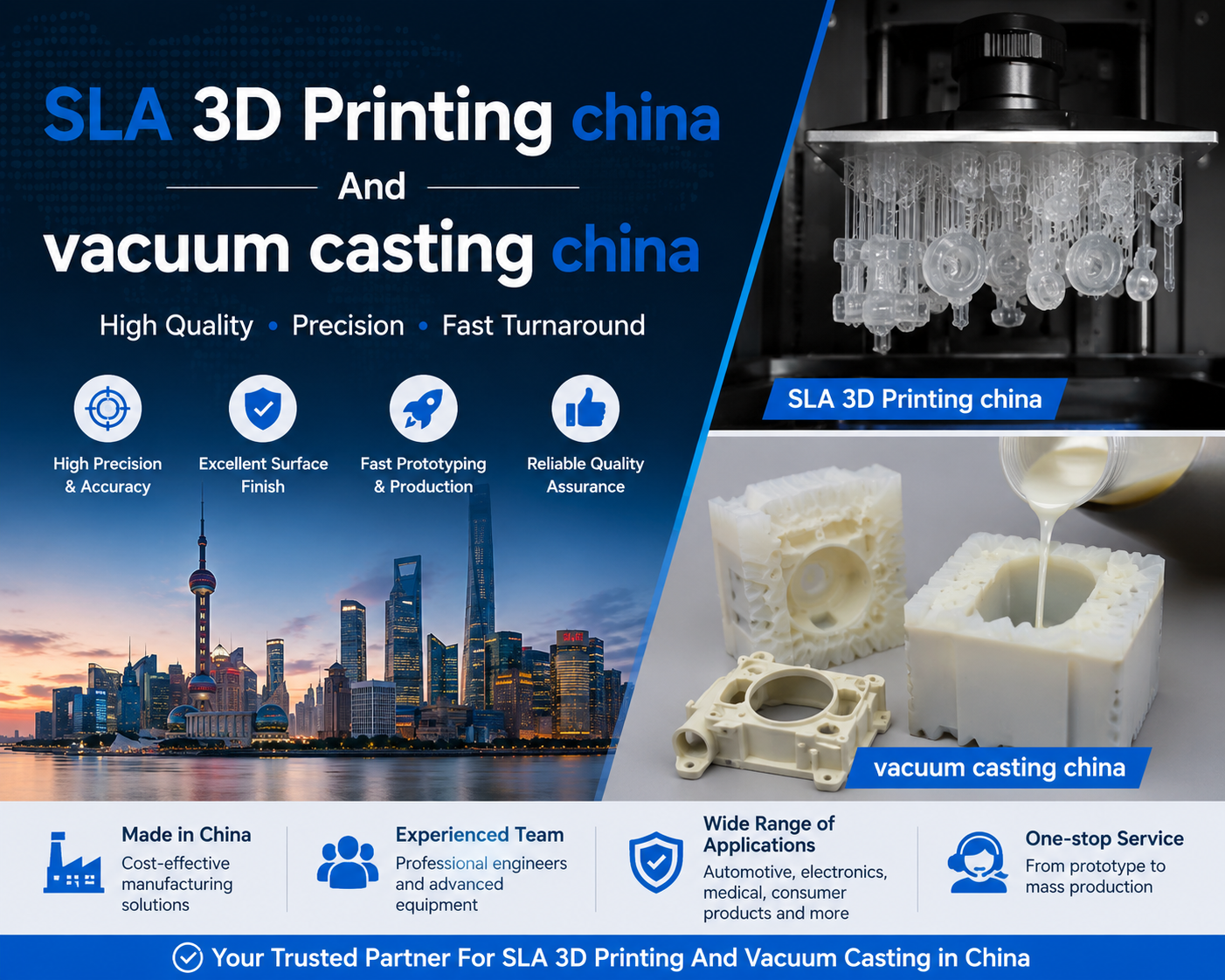
Modern product development depends on speed, precision, and the ability to test ideas before committing to expensive mass production. This is where SLA 3D printing China and vacuum casting China have become valuable manufacturing solutions for companies developing prototypes, functional models, presentation samples, and small production batches.
Although both technologies are used for rapid product development, they serve different purposes. SLA 3D printing is primarily associated with highly detailed prototypes created directly from digital CAD files, while vacuum casting is often selected when manufacturers need multiple parts with properties and appearances closer to injection-molded products.
What Is SLA 3D Printing China?
SLA 3D printing China refers to the production of three-dimensional parts using stereolithography services provided by Chinese manufacturers. The process uses a UV laser or light source to selectively cure liquid photopolymer resin layer by layer.
Because the technology can produce fine details and smooth surfaces, SLA is widely used for product prototypes, design verification, concept models, and complex components.
How SLA 3D Printing Works
The typical SLA workflow includes several important stages:
- CAD model preparation: Engineers create or optimize a digital 3D model.
- File conversion: The model is converted into a format suitable for 3D printing.
- Slicing: Specialized software divides the model into thin layers.
- Resin curing: A light source selectively cures liquid resin layer by layer.
- Support removal: Temporary support structures are carefully removed.
- Post-processing: Parts may be washed, UV-cured, sanded, polished, or painted.
- Quality inspection: Finished components are checked against design requirements.
This workflow allows manufacturers to move from a digital concept to a physical prototype relatively quickly.
Key Benefits of SLA Prototyping
The main advantages include:
- Excellent dimensional detail
- Smooth surface finish
- Ability to produce complex geometries
- Fast prototype development
- Reduced tooling requirements
- Suitable for visual and fit testing
- Wide selection of resin characteristics
- Cost-effective development before mass production
For businesses working with overseas manufacturing partners, Chinese suppliers can combine advanced equipment with extensive production experience, making SLA a practical option for prototype development.
What Is Vacuum Casting China?
Vacuum casting China is a low-volume manufacturing process commonly used to create multiple polyurethane or similar resin parts from a master pattern. The master model is typically produced through SLA 3D printing or another high-precision manufacturing method.
A silicone mold is created around the master pattern. Once the mold is prepared, liquid casting material is introduced under vacuum conditions to minimize air bubbles and improve part quality.
The Vacuum Casting Process
The process generally follows these steps:
- A highly accurate master prototype is manufactured.
- The master is finished and inspected.
- Liquid silicone is poured around the master model.
- The silicone cures to form a flexible mold.
- The mold is carefully opened and the master is removed.
- Casting resin is mixed and placed into the mold under vacuum.
- The material cures to create the final component.
- The part is removed and undergoes finishing and inspection.
A single silicone mold can generally produce a limited number of replicas before degradation affects dimensional accuracy and surface quality.
SLA 3D Printing China vs. Vacuum Casting China
Choosing between these technologies depends largely on production quantity, material requirements, surface finish, and project objectives.
| Factor | SLA 3D Printing China | Vacuum Casting China |
| Primary purpose | Prototypes and design validation | Low-volume production |
| Tooling | No traditional mold required | Silicone mold required |
| Production volume | Best for individual or limited prototypes | Better for multiple duplicate parts |
| Surface finish | Very smooth with post-processing | Often similar to molded components |
| Material options | Photopolymer resins | Polyurethane and specialized casting resins |
| Complex geometry | Excellent | Good, depending on mold design |
| Unit cost | Efficient for small quantities | More economical for repeated parts |
| Appearance | Suitable for visual prototypes | Suitable for production-like samples |
| Flexibility | High for design changes | Moderate after mold creation |
When Should You Choose SLA?
SLA is particularly useful when the primary objective is to validate a design. It allows engineering teams to examine dimensions, ergonomics, assembly relationships, and visual appearance before investing in expensive tooling.
Common applications include:
- Consumer electronics prototypes
- Automotive design models
- Medical device concepts
- Industrial equipment components
- Architectural models
- Product housings
- Custom enclosures
When Is Vacuum Casting Better?
Vacuum casting becomes attractive when a project requires several identical parts and the final components need a more production-like appearance or material behavior.
Typical applications include:
- Pilot production
- Pre-production testing
- Marketing samples
- Product demonstrations
- Small-batch manufacturing
- Functional testing
- Customized product components
Why Companies Consider China for These Services
China has developed a large ecosystem for rapid prototyping and advanced manufacturing. Companies seeking SLA 3D printing China services often benefit from access to experienced engineering teams, modern production equipment, and integrated manufacturing capabilities.
The same supplier may offer a complete development pathway that includes:
- CAD design assistance
- SLA prototyping
- CNC machining
- Vacuum casting
- Surface finishing
- Product assembly
- Quality inspection
- Packaging
This integrated approach can simplify supplier management and reduce unnecessary communication between multiple manufacturing partners.
How to Select a Reliable Manufacturing Partner
Selecting the right supplier is essential for achieving consistent results. Before placing an order, evaluate the manufacturer based on several criteria.
Important Supplier Evaluation Factors
- Technical capability: Check whether the supplier has suitable SLA equipment and vacuum casting expertise.
- Material selection: Confirm that available resins match your functional and appearance requirements.
- Quality control: Ask about dimensional inspection and process monitoring.
- Surface finishing: Review available options such as sanding, polishing, painting, and coating.
- Production capacity: Ensure the supplier can handle both prototype and small-batch requirements.
- Communication: Clear technical communication is essential when working internationally.
- Confidentiality: Discuss intellectual property protection before sharing sensitive CAD files.
- Sample quality: Request representative samples or previous project examples when appropriate.
Common Mistakes to Avoid
Businesses can encounter problems when they select a manufacturing process based only on price. A low initial quotation may not provide the best overall value if the supplier lacks technical expertise or quality controls.
Avoid these common mistakes:
- Choosing materials without understanding their properties
- Ignoring required tolerances
- Failing to review prototype designs before production
- Selecting a supplier solely because of the lowest price
- Not clarifying surface finishing requirements
- Overlooking packaging and shipping requirements
- Sending incomplete technical specifications
A well-prepared technical brief can significantly improve the final outcome.
Frequently Asked Questions
1. What is SLA 3D printing China used for?
It is commonly used for detailed prototypes, visual models, engineering validation, and complex product development.
2. Is SLA suitable for functional prototypes?
Yes. Depending on the resin selected, SLA parts can be useful for certain functional testing applications, although material performance should be evaluated carefully.
3. What is vacuum casting China?
It is a low-volume manufacturing technique that uses a silicone mold to create multiple resin replicas from a master model.
4. How is the master model made?
The master is often manufactured using SLA 3D printing because of its precision and smooth surface quality.
5. How many parts can a silicone mold produce?
The exact quantity depends on mold complexity, resin selection, and handling, but silicone molds are generally intended for limited production runs.
6. Is vacuum casting cheaper than injection molding?
For low production quantities, vacuum casting can avoid the high upfront tooling investment associated with injection molding and may therefore be more economical.
7. Can SLA prototypes be painted?
Yes. SLA parts can typically undergo sanding, priming, painting, and other finishing processes.
8. Which process is better for mass production?
Neither is normally the first choice for large-scale mass production. Injection molding or other dedicated production methods are generally more suitable at high volumes.
9. Can Chinese suppliers provide both services?
Many rapid manufacturing companies offer both SLA prototyping and vacuum casting, allowing customers to move between development stages with one manufacturing partner.
10. How do I choose between SLA and vacuum casting?
Choose SLA when you need a small number of highly detailed prototypes. Consider vacuum casting when you need multiple similar parts with production-like appearance and characteristics.
https://newsgrow.blogspot.com/2026/06/sla-3d-printing-china-and-vacuum.html