Moving between floors sounds simple until a building becomes busy. A restaurant team carrying meals upstairs dozens of times a day, hotel employees transporting supplies, or residents waiting for an undersized elevator quickly reveals why vertical transportation deserves careful planning.
This is where the dumbwaiter lift and passenger lift serve two very different purposes. One simplifies the movement of goods, while the other provides safe and convenient transportation for people.
For architects, property owners, restaurant operators, developers, and facility managers, understanding these differences can prevent expensive planning mistakes and help create a building that functions efficiently for years.
Think About What Needs to Move First
Before comparing motors, cabin finishes, or lift capacities, ask one basic question: what needs to travel between floors?
If the answer is meals, documents, medicines, utensils, packages, or other suitable goods, a dumbwaiter lift could provide the practical solution.
If the requirement involves residents, customers, employees, patients, or visitors, a passenger lift is necessary.
The two systems should not be considered interchangeable because their construction and safety requirements are designed around different applications.
Why Dumbwaiter Lifts Solve an Everyday Business Problem
Many businesses lose considerable working time through small repetitive tasks.
Consider a two-floor restaurant. A waiter receives an order upstairs, walks downstairs, collects it from the kitchen, and carries it back. The same journey may occur hundreds of times during a busy week.
A dumbwaiter lift can create a dedicated route between the kitchen and service area.
The concept extends well beyond restaurants. Dumbwaiters can be useful in:
- Hotels
- Commercial kitchens
- Hospitals
- Clinics
- Offices
- Libraries
- Laboratories
- Retail properties
- Warehouses
- Multi-storey homes
By separating material movement from normal pedestrian routes, businesses can create a more organized workflow.
What Happens Inside a Dumbwaiter System?
Although compact, a dumbwaiter is a coordinated mechanical and electrical system.
Goods are loaded into the cabin at one floor. Once the landing door is properly closed, the operator selects the required destination. The drive mechanism moves the cabin through the shaft until it reaches the selected landing.
Staff at the destination can then unload the goods.
Depending on design and application, a system may contain a motor, controller, guide rails, cabin, landing doors, interlocks, switches, operating stations, and safety equipment.
Why Cabin Design Deserves Attention
The cabin should be selected according to what the business actually transports.
A restaurant may need space for food trays, while a hotel may transport supplies of different dimensions. Stainless steel is frequently considered in environments where hygiene and easy cleaning are priorities.
Planning around real goods rather than theoretical capacity produces a more practical dumbwaiter lift installation.
Passenger Lifts Solve a Completely Different Challenge
When people enter the cabin, elevator requirements change significantly.
A passenger lift must provide more than vertical movement. It needs to address safe entry and exit, accessibility, ride quality, stopping accuracy, passenger capacity, emergency communication, and reliable door operation.
Passenger elevators are therefore widely used in:
- Apartment buildings
- Hotels and resorts
- Office complexes
- Shopping centres
- Hospitals
- Educational institutions
- Public buildings
- Commercial towers
- Transportation facilities
- Mixed-use developments
For people with mobility limitations, elevators can also determine whether parts of a building are practically accessible.
What Makes Modern Passenger Elevators Smarter?
Modern elevator operation is increasingly controlled by sophisticated electronic systems.
When someone presses a landing button, the passenger lift controller evaluates the request and manages cabin movement. It can coordinate direction, stopping, door operation, acceleration, and deceleration.
In multi-elevator installations, intelligent controls can also help distribute passenger demand among available cabins.
Drive Technology Matters
Traction systems are widely used for passenger applications, while hydraulic systems can be appropriate for certain building configurations.
Variable-frequency drives can provide controlled motor acceleration and deceleration, helping create smoother passenger journeys.
The most appropriate technology depends on factors such as building height, speed, capacity, traffic, and available installation space.
Safety Should Never Be Reduced to a Feature List
Passenger elevator safety depends on multiple systems operating together.
A modern passenger lift, depending on specifications and applicable requirements, may include:
- Door protection sensors
- Landing door interlocks
- Overload monitoring
- Emergency alarms
- Emergency communication
- Automatic rescue systems
- Safety braking mechanisms
- Speed monitoring
- Emergency lighting
- Accurate floor leveling
- Backup arrangements
- Fire-related operating functions
These requirements are also why people should never travel in a goods-only dumbwaiter.
Even when a dumbwaiter cabin appears physically large enough, it is not designed as a passenger transportation system.
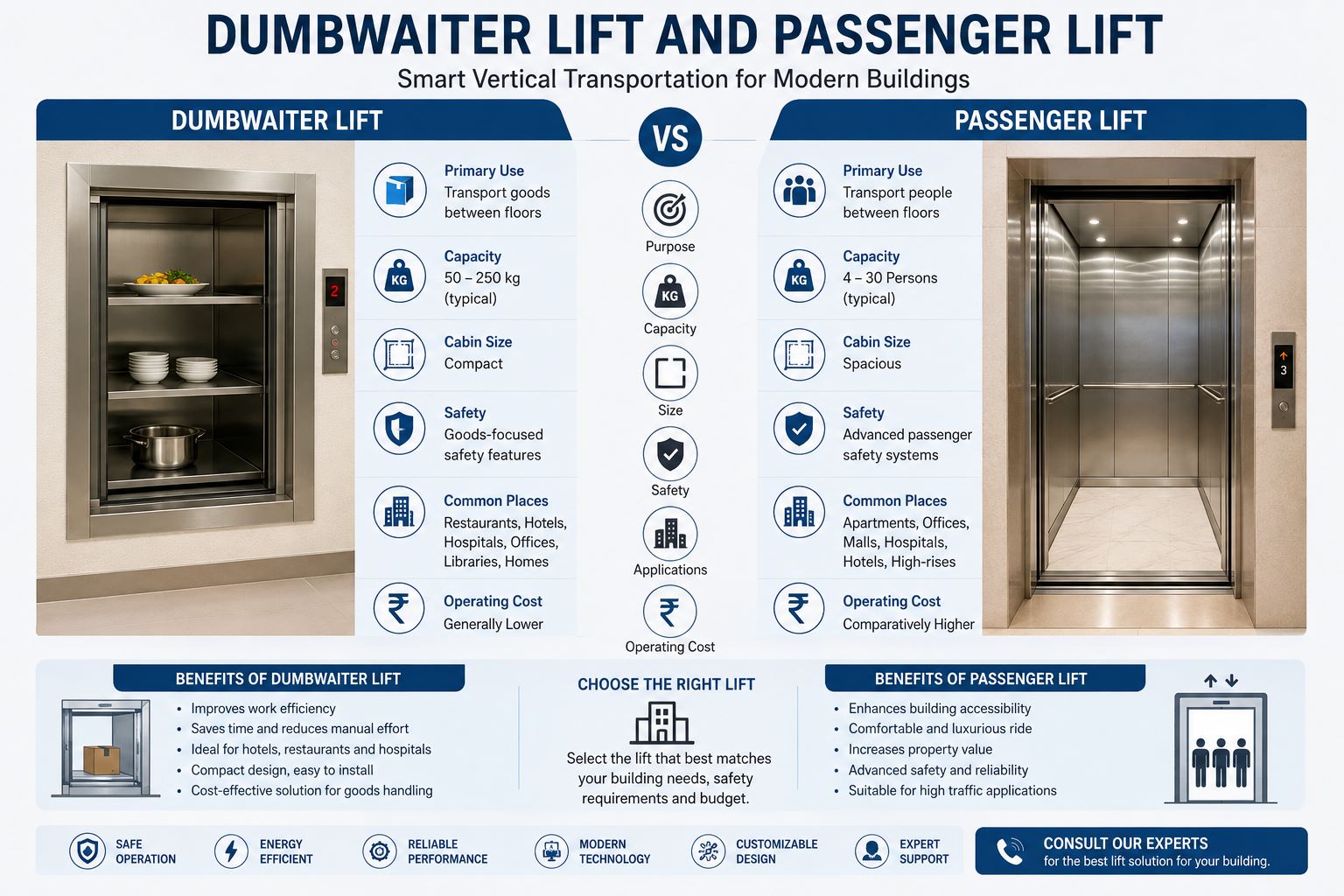
Dumbwaiter Lift vs Passenger Lift at a Glance
| Requirement | Dumbwaiter Lift | Passenger Lift |
| Designed to Carry | Goods | People |
| Typical Cabin | Compact | Passenger-sized |
| Human Travel | Not intended | Specifically intended |
| Main Priority | Efficient goods movement | Safe passenger mobility |
| Capacity Planning | Load size and weight | Occupancy and traffic |
| Interior | Functional | Comfort-focused |
| Controls | Call-and-send | Passenger controls |
| Space Requirement | Often smaller | Usually greater |
| Common Usage | Restaurants, hotels, services | Homes, offices, public buildings |
| Accessibility | Loading oriented | Passenger oriented |
The decision should therefore be based on purpose before price.
Five Questions to Ask Before Choosing a Lift
A successful lift project begins with detailed planning.
1. What will the lift transport?
Identify whether the requirement involves people or goods.
2. How much capacity is actually required?
Calculate realistic everyday loads instead of selecting equipment based on assumptions.
3. How frequently will it operate?
A restaurant operating a dumbwaiter throughout the day has different demands from a lightly used residential installation.
4. How much installation space is available?
Shaft dimensions, door openings, structural conditions, and maintenance access should be examined.
5. What happens after installation?
Consider maintenance availability, replacement parts, servicing requirements, and long-term operating costs.
Answering these questions early can prevent expensive modifications later.
Capacity Is About More Than Weight
A common misconception is that lift capacity can be selected using weight alone.
With a dumbwaiter lift, physical dimensions can be equally important. Large food trays, boxes, or other items must fit comfortably within the cabin.
Passenger elevator planning becomes more complex because traffic must also be considered.
A small apartment building may have relatively predictable traffic. A commercial office can experience concentrated demand every morning, lunchtime, and evening.
Choosing an appropriate passenger lift therefore requires understanding both building population and movement patterns.
Energy Efficiency Can Reduce Long-Term Costs
Lift ownership involves costs beyond installation.
Modern technologies can help control energy consumption through efficient motors, intelligent standby functions, LED lighting, variable-frequency drives, and optimized controllers.
Correct capacity selection also contributes to efficiency. Oversized equipment may create unnecessary capital and operating expenses.
Building owners should therefore consider lifecycle performance rather than focusing exclusively on the initial quotation.
Maintenance Is What Protects Your Investment
Even a correctly designed elevator needs preventive servicing.
Routine maintenance can identify developing problems before they cause unexpected interruptions.
Important inspection areas commonly include:
- Doors and interlocks
- Motors and drive components
- Controllers
- Electrical connections
- Guide systems
- Safety switches
- Braking mechanisms
- Floor-leveling systems
- Emergency equipment
Choosing a lift supplier should consequently involve evaluating technical support and maintenance capability alongside equipment specifications.
Frequently Asked Questions
1. What exactly is a dumbwaiter lift?
It is a compact elevator intended to transport suitable goods and materials between different building levels.
2. Can dumbwaiters carry people?
No. Goods-only dumbwaiters should not be used for passenger transportation.
3. Are dumbwaiters only useful in restaurants?
No. Hotels, hospitals, offices, libraries, laboratories, warehouses, and residences can also use them.
4. Why choose a passenger lift?
It provides purpose-designed vertical transportation for residents, employees, customers, visitors, patients, and other building users.
5. Which lift is better for a hotel?
Hotels may require passenger elevators for guests and separate service solutions depending on operational requirements.
6. Can dumbwaiter cabin sizes be customized?
Yes. Dimensions, capacity, loading height, shelving, finishes, and doors can vary according to application.
7. What determines passenger lift size?
Occupancy, passenger traffic, floors served, accessibility, available space, and required capacity influence selection.
8. Can a lift be added to an existing property?
Potentially, subject to structural feasibility, available space, electrical supply, access, and applicable requirements.
9. How important is regular lift maintenance?
It is essential for dependable performance, identifying wear, reducing unexpected downtime, and supporting equipment longevity.
10. Are energy-efficient elevators available?
Yes. Modern motors, intelligent controllers, standby modes, LED lighting, and advanced drives can improve energy performance.
https://gosarkarijobs.com/how-escalator-companies-and-cargo-lifts-are-transforming-modern-buildings/
https://newsgrow.blogspot.com/2026/08/vertical-transportation-enters-new-era.html
https://bhoomijanatural.info/the-hidden-engineering-behind-moving-walkways-and-elevator-parts/
https://shopnets.com/infrastructure-growth-puts-moving-walkway-and-elevator-parts-in-focus/
https://blogstream.net/smart-mobility-systems-transform-how-modern-buildings-move-people/
https://newsgrow.blogspot.com/2026/08/new-era-of-passenger-mobility-brings.html