The rapid development of airports, metro networks, shopping destinations, hospitals, hotels, and high-rise buildings is placing greater emphasis on efficient passenger mobility. As infrastructure becomes larger and more complex, technologies such as the moving walkway and specialized elevator parts are taking on an increasingly important role in keeping people moving.
Today, mobility systems are expected to deliver more than transportation. Building operators are looking for dependable performance, passenger comfort, energy efficiency, intelligent monitoring, easier maintenance, and long equipment life.
This changing environment is encouraging the industry to focus on component quality and smarter system management.
Passenger Mobility Enters a New Phase
Large facilities face a simple challenge: how can thousands of people move efficiently without creating congestion or unnecessary physical effort?
The moving walkway has become one answer.
Commonly associated with airports, the technology is now relevant across transportation terminals, metro stations, commercial centres, exhibition venues, and other high-footfall environments.
Unlike conventional elevators that transport groups between different floors, moving walkways provide continuous passenger transportation along horizontal or moderately inclined routes.
This continuous-flow model can be particularly useful in facilities where long walking distances are unavoidable.
Moving Walkway Technology Goes Beneath the Surface
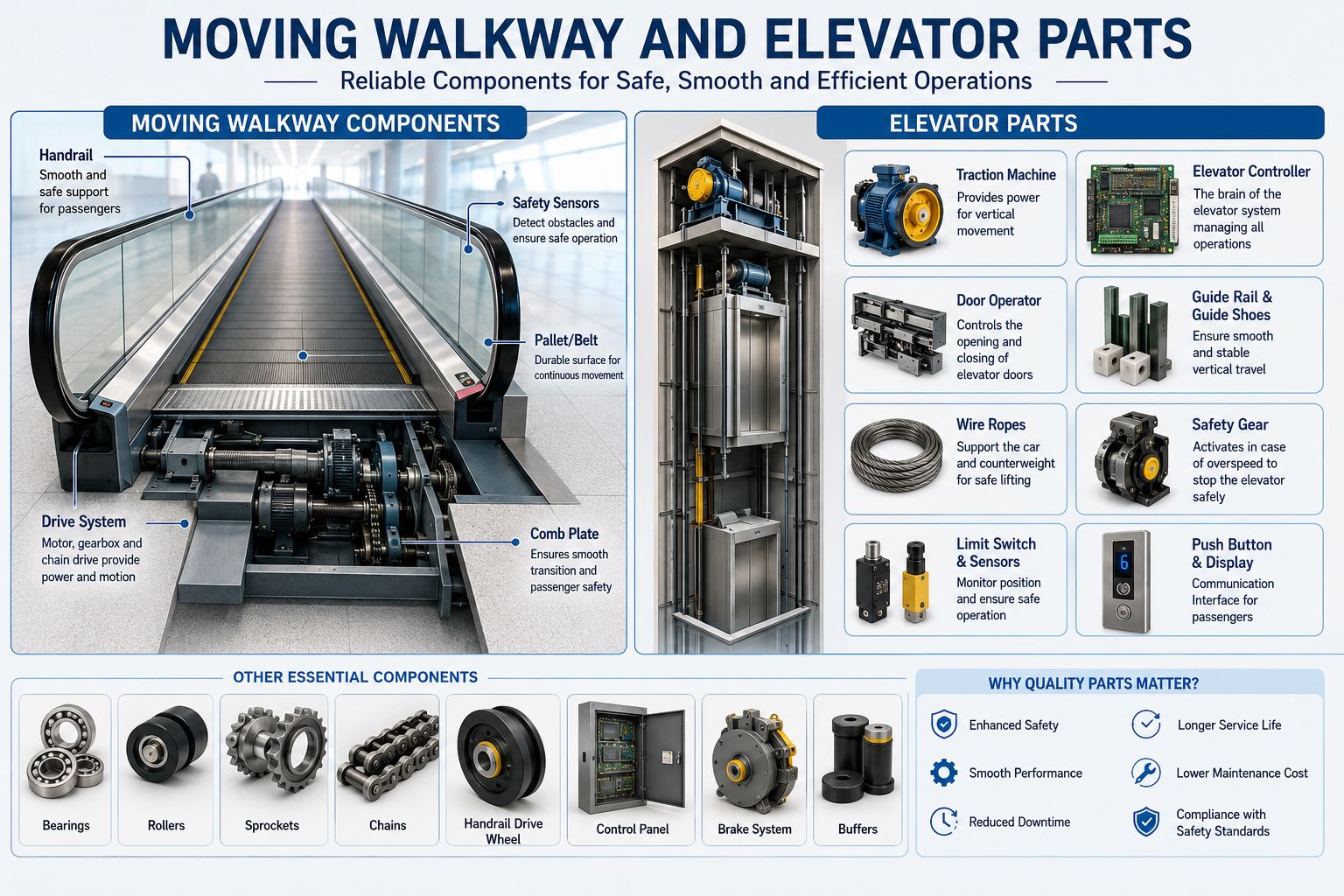
Although passengers interact primarily with the handrail and moving surface, much of the technology remains hidden beneath the installation.
Drive Technology Powers the Journey
Every moving walkway requires a dependable drive arrangement.
An electric motor supplies mechanical energy, while transmission components transfer that power to the moving passenger surface.
Depending on equipment design, the system can incorporate:
- Gearboxes
- Drive chains
- Sprockets
- Shafts
- Bearings
- Tensioning mechanisms
These components operate under repetitive loads and therefore require appropriate inspection and maintenance.
Pallets, Rollers and Tracks Maintain Movement
Pallet-based walkways use a continuous series of connected platforms. These travel along dedicated tracks with assistance from rollers and guidance components.
The condition of these components can influence noise, vibration, alignment, and passenger comfort.
Small changes in equipment behaviour may therefore provide valuable maintenance information.
Handrail Performance Remains Important
Handrails operate through a separate mechanical arrangement that needs to remain coordinated with the passenger surface.
Drive wheels, rollers, guides, and tensioning components help maintain handrail movement.
Regular inspection can identify deterioration, alignment issues, incorrect tension, or other conditions requiring attention.
Elevator Parts Market Evolves With Building Technology
Elevators are also undergoing significant technological development.
Behind every cabin movement is a network of elevator parts responsible for processing commands, producing movement, controlling doors, monitoring position, regulating speed, and supporting safety functions.
As elevators become increasingly digital, components that were once primarily mechanical are now working alongside advanced electronics, software, sensors, and communication systems.
This creates new possibilities for both elevator operation and maintenance.
Controllers Become the Intelligence Behind Elevators
The elevator controller is central to system coordination.
When a passenger requests a floor, the controller receives the command and communicates with multiple components to determine the appropriate action.
Modern controllers may handle:
- Passenger calls
- Cabin positioning
- Travel direction
- Acceleration and deceleration
- Door operation
- Fault monitoring
- Safety circuits
- Elevator group management
In larger buildings, intelligent dispatch technology can also help allocate elevator cabins according to passenger demand.
Elevator Doors Become a Key Maintenance Area
While motors and controllers often receive considerable attention, door systems remain one of the most active areas of an elevator.
Doors may operate thousands of times during normal service.
Several elevator parts contribute to this process, including operators, motors, belts, rollers, tracks, hangers, sensors, and interlocks.
Repeated movement naturally creates wear.
Maintenance teams can therefore benefit from monitoring changes such as unusual door noise, slower movement, inconsistent closing, or repeated reopening.
Different Systems, Similar Engineering Priorities
| Key Area | Moving Walkway | Elevator |
| Primary purpose | Long-distance passenger assistance | Floor-to-floor transportation |
| Travel direction | Horizontal/slight incline | Vertical |
| Passenger flow | Continuous | Controlled trips |
| Main platform | Pallets or moving belt | Cabin |
| Core drive | Motor and transmission | Traction/hydraulic drive |
| Typical wear points | Rollers, chains, handrails | Doors, rollers, guides |
| Common locations | Airports and transit facilities | Multi-storey buildings |
Despite their differences, both technologies depend on precise engineering and effective component management.
Replacement Parts Become a Strategic Maintenance Decision
The increasing complexity of mobility equipment means component replacement requires careful technical evaluation.
A replacement component cannot be considered appropriate simply because its appearance resembles the original.
When selecting elevator parts, technicians and procurement professionals should consider:
- Equipment make and model.
- Component identification.
- Mechanical dimensions.
- Electrical specifications.
- Operating capacity.
- Material requirements.
- Installation configuration.
- Applicable technical and safety requirements.
Correct identification is particularly important when maintaining older systems where components may have undergone revisions or upgrades.
Maintenance Strategies Move Away From Breakdown Repairs
One of the clearest trends across the mobility sector is the movement from reactive to preventive maintenance.
Traditional reactive servicing starts when equipment stops working or develops an obvious fault.
Preventive maintenance takes the opposite approach.
Technicians inspect a moving walkway or elevator at planned intervals, searching for signs of deterioration before equipment availability is affected.
Indicators may include abnormal noise, vibration, temperature changes, worn components, inconsistent door operation, lubrication problems, or recurring fault codes.
Identifying these symptoms early can provide more time to plan repairs.
Connected Sensors Create New Maintenance Opportunities
The introduction of connected monitoring is pushing the industry another step forward.
Modern sensors can collect information continuously while equipment operates.
Depending on the system, this can include:
- Motor temperature
- Vibration levels
- Operating hours
- Travel cycles
- Door cycles
- Equipment speed
- Energy consumption
- Fault information
The resulting data can provide maintenance professionals with a clearer understanding of equipment condition.
Predictive Maintenance Gains Ground
Predictive maintenance attempts to use operating information to identify patterns that may indicate deterioration.
For example, gradually increasing vibration could encourage technicians to investigate bearings, rollers, or other rotating components.
This does not eliminate physical inspection. Instead, data can help maintenance teams determine where additional attention may be required.
Safety Continues to Drive Component Development
Passenger safety remains fundamental to both technologies.
A moving walkway can incorporate emergency stop controls, speed monitoring, entry protection, comb plate monitoring, and handrail-related safety mechanisms.
Elevators can use brakes, overspeed governors, safety gears, door interlocks, buffers, position monitoring, and limit devices.
These safety-related elevator parts must function according to the equipment’s engineering requirements.
Inspection, adjustment, testing, and replacement of safety equipment should always be performed by qualified personnel in accordance with applicable standards.
Energy Efficiency Becomes an Industry Priority
Building energy management is another factor influencing mobility equipment.
Modern walkway installations can incorporate variable-frequency drives and passenger detection technologies. Depending on design requirements, the equipment can adjust operation according to traffic conditions.
Elevators can similarly incorporate technologies such as:
- High-efficiency motors
- Regenerative drives
- Intelligent dispatching
- LED lighting
- Standby modes
- Advanced drive controls
These developments can help integrate mobility equipment into broader energy-management strategies.
Frequently Asked Questions
1. Why are moving walkways important for modern infrastructure?
A moving walkway helps passengers travel longer distances efficiently while supporting continuous pedestrian movement in high-traffic facilities.
2. Are moving walkways limited to airports?
No. They can also be used in metro stations, railway terminals, malls, exhibition centres, and large public complexes.
3. What components are used in moving walkways?
Common components include motors, gearboxes, chains, sprockets, pallets, rollers, tracks, handrails, controllers, and sensors.
4. What are common elevator parts?
Common elevator parts include motors, controllers, doors, brakes, guide systems, sensors, switches, suspension components, and safety devices.
5. Why are elevator doors maintenance-intensive?
Doors perform repeated operating cycles, exposing rollers, belts, tracks, motors, and associated components to regular mechanical wear.
6. Can similar-looking elevator components be interchangeable?
Not necessarily. Dimensions, electrical ratings, capacity, communication requirements, and technical specifications must be verified.
7. What can abnormal walkway vibration indicate?
It may indicate issues involving rollers, bearings, chains, alignment, tension, or other mechanical components.
8. What is preventive maintenance?
It involves planned inspection and servicing intended to identify wear and deterioration before significant operational problems occur.
9. How does predictive maintenance work?
It uses equipment condition and operational data to identify trends that may indicate developing maintenance requirements.
10. Can older elevators benefit from modernization?
Yes. Depending on their condition and design, older systems may benefit from updated drives, controllers, doors, sensors, or displays.
https://gosarkarijobs.com/how-escalator-companies-and-cargo-lifts-are-transforming-modern-buildings/
https://newsgrow.blogspot.com/2026/08/vertical-transportation-enters-new-era.html
https://bhoomijanatural.info/the-hidden-engineering-behind-moving-walkways-and-elevator-parts/