
A hose failure on a construction machine can stop an entire job. On an oilfield site, a damaged fluid-transfer line can interrupt an even larger operation. This is why industrial hoses should never be viewed as simple accessories. They are engineered components that influence productivity, safety and equipment performance.
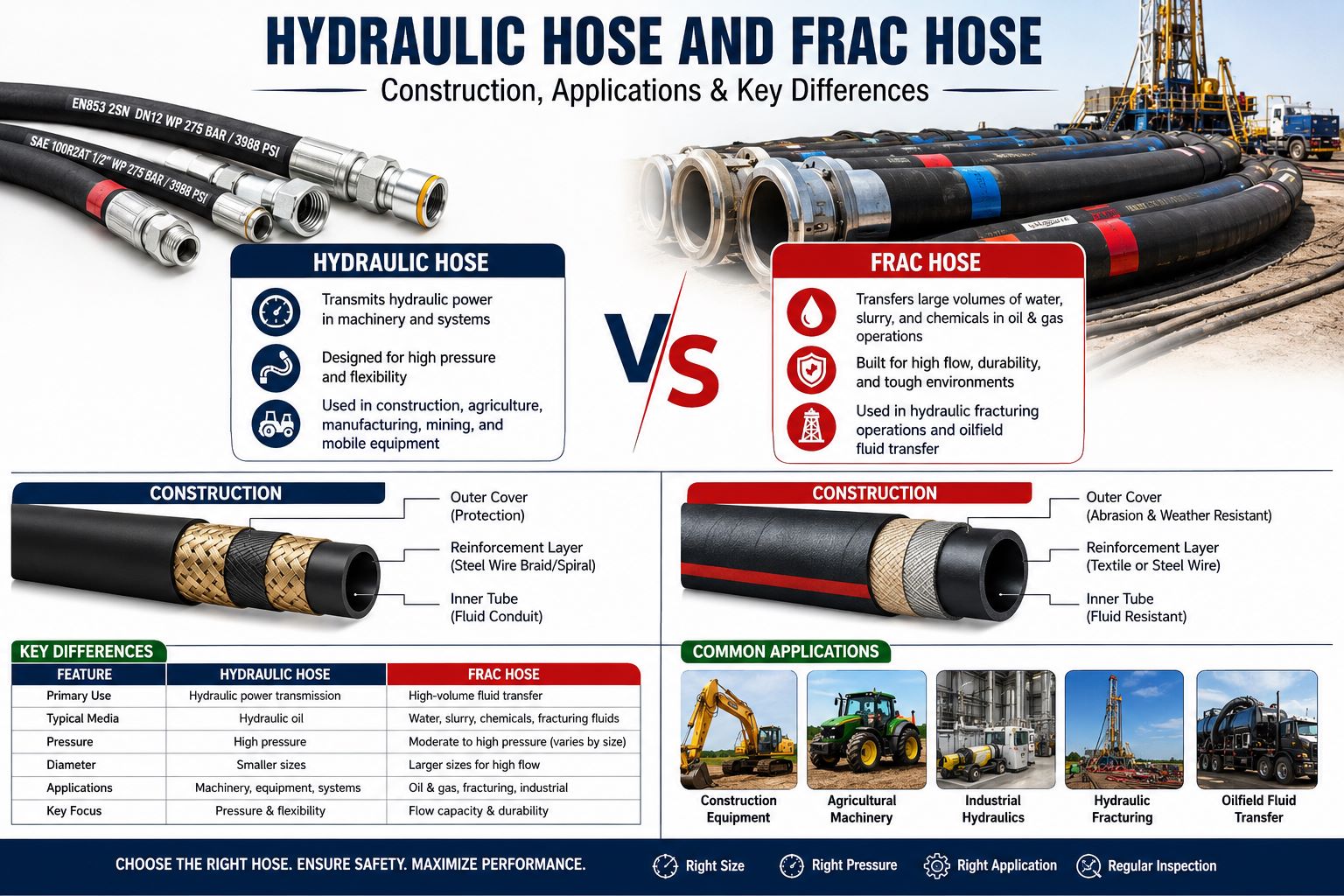
Among the many industrial hose types, Hydraulic Hose and frac hose are especially important in high-demand environments. One primarily supports hydraulic power transmission, while the other is closely associated with fluid movement during hydraulic fracturing and oilfield operations.
Knowing how they differ—and how to select them correctly—can prevent costly mistakes.
Why Hydraulic Hose Is More Than a Flexible Pipe
A Hydraulic Hose carries pressurised fluid from one part of a hydraulic circuit to another. The movement of this fluid allows machinery to generate considerable mechanical force.
Think about an excavator digging into hard ground. Hydraulic pumps create pressure, valves control the direction of the fluid, and cylinders convert that hydraulic energy into physical movement. The hoses provide flexible pathways between these components.
This explains why hydraulic hoses are widely used in:
- Earthmoving equipment
- Cranes and lifting machinery
- Agricultural equipment
- Mining machinery
- Forklifts
- Industrial presses
- Manufacturing equipment
- Material-handling systems
Without correctly specified hoses, even a sophisticated hydraulic system cannot operate reliably.
How a Hydraulic Hose Handles Pressure
The strength of a hydraulic hose comes from its layered construction.
The innermost tube carries the fluid. Surrounding this is reinforcement, which provides resistance against internal pressure. An external cover then protects the structure against environmental and mechanical damage.
Depending on the intended service, reinforcement can include braided textile, steel-wire braid or multiple layers of spiral wire.
Higher pressure does not automatically mean that every application requires the heaviest hose available. The correct design depends on pressure, flexibility, flow, movement and installation requirements.
Where Frac Hose Becomes Essential
Oil and gas operations create a different set of fluid-transfer challenges.
During hydraulic fracturing, significant volumes of water and prepared fluids may need to move between storage units, blending systems, pumping equipment and wellsite infrastructure.
A frac hose provides the flexible connection required for specific stages of these operations.
Depending on its construction, it may be used to transfer:
- Water
- Fracturing fluids
- Slurry
- Chemical mixtures
- Compatible oilfield fluids
Unlike a typical hydraulic circuit, some frac applications prioritise large-volume transfer. This makes internal diameter, flow capability and abrasion resistance particularly important considerations.
What Makes Frac Hose Different?
A wellsite can expose hoses to conditions that are rarely encountered in ordinary factory environments.
The hose may be moved repeatedly, dragged across surfaces or exposed to mud, dust, sunlight and changing temperatures. Fluids themselves may also contain abrasive solids or chemical additives.
Therefore, selecting a frac hose requires consideration of the entire operating environment.
A suitable hose may require:
- Heavy-duty reinforcement
- Abrasion-resistant cover
- Compatible internal lining
- Secure couplings
- Appropriate pressure rating
- Sufficient internal diameter
- Environmental resistance
The exact specification should always be based on the application.
Hydraulic Hose and Frac Hose at a Glance
| Area | Hydraulic Hose | Frac Hose |
| Main job | Transfers hydraulic power fluid | Transfers process fluids |
| Typical industry | Construction, manufacturing, agriculture | Oil and gas |
| Common media | Hydraulic oils | Water, slurry and compatible frac fluids |
| Major concern | Pressure and flexibility | Flow, abrasion and fluid compatibility |
| Installation | Machinery and hydraulic circuits | Wellsite fluid-transfer systems |
| Movement | Equipment-related movement | Field handling and repositioning |
| Selection priority | Pressure, size, temperature, media | Flow, media, pressure and environment |
These differences explain why replacing one hose type with another based solely on appearance can be problematic.
The Pressure Rating Mistake Buyers Should Avoid
One of the biggest mistakes when buying a Hydraulic Hose is looking only at maximum pressure.
Hose selection should consider the system’s normal working pressure as well as operating conditions such as pressure pulsation.
Working pressure must also not be confused with burst pressure.
Burst pressure relates to the point at which a hose fails under testing conditions. It is not a recommended everyday operating pressure.
Using a hose outside its rated conditions may contribute to leakage, deformation, reinforcement damage or sudden failure.
Why Flow Rate Can Change Your Hose Choice
Pressure receives plenty of attention, but flow is equally important.
Imagine forcing a large volume of fluid through an unnecessarily narrow hose. Fluid velocity increases and additional pressure loss may occur.
In hydraulic machinery, this can negatively affect efficiency and increase heat generation.
Flow capacity is particularly important when selecting a frac hose, where high-volume fluid transfer may be required.
Correct hose sizing considers:
- Required flow
- Internal diameter
- Hose length
- Fluid characteristics
- Pressure requirements
- Acceptable pressure loss
A technically correct hose therefore balances both pressure and flow.
Fluid Compatibility Can Determine Hose Life
The fluid inside the hose continuously contacts the inner tube.
If the tube material is incompatible with that fluid, deterioration can begin internally—even when the outside of the hose looks perfect.
Possible effects include:
- Swelling
- Softening
- Hardening
- Cracking
- Loss of flexibility
For a Hydraulic Hose, verify compatibility with the specific hydraulic fluid being used.
For a frac hose, operators should consider the complete fluid mixture, including water, chemicals, additives and suspended solids.
Never assume that a hose suitable for water is automatically suitable for every water-based chemical mixture.
Temperature Has Two Sides
When discussing hose temperature, people often think only about the liquid inside.
Ambient temperature matters too.
A Hydraulic Hose running near an engine or hot industrial component may experience external heat exposure. A frac hose operating outdoors may face changing temperatures throughout the day or across seasons.
Both fluid temperature and environmental temperature should remain within the hose manufacturer’s specified limits.
Where external heat cannot be avoided, improved routing or suitable protective solutions may be necessary.
A Small Routing Error Can Create a Big Problem
Correct hose routing can significantly influence service life.
For example, installing a hose with a tight bend immediately behind the fitting concentrates stress in a small area. Repeated movement can eventually damage the hose.
Similarly, allowing a hose to rub continuously against a metal edge may gradually wear through the outer cover.
Good installation avoids:
- Excessive twisting
- Tight bends
- Sharp edges
- Continuous rubbing
- Unnecessary stretching
- Crushing
- Excessive heat exposure
Always respect the manufacturer’s minimum bend-radius requirements.
Why Fittings Deserve Equal Attention
You can purchase an excellent Hydraulic Hose, but the assembly can still become unreliable if the wrong fittings are used.
Fittings should be compatible with the hose construction and specified assembly system.
Important considerations include:
- Thread or coupling type
- Connection size
- Material
- Pressure rating
- Crimp specification
- Equipment interface
Correct assembly is especially important in high-pressure systems.
For frac hose installations, coupling reliability is equally significant because large-volume transfer systems depend on secure connections.
What Does a Failing Hose Look Like?
Industrial hoses rarely improve with age. Regular visual inspection can reveal early signs of deterioration.
Pay attention to:
- Deep cuts
- Cracks
- Abrasion
- Blistering
- Fluid leakage
- Exposed wire reinforcement
- Damaged fittings
- Kinks
- Corrosion
- Unusual deformation
Do not ignore small leaks in high-pressure hydraulic systems. Pressurised fluid can present serious hazards.
Inspection and replacement procedures should always follow manufacturer guidance and applicable workplace safety practices.
Selecting a Hydraulic Hose Without Guesswork
A practical selection method is often remembered through the concept of size, temperature, application, media, pressure and ends.
Ask:
What size is required?
Determine internal diameter and length.
What temperature will it experience?
Consider both fluid and ambient conditions.
Where will it operate?
Identify movement, abrasion and environmental exposure.
What fluid will it carry?
Confirm chemical compatibility.
What pressure will it experience?
Check the system’s operating requirements.
What connections are needed?
Identify the correct fittings and interfaces.
This information gives a hose specialist a much stronger basis for product selection.
Selecting Frac Hose for Real Field Conditions
Buying a frac hose requires the same disciplined approach, but field conditions deserve additional attention.
Before ordering, determine:
- Fluid composition
- Required transfer volume
- Internal diameter
- Working pressure
- Operating temperature
- Abrasion exposure
- Hose movement
- Required length
- Coupling requirements
If abrasive slurry is being transferred, tell the supplier. If the hose will frequently be dragged or repositioned, mention that too.
The more accurately the application is described, the more appropriate the hose recommendation can be.
Why Preventive Maintenance Costs Less Than Emergency Replacement
Waiting for a hose to fail may appear economical because every component is used for as long as possible. In reality, unexpected failure can create additional costs.
These can include:
- Machine downtime
- Emergency labour
- Lost hydraulic fluid
- Production delays
- Cleanup costs
- Damage to nearby components
Planned inspection gives maintenance teams an opportunity to identify deterioration before it develops into an operational interruption.
Frequently Asked Questions
1. What is a Hydraulic Hose used for?
It transfers pressurised hydraulic fluid between components such as pumps, valves, motors and cylinders.
2. What is the purpose of a frac hose?
It provides flexible fluid transfer for specific hydraulic fracturing and oilfield applications.
3. Can Hydraulic Hose be used for water?
Only when the hose construction and inner tube are approved for the intended fluid and operating conditions.
4. Can frac hose transfer slurry?
Certain designs can handle slurry, but abrasion resistance and fluid compatibility must be verified.
5. Why are hydraulic hoses reinforced?
Reinforcement enables the hose to withstand internal pressure while maintaining flexibility.
6. How do I know the correct hydraulic hose size?
Determine required flow, internal diameter, pressure, length and acceptable pressure loss.
7. What is hose working pressure?
It is the pressure level at which the hose is designed to operate under specified conditions.
8. Why should burst pressure not be used for hose selection?
Burst pressure represents a failure-related test value, not the recommended continuous operating pressure.
9. What causes external hose damage?
Abrasion, heat, sharp edges, crushing, environmental exposure and poor routing are common causes.
10. Can fittings from different hose systems be mixed?
Components should only be combined when their compatibility and assembly requirements have been properly verified.
Read more – https://newsgrow.blogspot.com/2026/08/hydraulic-hose-manufacturer-and.html
https://newsgrow.blogspot.com/2026/08/hydraulic-hose-and-frac-hose-deep.html