Bringing a new product to market involves one critical question: will the design work as expected once it becomes a real, physical component? A CAD model can confirm dimensions and simulations can predict certain behaviours, but manufacturers still need physical parts to evaluate assembly, strength, appearance and manufacturability.
This is where aluminum prototype manufacturing and sheet metal prototyping provide significant value. Instead of investing immediately in production tooling, businesses can manufacture small quantities of metal components, test them under realistic conditions and improve the design before scaling production.
These processes are increasingly important across automotive, aerospace, electronics, robotics, medical equipment and industrial manufacturing because they connect product design with real-world production.
The Growing Importance of Metal Prototyping
Product development has become faster, but customer expectations for quality, reliability and design have also increased. Manufacturers therefore need development methods that allow quick improvements without compromising engineering accuracy.
Metal prototyping creates a practical feedback loop between designers and manufacturers.
A typical development cycle may involve:
- Creating the initial concept
- Developing the CAD model
- Selecting suitable materials
- Producing the prototype
- Testing fit and functionality
- Identifying manufacturing challenges
- Modifying the design
- Producing the improved version
- Moving towards production
An aluminum prototype or fabricated sheet-metal component can uncover problems that may not be obvious during digital design.
Aluminum Prototype Manufacturing Goes Beyond Visual Models
An aluminum prototype should not be viewed simply as a metal representation of a product. Depending on its design and manufacturing accuracy, it can become an important engineering tool.
Unlike a basic visual mock-up, an aluminium component can help evaluate mechanical interfaces, mounting arrangements, structural behaviour and thermal characteristics.
Common applications include:
- Motor housings
- Robotic components
- Heat sinks
- Machine fixtures
- Electronic housings
- Structural supports
- Automotive components
- Industrial equipment parts
CNC machining is commonly used because a digital CAD model can be converted into a physical component without conventional moulds or dies.
Why Aluminum Works Well for Functional Prototypes
Aluminium provides a combination of properties that suits many engineering applications.
It is considerably lighter than many steels while providing useful strength. It is also relatively straightforward to machine and available in numerous alloys.
Useful Characteristics of Aluminium
Key characteristics include:
- High strength-to-weight potential
- Good machinability
- Corrosion resistance
- Good thermal conductivity
- Good electrical conductivity
- Wide alloy availability
- Multiple surface treatments
- Attractive finished appearance
For components such as electronics housings and heat-management parts, aluminium’s thermal properties may be particularly useful.
For mechanical assemblies, an aluminum prototype can provide a more realistic evaluation than a plastic sample when the eventual production component will also be metal.
Understanding Sheet Metal Prototyping from a Manufacturing Perspective
Sheet metal prototyping takes a different approach.
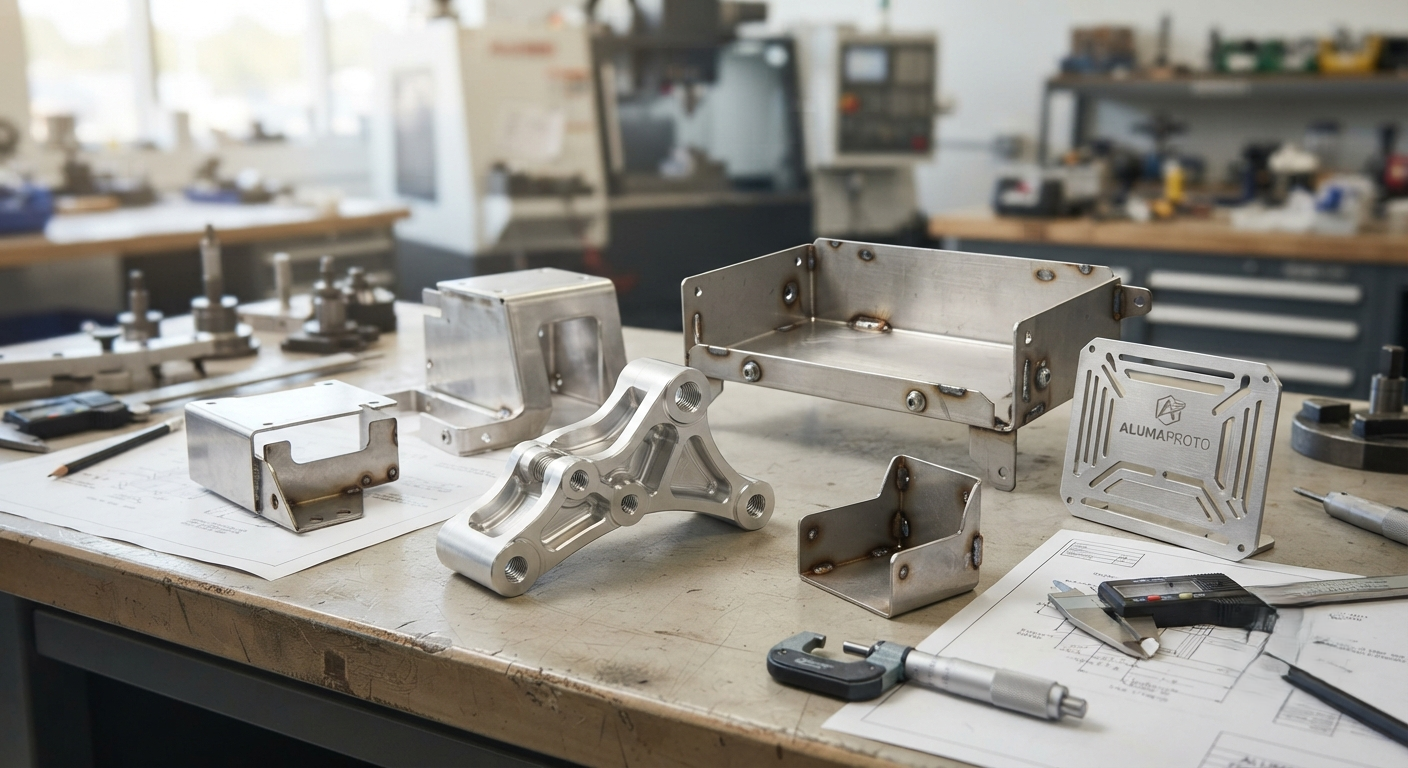
Instead of starting with a solid block and removing material, manufacturers begin with a flat sheet. The sheet is cut and formed until the required three-dimensional component is created.
Common operations include:
- Laser cutting
- CNC punching
- Bending
- Forming
- Welding
- Riveting
- Fastener installation
- Grinding
- Surface finishing
This manufacturing method is especially useful when the design contains large, relatively thin surfaces.
Products Commonly Developed Through Sheet Metal Prototyping
Walk through almost any manufacturing facility and sheet-metal components will be easy to find.
Machine guards, electrical cabinets, brackets, panels and equipment covers are typical examples.
Sheet metal prototyping can be applied to:
- Electronic enclosures
- Industrial cabinets
- Automotive brackets
- Battery boxes
- Server chassis
- Machine covers
- Mounting plates
- Ventilation housings
- Control panels
- Telecommunications equipment
A prototype allows designers to determine whether openings, mounting locations, bends and assembly points function correctly before larger quantities are ordered.
Aluminum Prototype and Sheet Metal Prototyping Solve Different Problems
Although both processes create metal parts, their manufacturing logic differs significantly.
| Requirement | Aluminum Prototype | Sheet Metal Prototyping |
| Starting form | Solid aluminium stock | Flat metal sheet |
| Main operation | Material removal | Cutting and forming |
| Detailed 3D geometry | Excellent | Limited by forming |
| Large thin surfaces | Less economical | Highly suitable |
| Precision pockets | Excellent | Generally unsuitable |
| Brackets and panels | Possible | Excellent |
| Threads | Easy to incorporate | Often require inserts/tapping |
| Material efficiency | Moderate | Generally high |
| Typical volume | Prototype to low volume | Prototype to production |
| Design flexibility | High | High with DFM consideration |
Understanding these differences helps prevent an expensive mistake: selecting a manufacturing process that does not naturally suit the component.
Think About Geometry Before Choosing the Process
Geometry is often the clearest indicator of which method should be used.
Imagine a compact gearbox housing containing bearing seats, precision holes, internal pockets and threaded mounting locations.
Such geometry is naturally suited to an aluminum prototype manufactured through CNC machining.
Now consider a protective enclosure surrounding that gearbox. It may consist of several thin surfaces, mounting flanges and ventilation slots.
Producing the enclosure through sheet metal prototyping would generally make more manufacturing sense.
In a complete product, therefore, both processes can work together.
Design Decisions That Influence Aluminum Prototype Quality
CNC machining offers considerable design freedom, but every feature affects manufacturing complexity.
Internal Corners
Milling cutters are round. Designers should therefore avoid specifying perfectly sharp internal corners unless a secondary manufacturing process genuinely requires them.
Deep Cavities
Deep pockets require extended cutting tools, which can increase vibration and machining difficulty.
Thin Walls
Very thin walls may move or distort as surrounding material is removed.
Tolerances
Extremely tight tolerances should be reserved for functional features.
A mounting surface that controls bearing alignment may require close dimensional control, while an external cosmetic surface may not.
Correct tolerance selection can help keep an aluminum prototype practical without sacrificing functionality.
Sheet Metal Design Requires a Different Mindset
A flat metal sheet changes when it is bent. Engineers must therefore design around the physical behaviour of the material.
Bend Radius Matters
Material cannot always be bent into an extremely sharp corner without deformation or cracking. Suitable bend radii should be considered during design.
Holes Need Space Around Bends
A hole positioned directly beside a bend line may deform during forming.
Fewer Bends Can Mean Simpler Manufacturing
A design containing twelve bends is not automatically better than one achieving the same functionality with six.
Reducing unnecessary fabrication operations can simplify both sheet metal prototyping and future production.
The Role of DFM Before Prototype Manufacturing
Design for Manufacturing, or DFM, is one of the most valuable stages of prototype development.
Rather than simply asking whether a component can be manufactured, DFM asks whether it can be manufactured efficiently and consistently.
A DFM review may identify:
- Unnecessary tight tolerances
- Difficult machining features
- Inaccessible internal geometry
- Poor bend locations
- Weak sections
- Excessive welding
- Unnecessary separate components
- Difficult assembly operations
Correcting these issues at the CAD stage is generally easier than discovering them after production tooling has been created.
Surface Finishing Is Part of Prototype Development
A prototype does not always need to remain in its raw-machined state.
An aluminum prototype may receive anodising, polishing, bead blasting, brushing, painting or other suitable surface treatments.
Sheet-metal parts may receive powder coating, painting, plating, polishing or protective treatments depending on their material.
Finishing can help teams evaluate not only engineering performance but also the visual characteristics of products that customers will eventually see.
Where Cost Actually Comes from in Prototype Manufacturing
Material price is only one element of prototype cost.
A small but highly complicated component may cost more to manufacture than a much larger simple part.
For CNC aluminium components, cost can be influenced by:
- Machine time
- Number of setups
- Tool requirements
- Material grade
- Part complexity
- Tolerances
- Finishing
- Inspection
For sheet metal prototyping, important factors include cutting length, material thickness, number of bends, welding, hardware and finishing.
The goal should therefore be manufacturing efficiency rather than simply reducing material quantity.
Why Testing a Prototype Can Save More Than Its Initial Cost
Prototype manufacturing creates an additional development expense, but skipping validation can expose a project to much larger problems later.
Imagine discovering after production begins that mounting holes are misaligned across hundreds of components.
Or imagine finding that an enclosure cannot be assembled because a bend blocks access to an internal fastener.
A prototype gives manufacturers an opportunity to discover these problems earlier.
Testing should examine:
- Dimensional accuracy
- Assembly compatibility
- Component clearance
- Mechanical behaviour
- Surface requirements
- Manufacturing practicality
- Service accessibility
- Final appearance
The information gained can influence the entire production strategy.
Moving from Prototype to Low-Volume Manufacturing
Modern prototyping processes can also support bridge production.
Once an aluminum prototype has passed testing, CNC machining can often continue producing tens or hundreds of components depending on their geometry, economics and production requirements.
Likewise, sheet metal prototyping can transition into small-batch fabrication without requiring immediate investment in dedicated stamping dies.
This flexibility is particularly useful for startups, customised machinery manufacturers and companies launching specialised products with uncertain initial demand.
Frequently Asked Questions
1. Why should manufacturers use an aluminum prototype?
An aluminum prototype helps validate mechanical design, dimensions, assembly, material behaviour and manufacturability before larger production commitments.
2. How is an aluminum prototype manufactured?
CNC milling and turning are common methods, although the appropriate process depends on component geometry and requirements.
3. What is sheet metal prototyping?
Sheet metal prototyping creates prototype parts by cutting, bending, forming and joining flat metal sheets.
4. Which products are suitable for sheet metal prototypes?
Brackets, panels, cabinets, enclosures, chassis, guards and covers are common applications.
5. Can aluminium sheet be used for prototyping?
Yes. Aluminium is commonly selected where low weight, corrosion resistance and good fabrication characteristics are beneficial.
6. Which process offers better complex geometry?
CNC machining generally offers greater flexibility for intricate three-dimensional features.
7. Is sheet metal prototyping economical for small quantities?
It can be, particularly when laser cutting and press-brake forming eliminate the need for dedicated stamping tooling.
8. Why are tolerances important in aluminum prototypes?
Tolerances determine acceptable dimensional variation and directly influence component fit, performance and machining complexity.
9. Can prototype components receive surface finishing?
Yes. Both machined aluminium and sheet-metal prototypes can receive application-appropriate cosmetic or protective finishes.
10. What is DFM in prototype manufacturing?
DFM means Design for Manufacturing. It evaluates a design to identify opportunities to simplify and improve its manufacturability.
https://newsgrow.blogspot.com/2026/08/rapid-injection-molding-and-china-rapid.html
https://newsgrow.blogspot.com/2026/08/aluminum-prototype-and-sheet-metal.html