Modern manufacturing industries are under constant pressure to improve productivity, maintain consistent product quality, reduce material losses, and meet increasingly demanding safety standards. As bulk solids and powdered materials move through production facilities, efficient handling and processing equipment has become a critical part of industrial operations. Among the technologies gaining attention are the big bag filling machine and powder sieving machine, two solutions designed to improve the efficiency, accuracy, and reliability of bulk material processing.
From chemicals and pharmaceuticals to food ingredients, minerals, plastics, and agricultural products, these machines support different stages of material handling. When properly integrated into a production line, they can help businesses achieve smoother workflows, better product consistency, and improved operational control.
Understanding the Role of a Big Bag Filling Machine
A big bag filling machine is an industrial system designed to fill flexible intermediate bulk containers (FIBCs), commonly known as bulk bags or jumbo bags. These containers are widely used for transporting and storing large quantities of dry, free-flowing materials.
Unlike manual filling methods, automated or semi-automated systems provide greater control over the filling process. Depending on the application, the equipment can be configured for different bag sizes, materials, filling capacities, and production requirements.
Key benefits include:
- Accurate bulk bag filling
- Reduced manual handling
- Improved workplace productivity
- Better control of dust emissions
- Consistent filling weights
- Efficient material transfer
- Reduced product spillage
- Flexible integration with production lines
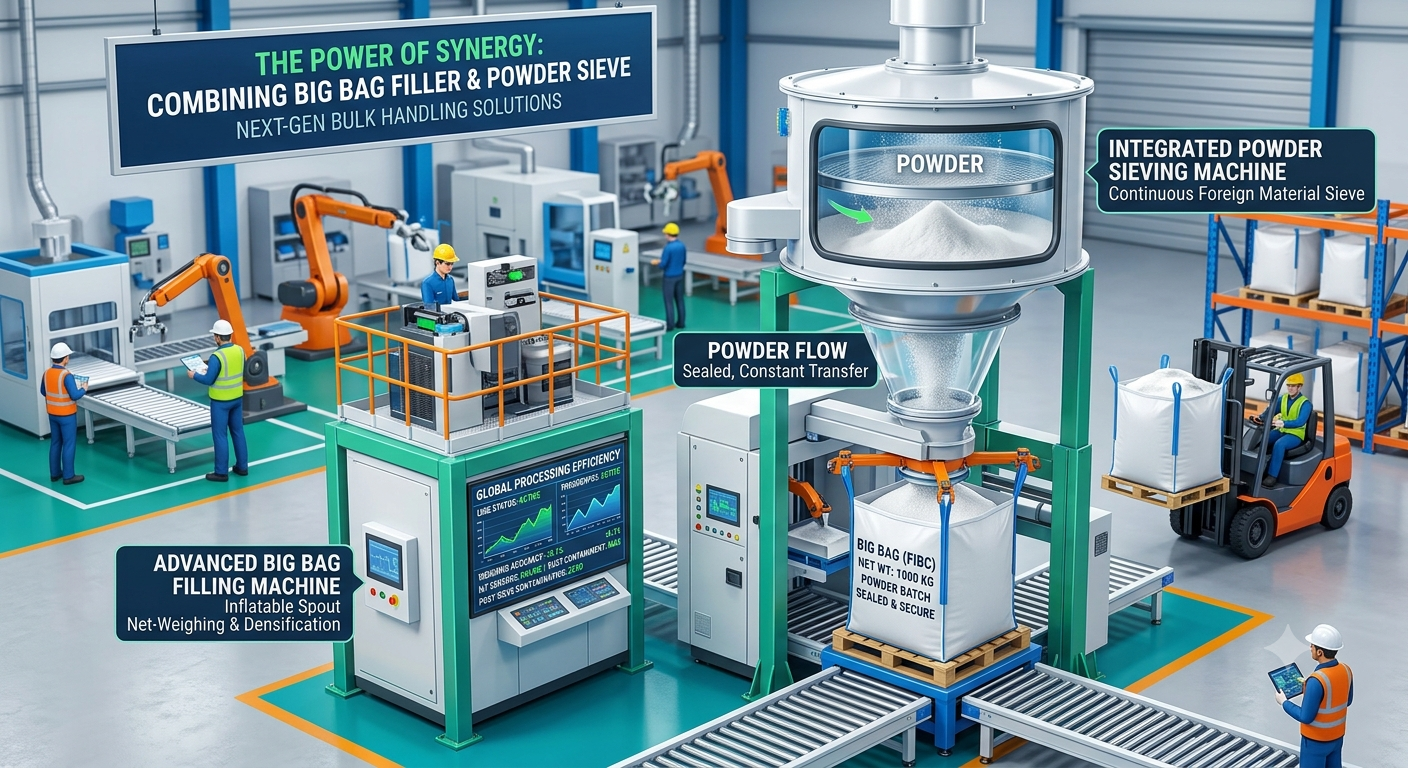
A well-designed system can also incorporate weighing technology, dust collection, bag clamping, vibration, and automated controls. This makes it easier for manufacturers to create a controlled and repeatable filling process.
Applications Across Multiple Industries
The versatility of a big bag filling machine makes it suitable for a broad range of industries. Chemical manufacturers can use it for powders and granules, while food processing companies may rely on bulk bag filling for ingredients such as flour, sugar, starch, and other dry products.
Other applications include:
- Pharmaceutical raw materials
- Plastic granules and compounds
- Minerals and industrial powders
- Fertilizers and agricultural products
- Construction materials
- Food and beverage ingredients
- Specialty chemicals
The right machine configuration depends on material characteristics, required output, bag dimensions, and weighing accuracy.
Why Powder Sieving Matters in Modern Production
A powder sieving machine performs an equally important function by separating particles according to size and removing unwanted contaminants or oversized particles. In industries where product uniformity is essential, sieving helps ensure that raw materials meet defined quality specifications before entering subsequent production stages.
Powders can develop lumps during storage or transportation, while foreign particles may enter the material stream during handling. A properly selected sieving system helps address these challenges and supports a more consistent production process.
Key Advantages of Powder Sieving Equipment
Modern sieving equipment can provide several operational advantages:
- Improved powder uniformity
- Removal of foreign particles
- Breaking up of agglomerated material
- Better downstream processing
- Improved final product quality
- Reduced risk of equipment blockages
- More reliable production performance
The effectiveness of a powder sieving machine depends on factors such as mesh size, material flow characteristics, moisture content, particle distribution, and required throughput.
Big Bag Filling Machine vs. Powder Sieving Machine
Although both technologies are used in bulk material processing, they serve different purposes within an industrial workflow.
| Feature | Big Bag Filling Machine | Powder Sieving Machine |
| Primary function | Fills bulk bags | Separates and screens powders |
| Main focus | Material packaging | Material quality and consistency |
| Typical output | Filled FIBC bags | Classified or purified powder |
| Key benefit | Efficient bulk handling | Uniform particle size |
| Common industries | Chemicals, food, minerals | Pharmaceuticals, food, chemicals |
| Automation potential | Manual to fully automated | Manual to continuous automated systems |
In many facilities, these machines can complement each other. Powder may first be screened to remove unwanted particles and then transferred to a bulk bag filling system for packaging and storage.
Choosing the Right Industrial Equipment
Selecting the appropriate equipment requires careful consideration of production conditions and material properties. Businesses should evaluate several factors before investing.
1. Material Characteristics
Manufacturers should assess whether the product is free-flowing, cohesive, abrasive, hygroscopic, or prone to forming lumps. These properties directly affect machine configuration.
2. Required Production Capacity
The desired hourly output should be clearly defined. A machine designed for small-scale operations may not be suitable for high-volume continuous production.
3. Automation Requirements
Businesses can select manual, semi-automatic, or fully automatic systems depending on labor availability and production targets.
4. Hygiene and Safety
For pharmaceutical and food applications, equipment should support hygienic operation and easy cleaning. Dust control is also important when handling fine powders.
5. Maintenance and Integration
Equipment should be compatible with existing conveyors, storage systems, weighing units, dust collectors, and control systems.
How These Machines Improve Industrial Efficiency
The combination of efficient filling and effective sieving can create a more streamlined material handling process. By automating repetitive tasks, manufacturers can reduce unnecessary manual intervention while improving process consistency.
A typical workflow may involve:
- Raw material receiving
- Powder screening and sieving
- Material inspection
- Controlled transfer
- Weighing and dosing
- Big bag filling
- Bag removal and storage
This integrated approach can help reduce bottlenecks and create better control over the movement of bulk materials throughout the facility.
Industry Trends Driving Equipment Innovation
Industrial processing is increasingly moving toward automation, digital monitoring, and smarter production systems. Modern equipment may include programmable controls, load-cell weighing, automated bag handling, sensor-based monitoring, and remote diagnostics.
The growing demand for operational efficiency is also encouraging manufacturers to seek equipment that minimizes material waste and improves energy utilization. At the same time, industries handling sensitive powders are placing greater emphasis on containment and dust management.
These trends are expected to influence the development of next-generation big bag filling machine and powder sieving machine technologies.
Frequently Asked Questions
What is a big bag filling machine?
A big bag filling machine is industrial equipment used to fill flexible intermediate bulk containers with powders, granules, and other dry bulk materials.
What does a powder sieving machine do?
A powder sieving machine separates particles by size and helps remove oversized particles, lumps, or unwanted contaminants from powdered materials.
Which industries use big bag filling systems?
Chemical, pharmaceutical, food, agricultural, mineral, plastic, and construction industries commonly use bulk bag filling systems.
Can these machines be automated?
Yes. Depending on the application, both filling and sieving equipment can be configured for manual, semi-automatic, or fully automated operation.
How does sieving improve product quality?
Sieving helps create more consistent particle distribution and removes unwanted material, supporting better product uniformity.
What materials can be processed?
The equipment can handle many dry powders and granules, although the final machine design must match the specific material characteristics.
Is dust control important?
Yes. Dust management is particularly important when processing fine powders because it can improve workplace cleanliness, operator safety, and overall process control.
How is filling accuracy achieved?
Filling accuracy is commonly supported through weighing systems, load cells, controlled feeding, and automated shut-off mechanisms.
Can equipment be customized?
Yes. Industrial systems can often be configured according to bag dimensions, material properties, throughput, automation level, and production requirements.
How should companies choose a supplier?
Companies should evaluate technical expertise, customization capabilities, equipment quality, after-sales support, maintenance requirements, and experience with similar applications.
https://newsgrow.blogspot.com/2026/06/big-bag-filling-machine-boosts.html