Product development rarely follows a perfectly straight path. Before a design reaches mass production, engineers and manufacturers need to test dimensions, material performance, assembly methods, and real-world functionality. This is where aluminum prototype development and sheet metal prototyping become valuable.
Modern prototyping allows businesses to identify design problems early, improve product performance, and reduce expensive production mistakes. Whether you are developing an electronic enclosure, automotive component, industrial machine part, or consumer product, choosing the right prototyping method can significantly influence the final result.
This guide explores how aluminum prototypes and sheet metal prototypes support modern product development, their advantages, key manufacturing processes, and how to select the right approach.
What Is an Aluminum Prototype?
An aluminum prototype is an early-stage physical model or functional component manufactured from aluminum to evaluate a product design before full-scale production.
Aluminum is widely used for prototyping because it combines low weight, strength, corrosion resistance, and excellent machinability. Engineers can create accurate prototypes that closely represent the properties of the final production component.
Depending on the project, an aluminum prototype may be produced through:
- CNC machining
- Aluminum extrusion
- Die casting
- Sheet metal fabrication
- Laser cutting
- Milling and turning
- 3D printing with aluminum-compatible technologies
CNC machining is particularly popular when high dimensional accuracy and a functional prototype are required.
Why Aluminum Is Popular for Prototyping
The choice of prototype material can influence testing results and production decisions. Aluminum offers several practical benefits for engineering applications.
Lightweight Construction
Aluminum is considerably lighter than many traditional engineering metals. This makes it useful for prototypes where weight reduction is an important design objective.
Excellent Machinability
Aluminum can be efficiently cut, drilled, milled, and turned. This allows manufacturers to produce complex geometries and detailed components with reliable precision.
Good Strength-to-Weight Ratio
For many applications, aluminum provides an attractive balance between structural performance and weight, making it suitable for automotive, aerospace, electronics, robotics, and industrial products.
Corrosion Resistance
The naturally occurring oxide layer on aluminum provides protection against corrosion. This can make aluminum prototypes useful for products intended for demanding environments.
Production-Like Testing
An aluminum prototype can provide a more realistic understanding of how a final metal component may perform compared with a prototype made from plastic or another substitute material.
What Is Sheet Metal Prototyping?
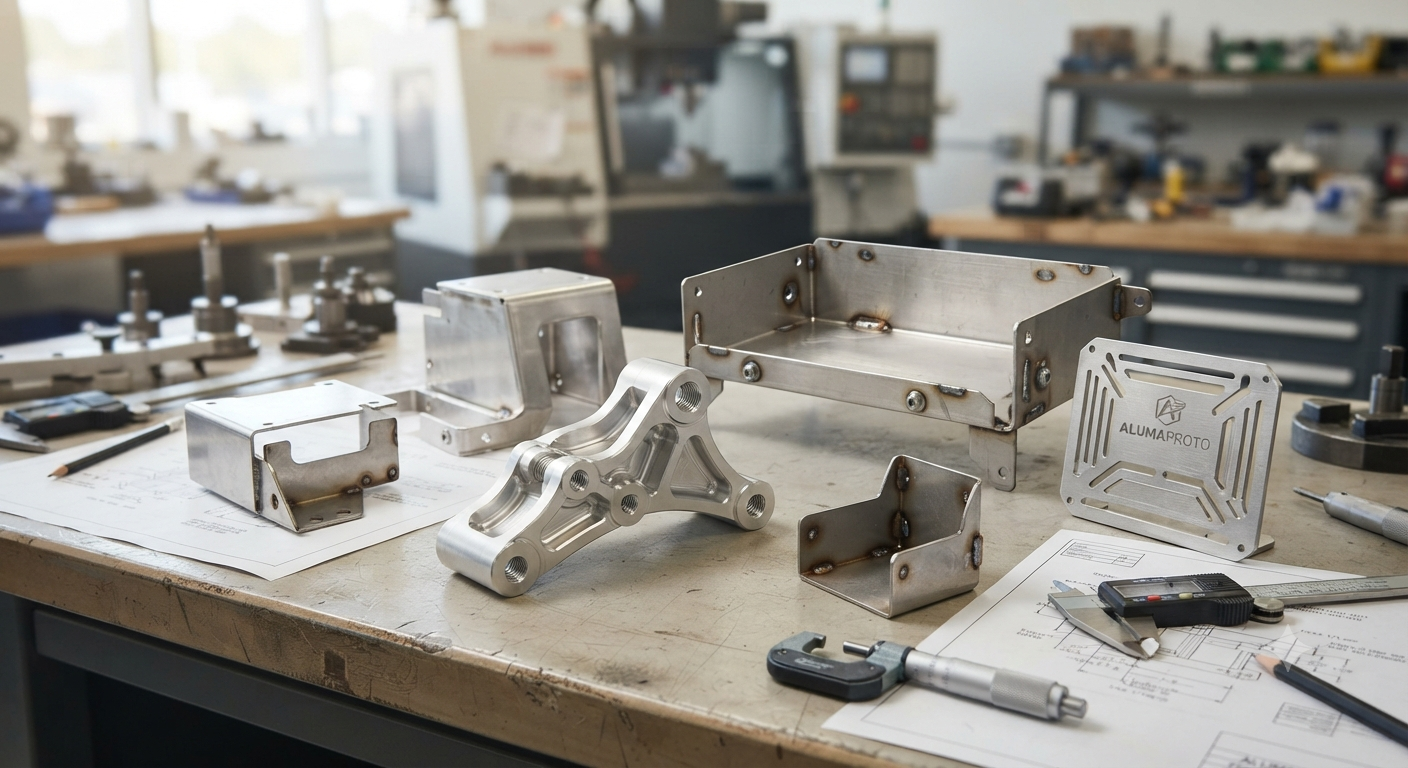
Sheet metal prototyping is the process of creating early-stage components or assemblies from flat metal sheets. These sheets are cut, formed, bent, and assembled to create a functional representation of the intended product.
Common materials include:
- Aluminum
- Stainless steel
- Mild steel
- Galvanized steel
- Copper
Sheet metal prototypes are widely used for enclosures, brackets, panels, cabinets, chassis, equipment covers, and structural components.
The process often begins with a 3D CAD model or 2D engineering drawing. The design is then converted into manufacturing instructions for cutting and forming.
Key Sheet Metal Prototyping Processes
Several manufacturing techniques can be combined to create a finished prototype.
Laser Cutting
Laser cutting produces accurate profiles from sheet material. It is suitable for creating holes, slots, openings, and complex external shapes.
CNC Bending
CNC press brakes are used to form precise bends in sheet metal. Correct bend allowances and tooling selection are essential for maintaining dimensional accuracy.
Punching
CNC punching machines create holes and repetitive features efficiently, particularly when working with designs that contain standardized patterns.
Welding
Welding joins individual sheet metal components to create a stronger prototype assembly. Depending on the material and application, manufacturers may use TIG, MIG, or other suitable welding methods.
Finishing
Prototypes may receive finishing treatments such as powder coating, anodizing, brushing, polishing, or painting. These processes can improve appearance and provide additional surface protection.
Aluminum Prototype vs. Sheet Metal Prototype
Although aluminum prototypes and sheet metal prototypes can overlap, they serve different design requirements.
| Factor | Aluminum Prototype | Sheet Metal Prototype |
| Typical process | CNC machining, extrusion, casting | Cutting, bending, punching, welding |
| Best for | Complex solid components | Enclosures and fabricated structures |
| Material form | Block, billet, extrusion, or casting | Flat metal sheet |
| Geometry | Suitable for detailed 3D shapes | Best for formed and folded designs |
| Strength testing | Excellent for functional parts | Excellent for structural assemblies |
| Production similarity | High for machined aluminum components | High for fabricated sheet products |
| Typical applications | Housings, brackets, mechanical parts | Cabinets, panels, covers, chassis |
The right option depends on the product’s geometry, material requirements, expected production method, and testing objectives.
How Aluminum Prototyping Supports Product Development
A prototype is more than a physical sample. It is a tool for learning and decision-making.
Engineers can use an aluminum prototype to:
- Verify critical dimensions.
- Test component fit and assembly.
- Evaluate mechanical performance.
- Identify interference issues.
- Check compatibility with other parts.
- Test surface finishes and appearance.
- Gather feedback from customers or stakeholders.
- Reduce manufacturing risks before production.
This iterative approach can prevent costly tooling changes and production delays.
Benefits of Sheet Metal Prototyping
Sheet metal prototyping provides several advantages for manufacturers developing products with folded or fabricated components.
Faster design validation: Engineers can quickly evaluate the physical form of an enclosure or structural component.
Cost-effective iteration: Design modifications can often be implemented without investing in expensive production tooling.
Realistic assembly testing: Teams can check screws, fasteners, hinges, brackets, and other components in an actual prototype.
Improved manufacturability: Prototyping reveals whether a design can be efficiently cut, bent, welded, and assembled.
Better communication: A physical model helps designers, engineers, manufacturers, and customers understand the product more clearly.
Choosing the Right Prototyping Method
Selecting a prototyping process should begin with the product’s requirements rather than simply choosing the cheapest manufacturing method.
Consider these factors:
- Material requirements
- Part complexity
- Dimensional tolerances
- Prototype quantity
- Functional testing needs
- Surface finish
- Expected production method
- Budget and development timeline
For a complex solid aluminum component, CNC machining may be the most practical choice. For a folded enclosure, sheet metal prototyping is often more suitable.
Common Applications
Aluminum and sheet metal prototypes are used across numerous industries, including:
- Automotive components
- Aerospace equipment
- Medical devices
- Consumer electronics
- Industrial machinery
- Robotics
- Telecommunications
- Renewable energy systems
- Defense equipment
- Commercial appliances
In each sector, prototypes help teams test designs before committing to high-volume manufacturing.
Frequently Asked Questions
1. What is an aluminum prototype?
An aluminum prototype is a physical product sample or component manufactured from aluminum to evaluate a design before production.
2. Why is aluminum suitable for prototypes?
Aluminum is lightweight, machinable, corrosion-resistant, and offers a useful strength-to-weight ratio for many engineering applications.
3. What is sheet metal prototyping?
Sheet metal prototyping involves cutting, bending, forming, and joining metal sheets to create functional prototype components or assemblies.
4. Is CNC machining suitable for aluminum prototypes?
Yes. CNC machining is widely used for aluminum prototypes that require accurate dimensions, complex geometries, and functional testing.
5. Which materials are used in sheet metal prototypes?
Common choices include aluminum, stainless steel, mild steel, galvanized steel, and copper.
6. How quickly can a prototype be manufactured?
The timeline depends on design complexity, material availability, quantity, tolerances, finishing, and manufacturing processes.
7. Are prototypes suitable for functional testing?
Yes. Properly manufactured prototypes can be used to evaluate fit, assembly, dimensions, mechanical performance, and usability.
8. Can sheet metal prototypes be customized?
Yes. Designs can be customized through different cutting patterns, bend configurations, materials, thicknesses, joining methods, and finishes.
9. Which is better: aluminum prototype or sheet metal prototype?
Neither is universally better. Aluminum prototypes are often ideal for machined or solid components, while sheet metal prototypes are better suited to fabricated enclosures, panels, and folded structures.
10. How can prototyping reduce production costs?
Prototyping helps identify design and manufacturing problems before mass production, reducing the risk of expensive tooling modifications, material waste, and production rework.
https://newsgrow.blogspot.com/2026/07/aluminum-prototype-and-sheet-metal.html