
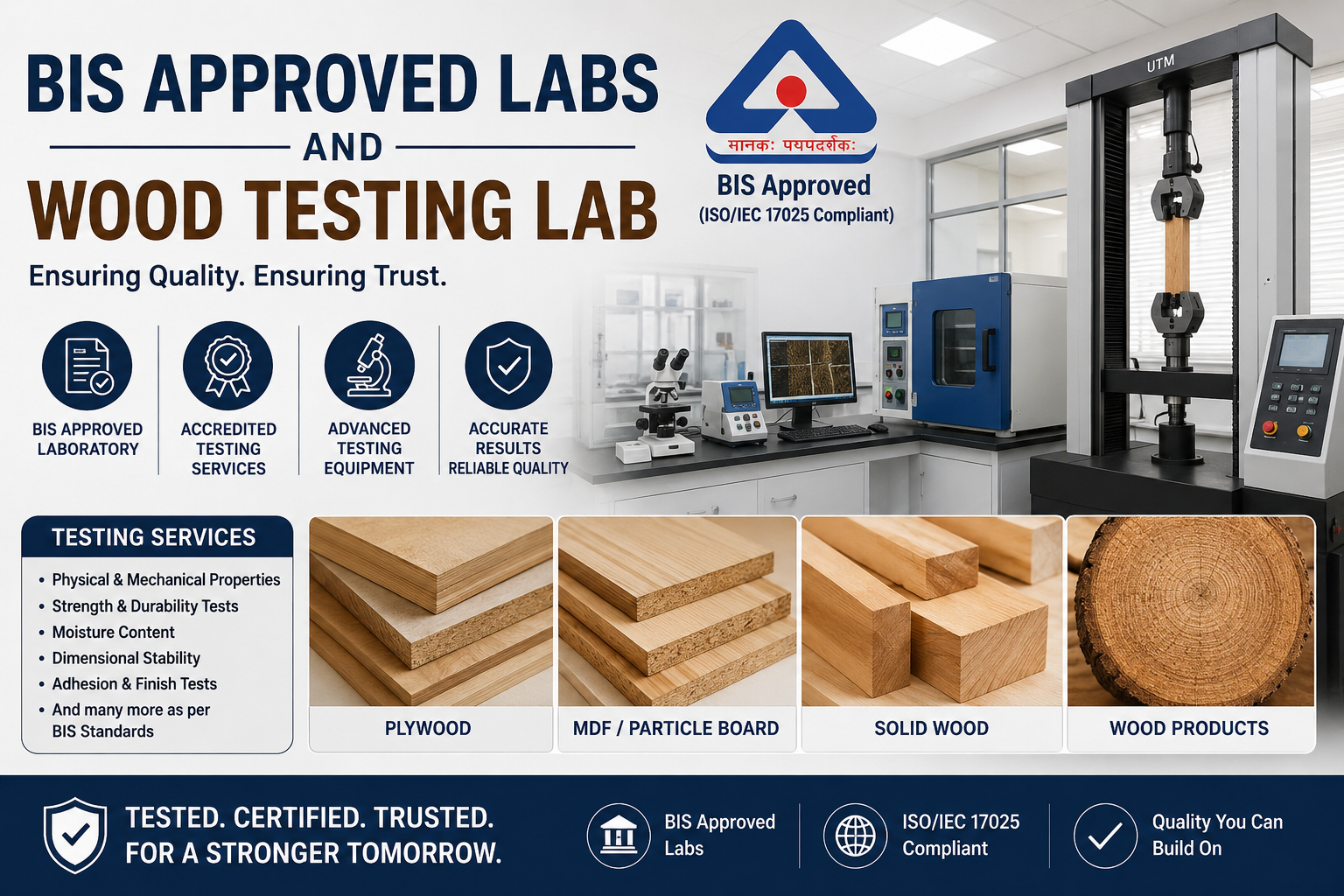
The demand for reliable product testing is rising as manufacturers, exporters, builders, and consumers become more focused on quality, safety, and regulatory compliance. In this changing environment, BIS approved labs and specialized wood testing lab facilities are playing an increasingly important role in verifying whether products meet established standards.
From construction materials and furniture to engineered wood products and industrial components, laboratory testing provides manufacturers with measurable data about performance, durability, strength, and safety. As businesses face greater scrutiny from regulators and customers, choosing a competent testing laboratory is becoming an essential part of responsible production.
Why BIS Approved Labs Are Gaining Importance
The Bureau of Indian Standards (BIS) plays a major role in establishing standards for products and services in India. Testing laboratories that operate within recognized quality frameworks help businesses assess their products against relevant technical requirements.
A BIS approved laboratory can support manufacturers by providing professional testing services designed around applicable Indian Standards. Depending on the product category, laboratory evaluation may cover physical, chemical, mechanical, electrical, or performance-related characteristics.
Key Benefits of Professional Testing
Businesses increasingly rely on laboratory testing to:
- Verify product quality and consistency
- Support regulatory compliance
- Identify manufacturing defects
- Improve product performance
- Reduce the risk of product failure
- Strengthen customer confidence
- Support certification and documentation requirements
- Maintain consistent production standards
For manufacturers entering competitive domestic and international markets, independent testing can also provide valuable evidence that products have been evaluated using recognized procedures.
The Growing Role of Wood Testing Labs
The wood and timber industry has its own unique testing requirements. Natural wood varies according to species, moisture content, density, age, and environmental conditions. Engineered wood products can also differ significantly based on manufacturing processes and raw materials.
A professional wood testing lab evaluates these characteristics using standardized methods to determine whether timber and wood-based products are suitable for their intended applications.
Testing can be relevant to:
- Construction timber
- Plywood
- Particle boards
- Medium-density fibreboards
- Laminated wood products
- Wooden furniture
- Flooring materials
- Doors and windows
- Structural wood components
What Does Wood Testing Involve?
Depending on the product and applicable standard, a laboratory may examine several important properties.
Moisture Content
Moisture is one of the most important factors affecting wood performance. Excessive moisture can contribute to dimensional changes, fungal growth, warping, and deterioration. Testing helps determine whether the material falls within the required moisture range.
Density and Specific Gravity
Density can provide useful information about wood quality and expected performance. It may also help differentiate between wood species and assess suitability for specific applications.
Strength and Mechanical Properties
Wood products used in construction must often withstand different types of loads. Laboratories may conduct tests related to bending strength, compression, tensile strength, hardness, and other mechanical characteristics.
Durability and Resistance
Depending on the application, testing may assess resistance to environmental conditions, biological attack, or other factors that can affect service life.
BIS Approved Labs vs. Wood Testing Labs
Although both laboratory categories support quality assurance, their focus can differ.
| Feature | BIS Approved Labs | Wood Testing Labs |
| Primary Focus | Product standards and compliance | Wood and wood-based material performance |
| Testing Scope | Multiple product categories | Timber, plywood, boards, and related products |
| Main Objective | Verify conformity with applicable standards | Assess physical, mechanical, and performance properties |
| Typical Users | Manufacturers, importers, exporters | Timber producers, furniture makers, builders |
| Key Benefits | Compliance, quality verification, certification support | Material selection, durability assessment, quality control |
Some laboratories may provide specialized wood testing services while also operating under recognized accreditation or approval frameworks. Businesses should always verify the laboratory’s current scope before commissioning testing.
Why Manufacturers Need Reliable Laboratory Testing
Quality problems can become expensive when they are discovered after products reach customers. A reliable testing process helps businesses identify potential issues earlier in the production cycle.
For example, a furniture manufacturer may use testing to evaluate the strength and moisture content of wood before manufacturing begins. Similarly, a construction company may require test results to confirm that wood-based materials meet project specifications.
Laboratory testing can therefore contribute to:
- Better raw material selection
- Improved production control
- Reduced product failures
- Greater consistency between batches
- Stronger technical documentation
- Better customer confidence
This makes testing an important component of modern quality management rather than simply a regulatory formality.
Choosing the Right Testing Laboratory
Selecting the right laboratory requires more than comparing prices. Businesses should evaluate the laboratory’s technical capabilities and relevant credentials.
Important considerations include:
- Accreditation or recognition status
- Scope of testing services
- Relevant Indian Standards
- Qualified technical personnel
- Modern testing equipment
- Sample handling procedures
- Reporting capabilities
- Turnaround time
- Experience with the specific product category
A laboratory’s scope should match the exact testing requirement. A facility experienced in general materials testing may not necessarily have the equipment or technical expertise required for specialized timber analysis.
What Businesses Should Ask Before Testing
Before submitting samples, companies can ask:
- Which standard applies to my product?
- Is the laboratory authorized or accredited for this specific test?
- What sample quantity is required?
- How should samples be prepared?
- What information will appear in the final report?
- How long will testing take?
- Can the results support certification or compliance requirements?
These questions can help businesses avoid delays and ensure that test results are suitable for their intended purpose.
Testing Trends Shaping the Industry
The laboratory testing sector is evolving alongside manufacturing and construction. Digital documentation, automated equipment, improved data management, and more sophisticated testing techniques are helping laboratories deliver more reliable results.
The growing use of engineered wood is also increasing demand for specialized testing. As sustainable construction gains momentum, manufacturers are exploring materials that combine renewable resources with improved performance. Testing will remain essential for verifying the properties of these materials.
At the same time, businesses are increasingly looking for laboratories that can provide transparent reports and traceable testing procedures. This reflects a broader shift toward evidence-based quality assurance across industrial supply chains.
Frequently Asked Questions
1. What is a BIS approved lab?
A BIS approved lab generally refers to a laboratory recognized or approved within the applicable BIS framework for conducting specified tests. The exact scope depends on the laboratory and product category.
2. What is a wood testing lab?
A wood testing lab is a specialized facility that evaluates timber and wood-based products for characteristics such as strength, moisture, density, durability, and other relevant properties.
3. Why is wood testing important?
Wood testing helps determine whether timber or wood-based products are suitable for specific applications and can identify potential quality or performance issues.
4. What materials can a wood testing lab examine?
Testing may cover timber, plywood, particle board, MDF, laminated products, flooring, furniture materials, and other wood-based products.
5. Can BIS approved labs test wood products?
Some laboratories may be authorized or accredited to conduct specific tests on wood products. Businesses should confirm the laboratory’s current scope for the required test.
6. What is tested in timber?
Common parameters include moisture content, density, dimensional stability, hardness, bending strength, compression strength, and other relevant characteristics.
7. How does testing help manufacturers?
Testing can improve quality control, identify defects, support compliance, reduce product failures, and provide technical evidence for customers and regulators.
8. Are all testing laboratories the same?
No. Laboratories differ in equipment, expertise, accreditation, approvals, testing scope, and technical capabilities.
9. How should a company select a laboratory?
Companies should choose a facility with suitable recognition, relevant testing expertise, appropriate equipment, and a testing scope that matches their specific requirements.
10. Can laboratory reports support certification?
Depending on the product and certification process, test reports from appropriately recognized laboratories may be used as supporting documentation. Businesses should confirm the applicable requirements beforehand.
Read more – https://shopnets.com/chemical-testing-lab-in-delhi-and-water-testing-in-delhi-why-reliable-testing-matters/
https://newsgrow.blogspot.com/2026/06/bis-approved-labs-and-wood-testing-lab.html