
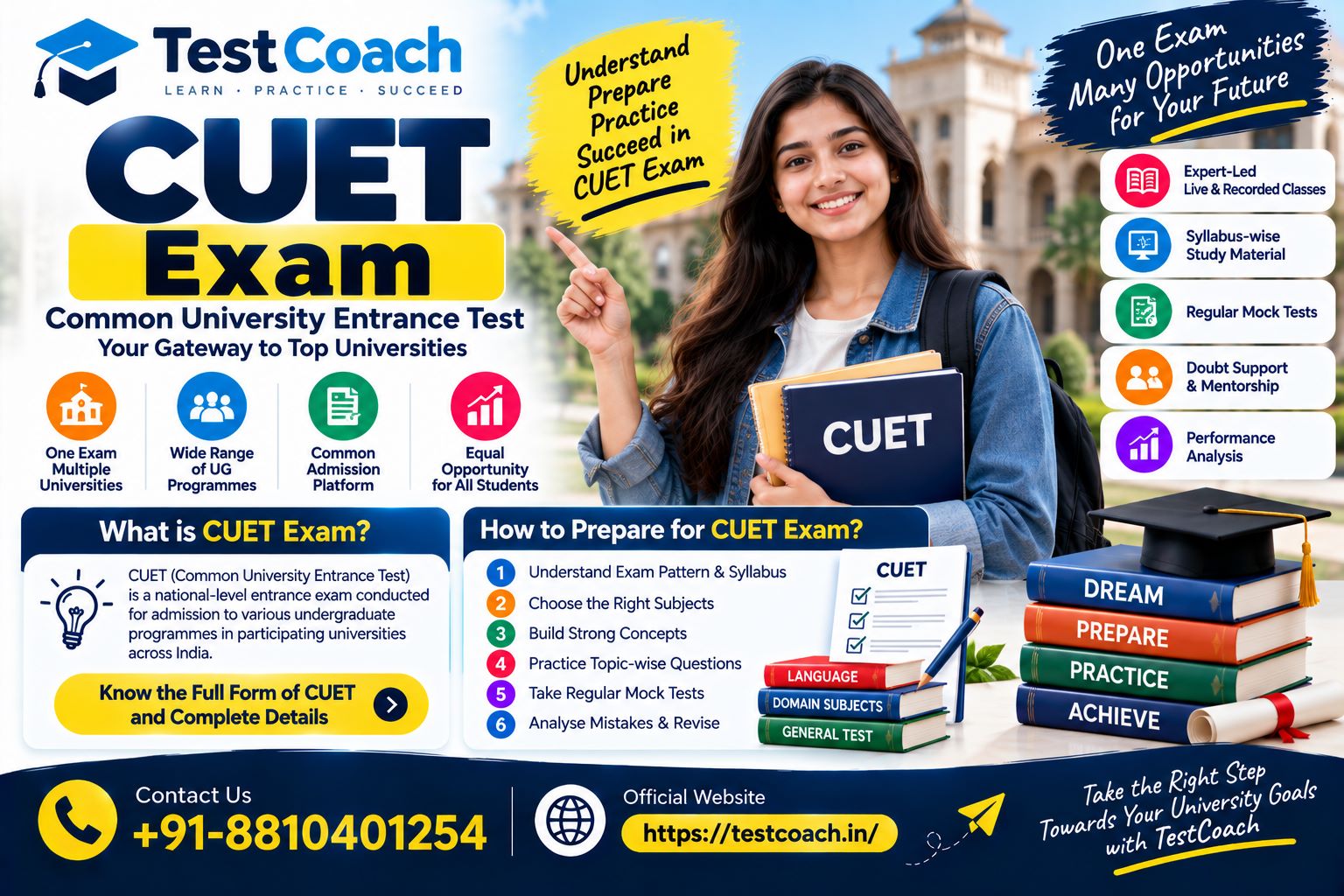
The cuet exam has become an important part of undergraduate admission planning for students seeking entry into participating universities across India. As more institutions use a common entrance-based approach for selected programmes, students and parents are increasingly searching for clear information about eligibility, subject selection, syllabus, preparation, and admission strategy.
One of the most common questions asked by first-time aspirants is the full form of cuet. CUET stands for Common University Entrance Test. It provides a common testing platform through which eligible students can apply for programmes offered by participating universities, subject to their individual admission rules.
What Is the CUET Exam?
The cuet exam is an entrance test used by participating universities and institutions for admission to various academic programmes.
For undergraduate aspirants, the examination can form an important part of the admission process. Students generally select papers based on the requirements of the courses and universities they intend to apply to.
This makes subject selection an important decision.
Candidates should not assume that the same combination of papers will work for every university or programme. Requirements may differ, so official admission information should be checked carefully before registration.
What Is the Full Form of CUET?
The full form of cuet is Common University Entrance Test.
The idea behind a common entrance examination is to provide students from different educational boards with a standardised testing route for participating universities.
However, a CUET score alone does not automatically guarantee admission.
Candidates may also need to meet:
- Academic eligibility requirements
- Course-specific subject criteria
- University admission conditions
- Document requirements
- Counselling or allocation procedures
Students should therefore view the examination as one part of the larger admission process.
Why Has the CUET Exam Become Important?
The cuet exam has encouraged students to think about university admission in a more structured way.
Instead of focusing only on school examination marks, aspirants may also need to develop entrance-exam skills such as:
- Objective question solving
- Accuracy
- Time management
- Concept application
- Reading speed
- Analytical thinking
- Regular revision
This has changed the preparation approach for many Class 12 students.
How Should Students Select CUET Subjects?
Subject selection should begin with the university programme, not with the examination itself.
Students should first shortlist the courses they want to study.
A sensible order is:
- Identify preferred undergraduate programmes.
- Shortlist participating universities.
- Check programme-specific eligibility.
- Confirm the required entrance papers.
- Select subjects accordingly.
- Verify all details before submitting the application.
This process reduces the risk of preparing an unsuitable subject combination.
Understanding the CUET Syllabus
Preparation should always begin with the relevant official syllabus.
Depending on a student’s selected papers, preparation may involve language tests, domain subjects, aptitude-oriented areas, or other prescribed components.
Students should divide their syllabus into manageable sections.
A useful method is to classify topics into:
Strong topics: Require periodic revision.
Moderate topics: Need additional practice.
Weak topics: Need concept rebuilding and focused study.
This approach is more efficient than giving every chapter the same amount of time.
How to Prepare for the CUET Exam
A strong cuet exam preparation plan can follow a simple cycle:
Learn → Practise → Test → Analyse → Revise
Build Strong Concepts
Students should first understand the underlying concepts instead of attempting to memorise answers.
Strong fundamentals make objective questions easier to handle even when they are presented differently.
Practise Topic-Wise Questions
After completing a topic, candidates should solve related questions.
This immediately reveals whether the concept has been understood correctly.
Use Timed Tests
Timed practice helps students gradually improve speed without sacrificing accuracy.
Analyse Mistakes
Every incorrect answer should be reviewed.
Students should identify whether the error came from:
- Weak understanding
- Careless reading
- Poor calculation
- Lack of revision
- Time pressure
Error analysis can be more useful than simply checking the final score.
Role of Mock Tests
Mock tests are an important part of entrance preparation.
They help candidates simulate real examination pressure and assess their readiness.
Mock testing can improve:
- Time management
- Accuracy
- Question selection
- Confidence
- Exam stamina
Students should not take repeated tests without analysing them.
“A mock test becomes truly useful when the student knows why each mistake happened and how to prevent it next time.”
Balancing Board Exams and CUET
Many aspirants prepare for board examinations and the cuet exam simultaneously.
This can feel challenging, but there is often overlap between school subjects and entrance preparation.
Students can use board studies to strengthen concepts and add objective-question practice for entrance readiness.
A balanced routine can include:
- School syllabus revision
- CUET-specific practice
- Short sectional tests
- Weekly revision
- Mock examinations
Consistency is generally more effective than studying for extremely long hours irregularly.
Common Preparation Mistakes
Students often lose time because of poor planning.
Common mistakes include:
- Preparing before checking course eligibility
- Choosing subjects without researching university requirements
- Using too many study resources
- Ignoring weak areas
- Skipping revision
- Taking tests without analysis
- Depending on outdated examination information
A focused preparation system with a limited number of reliable resources can be easier to manage.
Frequently Asked Questions
What is the full form of CUET?
The full form of cuet is Common University Entrance Test.
What is the CUET exam?
The cuet exam is a common entrance examination used by participating universities and institutions for admission to eligible academic programmes.
Who can apply for CUET?
Eligibility depends on the programme, institution, and level of admission. Students should check current official requirements.
Is CUET compulsory for all universities?
No. Admission processes vary across institutions and programmes.
How should I choose CUET subjects?
Choose papers only after checking the requirements of your preferred university programmes.
Is CUET difficult?
Difficulty depends on preparation, subject knowledge, question-solving ability, and time management. A structured study plan can make preparation more manageable.
Are mock tests important?
Yes. They help students improve accuracy, speed, confidence, and familiarity with timed examination conditions.
Can Class 12 students prepare for boards and CUET together?
Yes. Students can use overlapping syllabus areas efficiently and add entrance-oriented practice alongside board preparation.
Is school study enough for CUET?
School preparation can build strong concepts, but students may also need objective-question practice, mock tests, and exam strategy.
Should students check official information every year?
Yes. Examination structure, eligibility rules, subject requirements, and university admission processes can change.
What Students Should Do Before Applying
Before completing an application, candidates should verify:
- Programme eligibility
- Required subjects
- Official syllabus
- Application instructions
- Current examination pattern
- University-specific admission rules
Students should avoid making important decisions based only on older articles, videos, or previous admission cycles.
Current official information should always take priority.
Future of Common Entrance-Based Admissions
Common entrance testing is encouraging students to focus more on conceptual understanding, application, and examination strategy.
For future aspirants, success will increasingly depend on combining academic knowledge with practice, time management, and informed course selection.
The significance of the cuet exam therefore extends beyond the test itself. It also requires students to understand university eligibility, compare programmes, and plan their admissions carefully.
Media Contact
Student & Media Enquiries
Contact: +91-8810401254
Official Website: https://testcoach.in/