The steel tube manufacturing industry has never remained static. As construction became larger, vehicles became more sophisticated, infrastructure expanded, and industrial machinery became more demanding, the need for reliable steel tubes increased. Manufacturers responded by developing faster, more accurate, and more integrated production technologies.
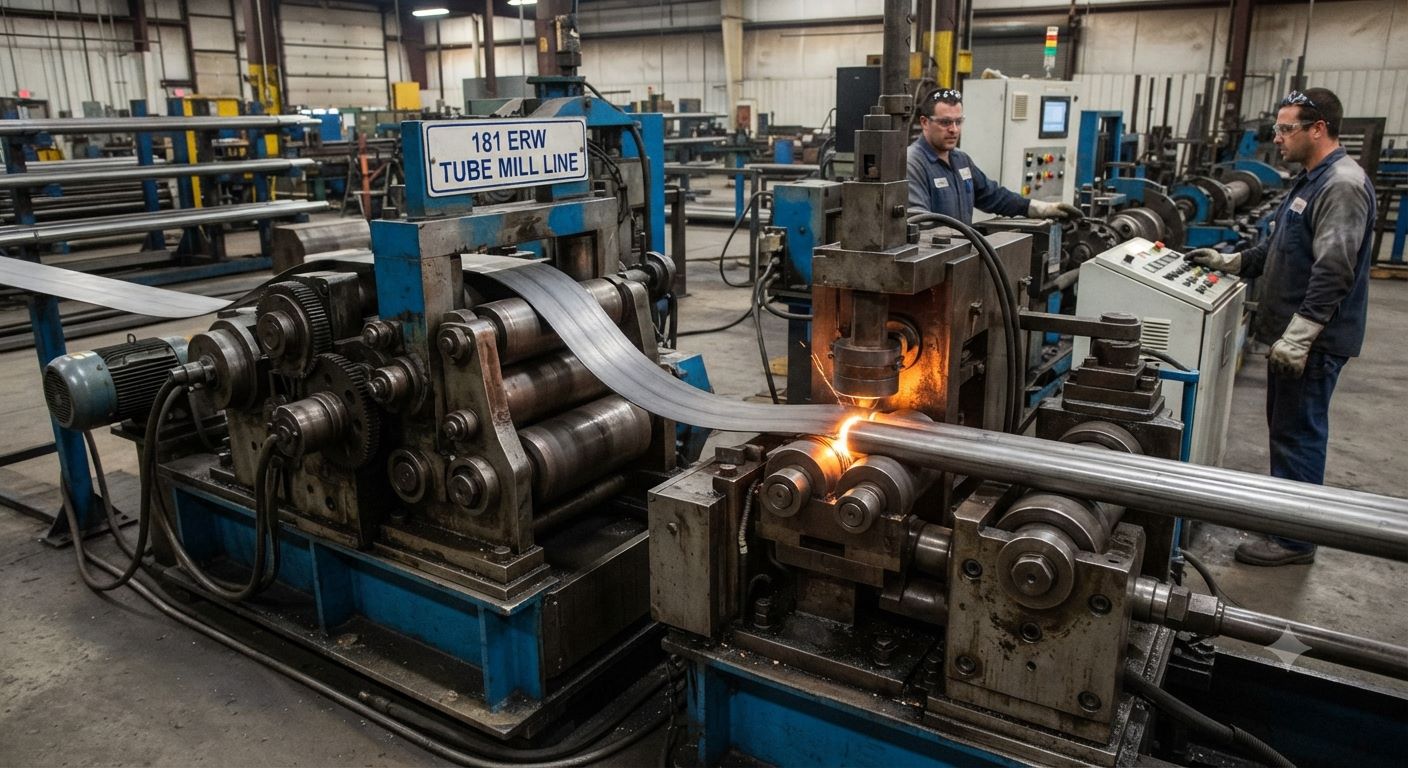
Among these technologies, the ERW Tube Mill Line and Tube Mill Line have become fundamental to the production of welded steel tubes and profiles. Their development represents more than an improvement in machinery. It represents a transition from conventional manufacturing toward continuous, automated, data-driven production.
Today, tube mills are expected to deliver high productivity without compromising weld quality, dimensional accuracy, operational reliability, or resource efficiency. At the same time, the next generation of equipment is being shaped by automation, artificial intelligence, predictive maintenance, digital inspection, and energy management.
The Beginning of Modern Tube Production
The early industrial production of steel tubes was considerably different from today’s automated systems. Manufacturing involved a greater number of separate operations, and skilled workers played a major role in controlling machines and maintaining product consistency.
The growing use of steel in bridges, buildings, machinery, transportation, and other industrial applications created pressure for higher production volumes. Manufacturers needed a method that could transform steel strip into tubes continuously instead of relying on disconnected production stages.
This requirement encouraged the development of continuous forming systems.
The Evolution of Roll Forming
Roll forming became one of the most important foundations of modern tube manufacturing. In this process, flat steel strip moves through multiple sets of rolls. Each set performs a controlled amount of bending until the strip gradually approaches a tubular shape.
The principle is simple, but achieving stable high-speed production requires accurate tooling, alignment, material control, and process management.
As roll-forming technology matured, it became possible to integrate it with continuous welding systems.
The Emergence of ERW Technology
Electric Resistance Welding introduced a highly practical method for joining the edges of continuously formed steel strip.
In an ERW process, electrical energy creates heat at the meeting edges. Pressure is then applied to join the heated material and create a longitudinal seam.
The ability to perform this operation continuously made ERW particularly suitable for industrial tube production.
Why ERW Changed the Industry
The technology provided manufacturers with several advantages:
- Continuous tube production
- High manufacturing productivity
- Controlled longitudinal welding
- Efficient material utilization
- Compatibility with automation
- Reduced dependence on conventional welding consumables
As electrical and control technologies developed, ERW systems became increasingly sophisticated.
The Tube Mill Becomes an Integrated Production System
Modern tube manufacturing is no longer based on a single machine. A complete Tube Mill Line combines several processes that must work together precisely.
The production journey generally starts with a steel coil. The coil is uncoiled and fed into the line, where forming rolls progressively shape the strip.
The formed strip then reaches the welding section, where its edges are joined. After welding, the tube moves through sizing and straightening equipment before being cut to the required length.
Depending on the application, inspection and material-handling systems may also be integrated.
A Typical Manufacturing Sequence
The process can be summarized as:
- Coil loading and preparation
- Uncoiling
- Strip feeding
- Progressive roll forming
- ERW welding
- Weld seam treatment
- Sizing
- Straightening
- Dimensional inspection
- Automatic cutting
- Tube collection
The integration of these stages is what gives a modern tube mill its production efficiency.
From Operator-Controlled Machines to Automation
One of the most important changes in the industry has been the growth of automation.
Older tube mills required operators to make frequent mechanical adjustments and rely heavily on experience. Modern systems increasingly use PLCs, HMIs, sensors, servo drives, automated controls, and digital monitoring.
The result is a production environment where many machine parameters can be controlled more consistently.
However, automation does not remove the importance of skilled employees. Instead, it changes their responsibilities. Modern operators need to understand production data, machine behavior, quality requirements, and maintenance conditions.
Why Forming Accuracy Matters
The quality of an ERW tube is influenced long before it reaches the welding section.
If the strip is not formed correctly, the edges may not meet in the intended position. This can affect welding stability and eventually influence the quality of the finished tube.
For this reason, forming rolls must be properly designed, aligned, maintained, and adjusted.
The Importance of Sizing
After welding, sizing rolls help establish the final dimensions of the tube. Accurate sizing becomes especially important when the finished product must fit into another component or meet strict dimensional requirements.
Poor sizing can lead to variations in diameter, width, height, straightness, or profile geometry.
Weld Quality Remains a Critical Factor
Although modern equipment provides advanced control, the welding section remains one of the most important parts of the production line.
ERW welding depends on the interaction of electrical energy, material characteristics, edge condition, alignment, pressure, and production speed.
A stable process is therefore essential for achieving consistent weld performance.
Modern monitoring systems can help operators observe welding-related conditions and respond to changes more quickly.
Why Online Quality Control Is Becoming Essential
Traditional quality control often depended on checking finished tubes. Modern manufacturing is moving toward continuous inspection.
Digital sensors, cameras, laser measurement systems, and other technologies can monitor products during production.
This provides a significant advantage: a deviation can potentially be identified before hundreds or thousands of additional tubes are produced.
The philosophy is changing from:
“Inspect the finished product.”
to:
“Control the process so defects are prevented.”
The Business Impact of Modern Tube Mill Technology
Technology improvements are not valuable only because they make machines more sophisticated. They can also influence the economics of manufacturing.
A well-optimized tube mill can potentially improve:
- Production consistency
- Material utilization
- Machine availability
- Product quality
- Changeover efficiency
- Labor productivity
- Maintenance planning
- Energy management
Reducing scrap is particularly important because steel is a significant raw-material cost. Every reduction in rejected material can have a direct financial impact.
The Challenge of Product Variety
The market for steel tubes is becoming more diverse. Some manufacturers produce a limited number of high-volume products, while others need to manufacture many different sizes and profiles.
This creates a challenge for tube mill design.
A line designed only for long production runs may not be ideal for a manufacturer that frequently changes product specifications.
Faster Changeovers
Future-oriented mills are therefore increasingly focused on reducing setup time.
Programmable production recipes, improved tooling systems, digital setup instructions, and automated adjustments can help manufacturers move from one product specification to another more efficiently.
Flexibility is becoming almost as important as production speed.
Where the Future of ERW Tube Mills Is Heading
The future of tube manufacturing is likely to be defined by connected and intelligent production.
Instead of operating as isolated machines, future tube mill components will increasingly exchange information with centralized production systems.
Artificial Intelligence and Machine Learning
Artificial intelligence could analyze information collected from the forming, welding, sizing, cutting, and inspection sections.
Over time, such systems may identify relationships between machine conditions and product quality.
AI-assisted systems could potentially help answer questions such as:
- Why is production quality changing?
- Which machine component may require attention?
- Is the current process consuming excessive energy?
- Is a dimensional trend developing?
- Can production parameters be optimized?
This would move tube manufacturing toward more data-driven decision-making.
Predictive Maintenance and Machine Reliability
Unexpected downtime is expensive because a failure in one important section can interrupt the entire production line.
Predictive maintenance aims to identify equipment problems before they become failures.
Sensors can monitor vibration, temperature, electrical current, motor load, and other operating characteristics. Software can analyze these signals and identify abnormal trends.
This can help maintenance teams plan interventions instead of responding to emergencies.
Energy Efficiency Will Shape Future Designs
Energy consumption is becoming a significant consideration for industrial manufacturers.
Future tube mills are likely to incorporate more efficient motors, drives, welding systems, and control strategies.
Digital energy monitoring can also help manufacturers understand where electricity is being consumed and identify opportunities for improvement.
Energy efficiency and material efficiency will increasingly become connected objectives. A production process that reduces scrap while using energy efficiently can improve both profitability and sustainability.
What Should Manufacturers Consider When Choosing a Tube Mill?
A tube mill is a long-term capital investment. Manufacturers should therefore evaluate the complete production requirement rather than focusing on a single specification.
Important factors include:
| Consideration | Why It Matters |
| Tube size range | Determines machine configuration |
| Wall thickness | Influences forming and welding requirements |
| Material grade | Affects processing conditions |
| Production speed | Determines potential output |
| Automation | Influences consistency and labor requirements |
| Changeover | Important for multi-product manufacturing |
| Inspection | Supports product quality |
| Maintenance | Influences long-term availability |
| Energy efficiency | Affects operating cost |
| Technical support | Important for installation and troubleshooting |
| Expansion capability | Supports future growth |
The right equipment should be capable of meeting current requirements while leaving sufficient flexibility for future changes.
Frequently Asked Questions
What is an ERW Tube Mill Line?
It is a continuous production line that forms steel strip into tubes and joins the edges using Electric Resistance Welding.
What is the difference between ERW and a general Tube Mill Line?
ERW specifically describes the electric resistance welding process, while Tube Mill Line is a broader term describing equipment used to manufacture tubes.
What is the first stage of tube production?
The process normally begins with steel coil preparation, followed by uncoiling and controlled strip feeding.
Why is roll forming performed in multiple stages?
Multiple forming stages distribute the deformation gradually, helping achieve stable geometry and controlled material movement.
Why is ERW welding suitable for continuous production?
The process can join the formed strip edges while the material continuously moves through the production line.
What does the sizing section do?
Sizing equipment establishes the final dimensions and profile of the welded tube.
Why is automatic cutting important?
It allows continuously manufactured tubes to be separated into specified lengths without repeatedly stopping the entire production process.
Can tube mills produce different profiles?
Depending on their configuration and tooling, tube mills can manufacture round, square, rectangular, and other profiles.
How will AI influence future tube mills?
AI can support process analysis, quality monitoring, equipment diagnostics, and production optimization.
What will determine the future success of tube mills?
Flexibility, automation, quality control, energy efficiency, predictive maintenance, digital connectivity, and the ability to adapt to changing customer requirements will become increasingly important.
Read more – https://tandtlawassociates.com/past-and-future-of-erw-tube-mill-line-and-tube-mill-line/