The packaging industry is changing rapidly as manufacturers look for faster, cleaner, and more flexible ways to package liquid and semi-liquid products. Among the technologies gaining attention, the Foil Lid And Spout Pouch Filling Machine has become an important solution for businesses that need reliable filling, sealing, and packaging performance.
From food and beverages to sauces, dairy products, cosmetics, and household liquids, spouted pouches and foil-lidded containers offer convenience while helping brands improve product protection. However, achieving consistent output requires more than choosing the right pouch. The filling equipment must deliver accurate dosing, hygienic operation, secure sealing, and dependable production speeds.
This guide explores how modern filling machines work, their benefits, applications, and the key factors manufacturers should consider before investing in packaging equipment.
What Is a Foil Lid and Spout Pouch Filling Machine?
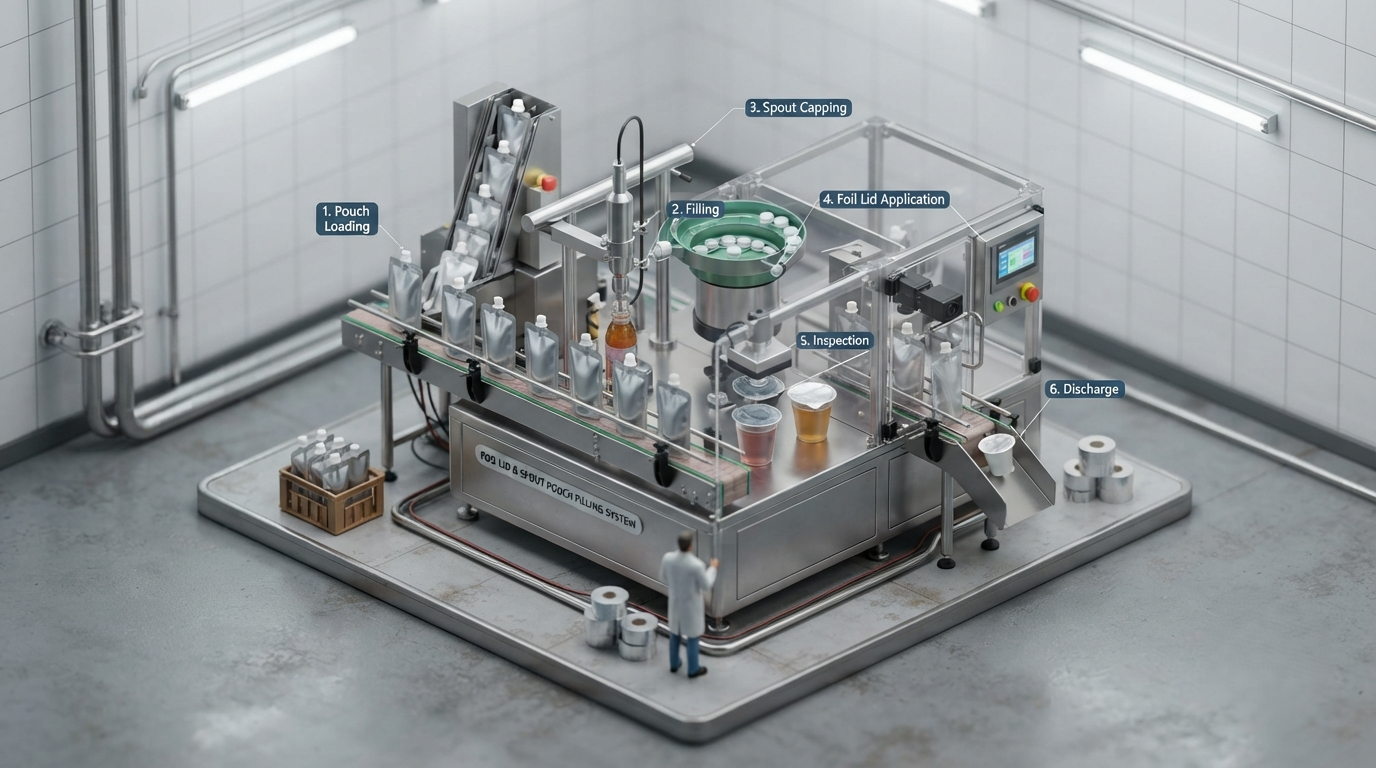
A Foil Lid And Spout Pouch Filling Machine is specialized packaging equipment designed to fill products into pouches or containers equipped with spouts and foil-based sealing systems. Depending on the machine configuration, the equipment can handle pouch feeding, product filling, foil lid placement, heat sealing, coding, and final inspection.
The system is designed to minimize manual intervention while maintaining consistent packaging quality. Automated controls allow manufacturers to manage filling volumes and production parameters with greater precision.
Modern machines can be configured for different pouch sizes, product viscosities, and packaging formats. This flexibility makes them suitable for both established manufacturers and companies introducing new products to the market.
How Does the Filling Process Work?
The exact process varies according to machine design and packaging format, but a typical automated filling operation includes several stages:
- Pouch or container feeding: Empty spout pouches or containers are loaded into the machine and positioned automatically.
- Product filling: A controlled dosing system fills the product according to the selected volume.
- Foil lid positioning: The foil sealing material is placed accurately over the designated opening.
- Heat sealing: Controlled heat and pressure create a secure seal that helps protect the packaged product.
- Coding and marking: Batch numbers, manufacturing dates, or other information can be printed on the package.
- Inspection and discharge: Finished packs are checked and transferred for secondary packaging or shipment.
This streamlined process helps reduce production inconsistencies while improving throughput.
Why Are Spout Pouches Becoming More Popular?
Spout pouches have become increasingly attractive because they combine convenience with efficient product packaging. Unlike traditional rigid containers, flexible pouches can use less packaging material and often require less storage space.
Consumers also appreciate their easy-pour and resealable features. A spout makes it simpler to dispense products while reducing the risk of spills.
For manufacturers, the format can provide several advantages:
- Convenient dispensing for consumers
- Lightweight packaging design
- Efficient transportation and storage
- Flexible branding and printing options
- Compatibility with a wide range of liquid products
- Potential reduction in packaging material
- Resealable designs for repeated use
As packaging preferences continue to evolve, automated spout pouch filling technology is helping manufacturers respond to changing consumer expectations.
Key Benefits of a Foil Lid and Spout Pouch Filling Machine
Investing in automated filling equipment can deliver benefits across production, quality control, and operational efficiency.
Improved Filling Accuracy
Accurate dosing is essential for maintaining product consistency and controlling material costs. Modern filling systems use precision-controlled mechanisms to deliver repeatable fill volumes, helping reduce product giveaway and packaging variation.
Better Production Efficiency
Automation allows manufacturers to process more packages in less time compared with manual filling operations. Faster production can be especially valuable for businesses handling large orders or seasonal demand.
Enhanced Product Protection
A properly applied foil seal can provide an additional barrier against contamination and environmental exposure. When combined with a secure spout closure, the packaging can help maintain product integrity throughout distribution and storage.
Reduced Manual Labor
Automated systems can reduce the number of repetitive tasks handled by operators. This allows production teams to focus more on quality checks, machine monitoring, maintenance, and other value-added activities.
Greater Packaging Flexibility
Many filling machines can be adapted to different pouch dimensions and filling volumes. This flexibility allows manufacturers to serve multiple product categories without completely changing their packaging infrastructure.
Applications Across Different Industries
The versatility of Foil Lid And Spout Pouch Filling Machine technology makes it suitable for numerous markets.
| Industry | Common Applications |
| Food | Sauces, purees, baby food, condiments |
| Beverages | Juices, concentrates, dairy drinks |
| Dairy | Yogurt-based products and liquid dairy |
| Cosmetics | Creams, gels, shampoos, lotions |
| Household | Cleaning liquids and detergents |
| Personal Care | Liquid soaps and body-care products |
| Industrial | Selected oils, chemicals, and specialty liquids |
The machine configuration should always be matched to the product’s viscosity, temperature, particle content, and hygiene requirements.
Foil Lid and Spout Pouch Filling Machine vs. Traditional Filling Systems
Choosing between packaging technologies depends on production requirements, product characteristics, and long-term business goals.
| Feature | Foil Lid and Spout Pouch Filling Machine | Traditional Filling System |
| Automation | High | Varies |
| Filling consistency | High | Moderate to high |
| Packaging flexibility | Excellent | Depends on format |
| Labor requirements | Lower | Often higher |
| Consumer convenience | High | Format dependent |
| Production scalability | Strong | Varies by equipment |
| Packaging format | Flexible pouches and spouted packs | Often bottles or rigid containers |
For companies seeking modern, flexible packaging formats, automated pouch filling can offer a strong alternative to conventional packaging methods.
How to Choose the Right Machine
Selecting the right equipment requires careful evaluation. Businesses should consider the following factors before purchasing:
Product Characteristics
Determine whether the machine can handle the product’s viscosity, temperature, acidity, particle size, and flow behavior. A system designed for thin liquids may not perform effectively with thick sauces or products containing particulates.
Filling Capacity
Consider the required production volume and target output. The ideal machine should meet current requirements while allowing room for future growth.
Sealing Performance
A reliable sealing system is essential for preventing leakage and protecting product quality. Manufacturers should evaluate sealing temperature control, pressure consistency, and compatibility with the selected foil material.
Hygiene and Cleaning
For food, beverage, and personal-care applications, hygienic design is critical. Look for equipment that supports efficient cleaning, easy maintenance, and appropriate sanitary standards.
Automation and Controls
Modern control systems can simplify operation and provide better monitoring of production parameters. Features such as touchscreen controls, programmable settings, and automated fault detection can improve usability.
Maintenance and Operational Best Practices
Even high-quality packaging equipment requires regular maintenance. Preventive maintenance can help reduce unexpected downtime and extend machine life.
Operators should routinely inspect filling components, sealing systems, sensors, pumps, and product-contact parts. Cleaning schedules should be followed carefully, especially when processing food, beverages, cosmetics, or other sensitive products.
Staff training is equally important. Properly trained operators can identify unusual machine behavior early and maintain consistent production performance.
Frequently Asked Questions
1. What is a spout pouch filling machine?
It is automated equipment designed to fill liquid or semi-liquid products into pouches fitted with dispensing spouts.
2. What is the purpose of a foil lid?
A foil lid provides a sealed barrier that can help protect the packaged product from contamination and environmental exposure.
3. Can these machines fill thick products?
Yes. Certain models are designed for viscous products, although the filling system must be selected according to the product’s specific characteristics.
4. Are spout pouches suitable for food products?
Yes. Spout pouches are widely used for various food and beverage applications when the packaging materials and equipment meet applicable safety requirements.
5. Can the machine handle different pouch sizes?
Many modern systems can accommodate multiple pouch formats, but the exact range depends on the machine’s design and configuration.
6. How does automation improve filling accuracy?
Automated dosing systems control the quantity of product delivered into each package, helping maintain consistent fill volumes.
7. Are these machines suitable for cosmetics?
Yes. They can be configured for suitable cosmetic products such as gels, creams, lotions, and other liquid formulations.
8. What affects machine production speed?
Production speed depends on factors such as pouch size, filling volume, product viscosity, sealing requirements, and machine configuration.
9. How often should filling equipment be maintained?
Maintenance frequency depends on operating hours and product type. Manufacturers should follow the equipment supplier’s recommended preventive maintenance schedule.
10. What should businesses consider before purchasing?
Key considerations include product compatibility, filling accuracy, production capacity, sealing quality, hygiene, automation, maintenance requirements, and future scalability.
https://newsgrow.blogspot.com/2026/07/foil-lid-and-spout-pouch-filling.html