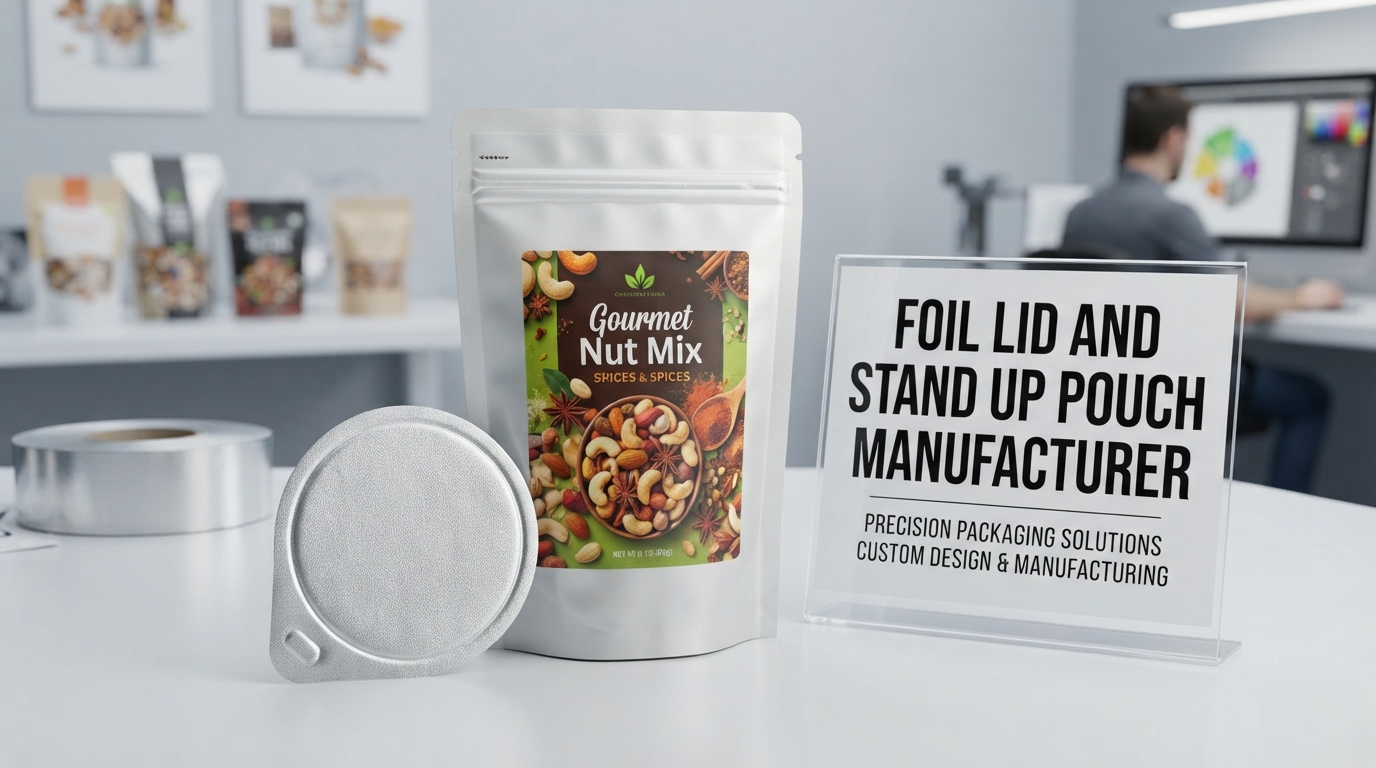
Packaging has become much more than a protective outer layer. In today’s competitive marketplace, packaging must preserve product quality, simplify transportation, support branding, improve user convenience, and increasingly address environmental concerns. Foil Lid packaging and stand-up pouches are two formats that clearly demonstrate this transformation.
Although one is generally used as a closure and the other as a complete flexible package, both have developed through advances in materials, converting technology, sealing systems, printing, and manufacturing automation. Understanding their past development provides useful insight into the future direction of flexible packaging.
The Beginning of Foil Lid Technology
The history of foil packaging is closely connected to the development of aluminum as a practical packaging material. Its thin construction, barrier capabilities, and ability to be converted into different shapes made it valuable for protecting sensitive products.
Traditional packaging often depended on rigid covers and closures. These solutions could provide protection but were not always lightweight or efficient for high-speed packaging operations.
The development of Foil Lid technology offered a different approach. A foil-based lid could be applied to compatible containers and provide a combination of sealing, protection, and convenient opening.
Over time, foil lids became increasingly common in:
- Dairy packaging
- Food containers
- Ready-to-eat meals
- Pharmaceutical packaging
- Nutritional products
- Cosmetic containers
- Specialty consumer products
The technology has continued evolving as manufacturers have demanded greater consistency and more precise sealing performance.
How Modern Foil Lids Work
A modern foil lid is generally designed around the container rather than produced as an isolated component.
The manufacturer considers the container material, sealing equipment, product characteristics, and required shelf life before selecting the appropriate structure.
Important performance factors can include:
- Seal strength
- Peel force
- Barrier protection
- Heat resistance
- Printing quality
- Dimensional accuracy
- Container compatibility
The objective is to create a lid that remains securely sealed during storage and transportation but can still be opened conveniently by the consumer.
The Rise of the Stand-Up Pouch
Flexible packaging experienced another major development with the introduction of the stand-up pouch.
Traditional flexible bags could provide lightweight packaging, but they often lacked stability. The bottom gusset changed this by creating a base that allows the package to stand upright.
This improvement helped the format gain visibility in retail environments.
A stand up pouch manufacturer can now create packaging for products including:
- Coffee and tea
- Snacks
- Pet food
- Sauces
- Spices
- Powders
- Detergents
- Cosmetics
- Nutritional products
The format’s popularity comes from its ability to combine flexible construction with practical consumer features.
From Simple Pouch to Advanced Packaging System
The stand-up pouch has developed significantly from its early versions.
Modern pouch production can involve multiple material layers or specialized structures designed to provide strength, sealing, and barrier protection.
Manufacturers can also integrate different functional elements.
Popular Pouch Options
Zippers: Provide convenient resealing for products consumed over multiple occasions.
Spouts: Allow controlled dispensing of liquids and semi-liquid products.
Tear Notches: Make opening faster and easier.
Handles: Improve carrying convenience for larger packages.
Custom Shapes: Help brands create distinctive shelf presentation.
High-Barrier Structures: Provide additional protection for products sensitive to oxygen, moisture, or light.
This flexibility has made stand-up pouches useful across many industries.
Why Material Selection Matters
Choosing packaging material should never be based solely on appearance or price.
The product inside the package determines many of the technical requirements.
A dry food product may need strong moisture protection. Coffee may require protection from oxygen and aroma loss. A liquid product may require strong seals and puncture resistance.
For this reason, a professional stand up pouch manufacturer typically evaluates the product and supply chain before recommending a structure.
The packaging may need to withstand:
- Filling operations
- Sealing processes
- Transportation
- Warehousing
- Temperature changes
- Retail handling
- Consumer use
The correct material must perform throughout this entire journey.
Sustainability Changes the Packaging Strategy
Sustainability is now one of the most important factors influencing packaging development.
Manufacturers are under increasing pressure to reduce material usage, minimize manufacturing waste, and explore packaging structures compatible with available recycling systems.
For flexible packaging, one important area is mono-material development. PE- and PP-based structures can simplify material composition for applications where they provide adequate performance and where suitable recycling pathways exist.
However, sustainability requires a broader evaluation.
A package should be assessed according to:
- Material efficiency
- Product protection
- Manufacturing impact
- Transportation efficiency
- Recycling availability
- Consumer disposal behavior
- End-of-life infrastructure
Reducing packaging material is valuable only when the package continues to perform its primary protective function.
The Future of Foil Lid Packaging
The future of Foil Lid manufacturing will likely involve optimization rather than simply replacing traditional foil systems.
Manufacturers are expected to explore ways to improve barrier performance, sealing reliability, opening characteristics, and material efficiency.
Advanced Sealing Systems
Improved process control can provide more consistent seals across high-speed production lines.
Better Consumer Opening
Future lids may focus on easier and more predictable peeling while maintaining product security.
Improved Manufacturing Inspection
Automated vision systems can inspect dimensions, print quality, and sealing-related characteristics.
Efficient Material Use
Manufacturers can continue optimizing foil thickness and supporting layers according to actual application requirements.
The Future of Stand-Up Pouch Manufacturing
The future stand up pouch manufacturer will operate in an environment where sustainability and customization are increasingly important.
Packaging companies are likely to invest in technologies that enable:
- Recyclable pouch structures
- Lower material consumption
- High-performance barrier films
- Digital printing
- Automated quality inspection
- Customized pouch shapes
- Improved closure systems
- Faster product development
The relationship between brands and manufacturers may also become more collaborative. Instead of simply ordering a standard pouch, companies may work with suppliers during the design stage to develop packaging around specific product requirements.
Foil Lid and Stand-Up Pouch: Key Differences
| Attribute | Foil Lid Packaging | Stand-Up Pouch Packaging |
| Primary role | Container sealing | Product containment |
| Typical base | Rigid container | Flexible film |
| Main advantage | Barrier and sealing | Lightweight convenience |
| Opening method | Peel or puncture | Tear, zipper or spout |
| Resealing | Usually unavailable | Commonly available |
| Design flexibility | Moderate to high | High |
| Typical applications | Cups, trays, tubs | Foods, beverages, pet care, household goods |
These formats are not necessarily alternatives. In many cases, they address completely different packaging requirements.
How to Choose a Packaging Manufacturer
The manufacturer can have a direct impact on packaging quality and product performance. Businesses should therefore evaluate suppliers carefully.
A reliable supplier should provide:
- Strong material knowledge
- Consistent production
- Application-specific recommendations
- Flexible customization
- Reliable quality testing
- Suitable printing capabilities
- Production scalability
- Technical support
- Sustainability-focused options
Companies should also request technical specifications and confirm that the packaging is appropriate for their product and filling process.
FAQ: Foil Lid and Stand-Up Pouch
What is a Foil Lid?
A Foil Lid is a foil-based sealing component designed to close and protect a compatible container.
What are the main benefits of foil lids?
They can provide barrier protection, reliable sealing, convenient opening, and printable branding surfaces.
Why do stand-up pouches stand upright?
Their bottom gusset forms a stable base that supports the package.
What industries use stand-up pouches?
Food, beverage, pet food, cosmetics, household, nutritional, and other consumer industries use the format.
Can stand-up pouches have different closures?
Yes. Zippers, spouts, tear notches, and other closure systems can be incorporated.
Are stand-up pouches suitable for dry products?
Yes. They are commonly used for snacks, powders, grains, spices, and other dry products.
Can they be used for liquids?
Yes. Liquid-compatible structures and appropriate seals or spouts can be developed.
What is a barrier layer?
A barrier layer helps reduce the movement of oxygen, moisture, light, aromas, or other external factors through packaging.
Are recyclable pouches available?
Some manufacturers offer structures designed for improved recycling compatibility, depending on the material and local recycling infrastructure.
How do I select a stand up pouch manufacturer?
Compare technical expertise, material options, customization, quality control, production capacity, sustainability capabilities, and customer service.