
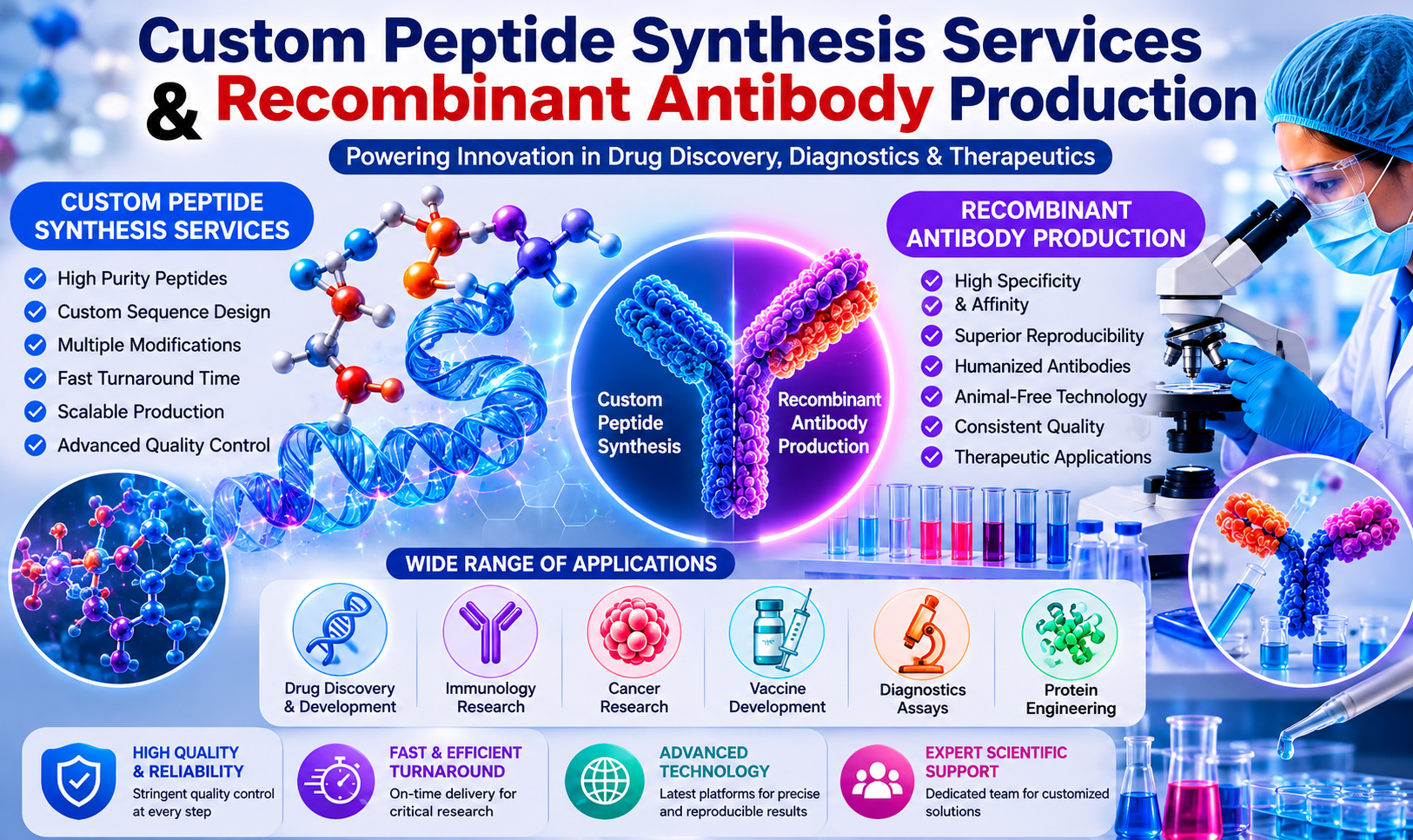
The world of biotechnology is moving faster than ever, and two technologies are playing a major role in that transformation: recombinant antibody production and custom peptide synthesis services. From drug discovery and cancer research to diagnostics and vaccine development, these advanced biological tools are helping scientists create more precise, consistent, and application-specific solutions.
Antibodies have been at the center of biomedical research for decades. Today, however, researchers are no longer limited to antibodies obtained from animals or traditional hybridoma-based production. Advances in genetic engineering, molecular biology, protein expression, and peptide chemistry have opened the door to highly customizable biological products designed around specific research and therapeutic needs.
But how does recombinant antibody production actually work? And where do custom peptide synthesis services fit into the modern biotechnology pipeline?
Let’s explore.
Understanding the Role of Antibodies in Modern Science
Antibodies, also known as immunoglobulins, are specialized proteins naturally produced by B cells. Their primary role is to recognize and interact with specific foreign substances, known as antigens.
This unique ability to recognize molecular targets with high specificity has made antibodies indispensable across numerous scientific fields.
Today, antibodies are widely used for:
- Drug discovery and development
- Cancer research
- Immunology studies
- Infectious disease research
- Diagnostic testing
- Biomarker detection
- Protein analysis
- Cell biology
- Therapeutic development
Historically, many laboratory antibodies were generated using biological sources such as immunized animals. While conventional antibody technologies remain valuable, modern research increasingly demands products with greater consistency, reproducibility, scalability, and control.
That is where recombinant technologies have changed the game.
What Is Recombinant Antibody Production?
Recombinant antibody production is a biotechnology process that uses genetic engineering to create antibodies or antibody fragments with defined molecular characteristics.
Instead of depending entirely on traditional animal immunization or hybridoma systems, researchers identify and manipulate the genes responsible for producing the desired antibody. These genes can then be introduced into suitable host cells, which act as biological factories for producing the target antibody.
The result is an antibody product that can be designed and optimized for specific research or therapeutic applications.
Depending on the project, recombinant antibodies may be developed in formats such as:
- Full-length antibodies
- Fab fragments
- Single-chain variable fragments (scFv)
- Single-domain antibodies (sdAbs)
- Other engineered antibody fragments
The ability to control the genetic sequence gives researchers greater flexibility when optimizing antibody performance.
Why Recombinant Antibodies Are Gaining Momentum
The rapid adoption of recombinant antibody production is closely connected to the growing demand for reliable and reproducible biological products.
Traditional antibody production can sometimes result in batch-to-batch variability. Recombinant approaches, in contrast, allow the antibody sequence to be defined at the genetic level, helping improve consistency across production cycles.
Key advantages include:
- High reproducibility
- Improved batch consistency
- Precise sequence control
- Scalable production
- Reduced dependence on animal-derived materials
- Flexible antibody engineering
- Potential for improved affinity and specificity
- Compatibility with different expression platforms
For researchers working on complex biological targets, these advantages can significantly accelerate the journey from early discovery to advanced development.
The Step-by-Step Journey of Recombinant Antibody Production
Creating a high-quality recombinant antibody involves much more than simply inserting a gene into a cell. It is a carefully designed workflow involving discovery, screening, engineering, expression, purification, and characterization.
1. Identifying the Target
The process begins with identifying the antigen or molecular target of interest.
Researchers first determine what biological molecule the antibody needs to recognize. This could be a protein, peptide, receptor, biomarker, or another molecular target.
The quality of this initial target selection can influence the entire downstream development process.
2. Antibody Sequence Discovery
Once the target has been established, researchers identify antibody sequences capable of binding to it.
Antibody genes may be sourced from immune cells, existing antibody libraries, hybridomas, or other biological resources. Advanced screening and display technologies can then help identify promising candidates.
3. Antibody Library Screening
Antibody libraries contain large collections of antibody sequences or fragments.
Technologies such as phage display and yeast display can be used to screen these libraries and identify candidates with desirable binding characteristics.
The objective is to find antibody candidates that demonstrate strong and specific interactions with the target antigen.
4. Antibody Engineering and Optimization
Finding an antibody that binds to a target is only the beginning.
Researchers may further optimize the candidate to improve properties such as:
- Binding affinity
- Specificity
- Stability
- Solubility
- Expression efficiency
- Functional activity
Genetic engineering techniques, including targeted sequence modification, can be used to improve antibody characteristics for specific applications.
5. Recombinant Expression
After selecting an optimized antibody sequence, researchers introduce the corresponding genetic material into an appropriate expression system.
The choice of host depends on the antibody format, production scale, structural requirements, and desired post-translational modifications.
Common expression platforms include:
- Mammalian cells
- Bacterial systems
- Yeast systems
For complex full-length antibodies, mammalian expression systems such as CHO and HEK293 cells are frequently used because they can support sophisticated protein folding and post-translational processing.
6. Purification and Characterization
Following expression, the recombinant antibody must be isolated and purified.
Chromatographic methods and other purification technologies can help separate the target antibody from unwanted proteins and cellular components.
The purified antibody is then characterized to evaluate factors such as:
- Purity
- Identity
- Binding activity
- Stability
- Specificity
- Molecular integrity
This stage is essential for ensuring that the final product performs as expected.
Where Custom Peptide Synthesis Services Enter the Picture
While antibodies are powerful tools for recognizing biological targets, peptides are equally important building blocks in modern life-science research.
This is why custom peptide synthesis services have become an essential resource for researchers working in pharmaceutical development, immunology, diagnostics, proteomics, and molecular biology.
Custom peptide synthesis allows scientists to obtain peptides designed according to specific sequences and research requirements.
These peptides may be used for:
- Antibody generation
- Immunogen development
- Epitope mapping
- Protein interaction studies
- Assay development
- Drug discovery
- Vaccine research
- Biomarker studies
- Structural biology
- Diagnostic research
For example, a researcher studying a specific protein may select a unique peptide sequence representing an important region of that protein. The synthesized peptide can then support downstream research, including antibody development and immunological studies.
This creates an important connection between peptide technology and antibody research.
Custom Peptide Synthesis and Recombinant Antibody Production: A Powerful Combination
The combination of custom peptide synthesis services and recombinant antibody production can provide researchers with a more integrated approach to biological discovery.
A simplified workflow may look like this:
Target identification → Peptide design → Custom peptide synthesis → Antibody discovery → Sequence identification → Recombinant antibody engineering → Expression → Purification → Characterization
By combining advanced peptide chemistry with recombinant DNA technology, researchers can develop highly targeted tools for studying specific biological mechanisms.
This integrated approach can be particularly valuable when working with challenging targets or when conventional antibody development methods do not provide the desired results.
Choosing the Right Expression System
Not every recombinant antibody can be produced using the same platform. Selecting an appropriate expression system is an important part of the development strategy.
Mammalian Expression
Mammalian cells, including CHO and HEK293 systems, are commonly selected for complex antibody molecules.
Advantages include:
- Advanced protein folding
- Complex post-translational modifications
- Strong support for full-length antibody production
- Broad applicability to therapeutic research
The main challenge is that mammalian systems can require more time, specialized infrastructure, and investment.
Bacterial Expression
Bacterial systems such as E. coli are widely used for certain recombinant proteins and antibody fragments.
Key advantages include:
- Fast growth
- Relatively simple cultivation
- Cost-effective production
- Convenient genetic manipulation
However, bacterial systems may not be suitable for every antibody format, particularly proteins requiring complex post-translational modifications.
Yeast Expression
Yeast provides another option for recombinant protein production.
These systems can offer higher productivity than some bacterial approaches while supporting certain protein-processing capabilities. However, their ability to reproduce specific mammalian glycosylation patterns may be limited.
The best choice ultimately depends on the molecular format and intended application.
Transient vs. Stable Recombinant Expression
Recombinant antibody expression can generally be achieved through transient or stable systems.
Transient Expression
In transient expression, genetic material is introduced into host cells for a limited period.
This approach is particularly useful during early-stage research and screening because it can provide relatively fast access to experimental antibody material.
Stable Expression
Stable expression involves establishing a cell line capable of continuously producing the recombinant antibody.
This approach is often more suitable for long-term production and larger-scale manufacturing, although establishing a stable production cell line can require additional development time.
The Growing Importance of Antibody Engineering
Modern antibody research is increasingly focused on engineering molecules with specific characteristics rather than simply producing antibodies that bind to a target.
Researchers can modify antibody sequences to investigate or improve properties such as:
- Affinity
- Specificity
- Stability
- Half-life
- Tissue penetration
- Effector function
- Expression levels
This engineering capability has contributed to the expansion of antibody-based applications across research and therapeutic development.
As the demand for more sophisticated biological medicines increases, antibody engineering and recombinant antibody production are expected to remain important areas of biotechnology innovation.
Recombinant Antibody Formats: More Than Full-Length Antibodies
One of the biggest advantages of recombinant technology is the ability to produce different antibody formats.
Fab Fragments
Fab fragments contain antigen-binding regions but lack the complete Fc portion of a full-length antibody. Their smaller size can make them useful for specific research and diagnostic applications.
Single-Chain Variable Fragments
scFv molecules combine antibody variable regions into a single engineered protein.
Their compact structure makes them valuable for applications where a smaller antibody format is preferred.
Single-Domain Antibodies
Single-domain antibodies are even smaller antibody-derived molecules. Their compact structure and potential stability have attracted considerable attention in research and therapeutic development.
The availability of these different formats allows scientists to select or engineer antibody molecules according to the requirements of their project.
Why Outsource Recombinant Antibody and Peptide Development?
Developing antibodies and peptides in-house can require significant investment in equipment, skilled personnel, laboratory infrastructure, and quality-control processes.
For this reason, many pharmaceutical companies, biotechnology firms, universities, and research organizations work with specialized service providers.
A professional provider offering custom peptide synthesis services and recombinant antibody production may support multiple stages of a research project, including:
- Peptide design
- Custom peptide synthesis
- Antibody discovery
- Antibody sequencing
- Antibody engineering
- Recombinant protein expression
- Recombinant antibody expression
- Purification
- Characterization
- Assay development
Working with an experienced partner can help researchers reduce development bottlenecks and focus internal resources on their core scientific objectives.
The Future of Recombinant Antibody Production
The biotechnology industry is entering an era defined by precision, personalization, and accelerated discovery.
As researchers continue to explore new therapeutic targets and biological mechanisms, the need for highly specific research tools will continue to grow.
Advancements in artificial intelligence, protein engineering, synthetic biology, high-throughput screening, and computational design are expected to further influence antibody and peptide development.
At the same time, custom peptide synthesis services are likely to remain an important component of modern research, supporting everything from early-stage target validation to antibody generation and diagnostic development.
The future will not simply be about producing more antibodies or peptides. It will be about designing better biological molecules with greater precision and tailoring them to specific scientific challenges.
https://newsgrow.blogspot.com/2026/06/custom-peptide-synthesis-services-fuel.html