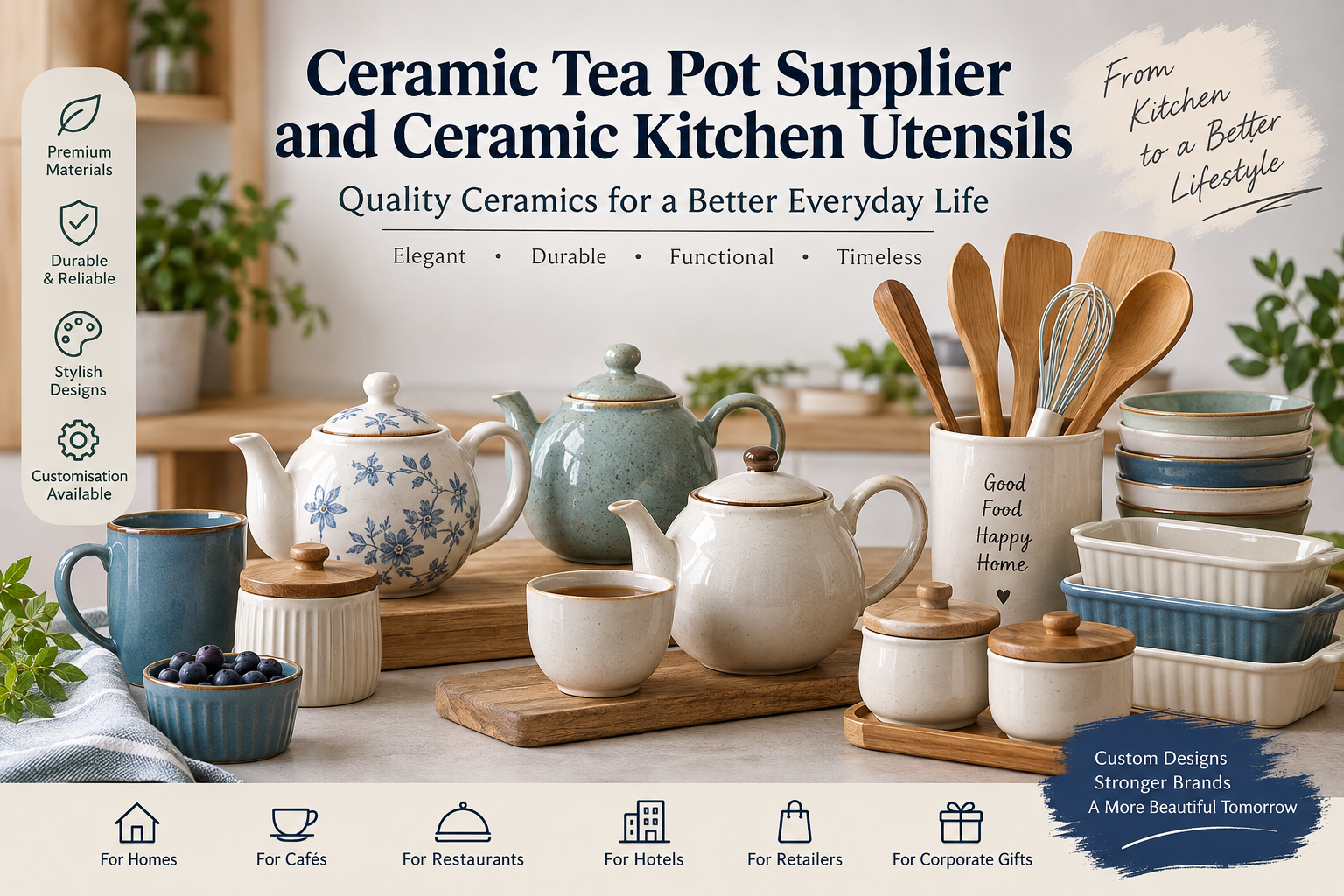
Some kitchen products are purchased purely for function. Others become part of the atmosphere of a home, café or restaurant. Ceramic tea pots and kitchen accessories comfortably belong to the second category.
A well-designed tea pot can make afternoon tea feel more inviting, while coordinated Ceramic Kitchen Utensils can transform an ordinary countertop into a thoughtfully arranged space. This balance between function, craftsmanship and visual character has helped ceramic kitchenware remain relevant even as kitchen trends continually change.
For retailers, importers, hospitality businesses and homeware brands, however, attractive designs are only one part of the buying decision. Working with a professional Ceramic Tea Pot Supplier requires understanding materials, manufacturing quality, glazing, customisation and product performance.
Ceramic Kitchenware Has Changed With Modern Lifestyles
Ceramics are traditional, but today’s products do not necessarily look traditional.
Modern ceramic collections range from understated neutral stoneware to bold colours, textured surfaces, botanical prints and reactive-glaze finishes. This flexibility allows ceramics to work in farmhouse kitchens, luxury hotels, contemporary cafés and minimalist homes alike.
Customers increasingly look for kitchen products that can remain visible rather than being stored away. A ceramic utensil holder, tea pot or storage jar can therefore serve two purposes: practical use and interior styling.
For sellers, this creates an opportunity to develop coordinated collections instead of offering unrelated kitchen products.
Why a Tea Pot Deserves More Attention Than Its Design
It is easy to choose tea ware based on appearance. Yet the real test begins when hot tea is poured.
A good tea pot should be comfortable to lift, easy to control and pleasant to use.
Several design details influence that experience:
- Overall weight
- Handle position
- Spout geometry
- Lid stability
- Capacity
- Base stability
- Wall thickness
- Surface finish
This is why selecting an experienced Ceramic Tea Pot Supplier matters. Reliable sourcing involves evaluating both aesthetics and practical performance.
The Pouring Test Can Reveal a Lot About Quality
One of the simplest ways to evaluate a tea pot is to fill it with water and use it.
Does the liquid flow smoothly? Does it drip excessively after pouring? Does the lid remain secure? Does the handle feel comfortable when the pot is full?
Balance Is Essential
A beautiful tea pot that becomes awkward when filled may disappoint customers. Handle placement and overall weight distribution should allow controlled movement.
Spout Design Influences Serving
The shape and angle of the spout influence how smoothly liquid leaves the pot.
Lid Fit Should Not Be Overlooked
The lid should sit appropriately within the body. Excessive movement can make pouring uncomfortable, particularly when serving several cups.
Simple functional testing can provide valuable information before approving a wholesale order.
Understanding What Happens Inside a Ceramic Factory
Ceramic production is a combination of material preparation, craftsmanship and controlled heating.
Clay-based raw materials are first prepared to achieve the properties required for forming. Depending on the product, manufacturing may involve moulding, casting or other ceramic-forming processes.
Products then pass through drying and firing stages.
A simplified production journey looks like this:
- Raw materials are prepared.
- The ceramic body is formed.
- Components such as handles may be attached.
- Products are carefully dried.
- Firing develops the ceramic body.
- Glaze and decoration are applied.
- Additional firing completes the surface.
- Products are inspected.
- Approved pieces are packaged.
Because ceramics respond to heat during manufacturing, controlled production is essential for maintaining dimensions, shape and finish.
Ceramic Kitchen Utensils Are Becoming Part of Interior Design
The kitchen countertop has increasingly become a display space.
Instead of keeping every accessory hidden inside drawers, homeowners often use attractive containers, jars and serving accessories as decorative elements.
Popular Ceramic Kitchen Utensils and accessories include:
- Spoon rests
- Utensil crocks
- Storage canisters
- Serving bowls
- Condiment jars
- Salt containers
- Butter dishes
- Tea accessories
- Baking dishes
- Countertop organisers
Matching products by glaze, colour or pattern can help create a more cohesive kitchen environment.
Stoneware, Porcelain or Earthenware?
Understanding ceramic materials helps buyers select the right products for their customers.
| Ceramic Material | Appearance | Common Positioning | Typical Products |
| Earthenware | Warm and traditional | Decorative/everyday | Jars and accessories |
| Stoneware | Substantial and contemporary | Everyday/premium | Tea pots and bowls |
| Porcelain | Smooth and refined | Premium | Tea ware and tableware |
| Reactive-glaze ceramic | Varied and artistic | Lifestyle/artisan | Decorative collections |
The ideal material depends on the product’s intended application rather than simply which option sounds more premium.
The Beauty and Complexity of Ceramic Glazing
Glazing is one of the reasons ceramic products can look so distinctive.
A glossy white glaze can communicate simplicity. Matte black may create a modern appearance. Speckled finishes can feel handcrafted, while reactive glazing can produce individual variations between pieces.
For buyers sourcing Ceramic Kitchen Utensils, glaze inspection should include:
- Surface consistency
- Intended colour
- Rough areas
- Pinholes
- Cracks or crazing
- Uneven application
- Unexpected marks
Where products will contact food or beverages, buyers should also confirm applicable food-contact requirements for the destination market.
A Supplier Should Be Evaluated Before a Large Order
A product catalogue is useful for discovering designs, but it does not provide a complete picture of manufacturing reliability.
Before selecting a Ceramic Tea Pot Supplier, consider asking about:
Product Samples
Samples help buyers assess actual construction rather than relying on photography.
Quality Control
Ask how products are inspected and how defective pieces are separated from acceptable production.
Manufacturing Capacity
Confirm whether production capacity aligns with your required volume and expected delivery schedule.
Custom Development
If you are creating an exclusive range, determine whether the supplier can support mould development, custom glazing, decoration and packaging.
The cheapest quotation does not automatically represent the lowest overall purchasing risk.
Customisation Can Turn Ceramics Into a Brand Experience
Private-label ceramics give businesses considerable creative flexibility.
A hotel might develop tea pots featuring subtle branding. A café could use a distinctive glaze that complements its interior. A homeware brand could launch a complete kitchen collection based around one colour palette.
Custom options may include:
- Logos
- Colours
- Patterns
- Shapes
- Capacities
- Glaze finishes
- Matching cups
- Retail boxes
- Gift packaging
- Private labels
Combining tea ware with Ceramic Kitchen Utensils can also help businesses create a recognisable family of products.
Building a Ceramic Collection Instead of Selling Individual Products
For retailers, product coordination can be commercially valuable.
Rather than selling one tea pot alone, consider creating a collection containing:
| Main Product | Coordinating Product |
| Ceramic Tea Pot | Tea Cups |
| Utensil Holder | Spoon Rest |
| Storage Jar | Condiment Jar |
| Serving Bowl | Serving Platter |
| Tea Set | Sugar Bowl |
| Baking Dish | Serving Accessories |
A consistent design language encourages customers to combine products while strengthening brand recognition.
Packaging Is the Final Stage of Product Development
Ceramic packaging should never be treated as an afterthought.
A tea pot contains several vulnerable areas, particularly its spout, handle and lid. Movement inside a carton can increase the possibility of damage during distribution.
Effective packaging may include protective inserts, individual boxes, separators, cushioning and suitable outer cartons.
Buyers should also consider retail presentation. Packaging must protect the product while communicating its value when displayed or delivered to customers.
Frequently Asked Questions
1. How do I choose a Ceramic Tea Pot Supplier?
Compare samples, manufacturing capability, product quality, customisation, quality control, packaging and communication before ordering.
2. What makes a ceramic tea pot high quality?
Good balance, secure construction, suitable glaze, comfortable handling and controlled pouring are important characteristics.
3. What are Ceramic Kitchen Utensils?
Ceramic Kitchen Utensils include practical ceramic accessories used for storage, serving, organisation and everyday kitchen activities.
4. Are ceramic tea pots available in custom colours?
Yes. Many manufacturers can develop custom colours and finishes depending on order requirements.
5. Can I add my brand logo to ceramic products?
Private-label manufacturers may offer logo printing, decals, embossing or other branding methods depending on the product.
6. What is reactive glaze?
Reactive glazing creates surface variations during firing, often giving each ceramic piece a slightly individual appearance.
7. Should I order samples before bulk purchasing?
Yes. Samples help evaluate dimensions, colour, glaze, construction and functional performance.
8. Can tea pots and Ceramic Kitchen Utensils have matching designs?
Yes. Coordinated collections can use similar colours, patterns, textures and glazing.
9. Why can ceramic colours vary between production batches?
Raw materials, glaze application and kiln conditions can contribute to natural colour variations.
10. What businesses commonly purchase ceramic products wholesale?
Retailers, cafés, hotels, restaurants, homeware brands, importers and gifting businesses commonly source ceramics in bulk.
https://newsgrow.blogspot.com/2026/08/ceramic-coaster-and-ceramic-canister.html
https://newsgrow.blogspot.com/2026/08/ceramic-butter-dish-and-ceramic-mug.html
https://newsgrow.blogspot.com/2026/08/ceramic-tea-pot-supplier-and-ceramic.html