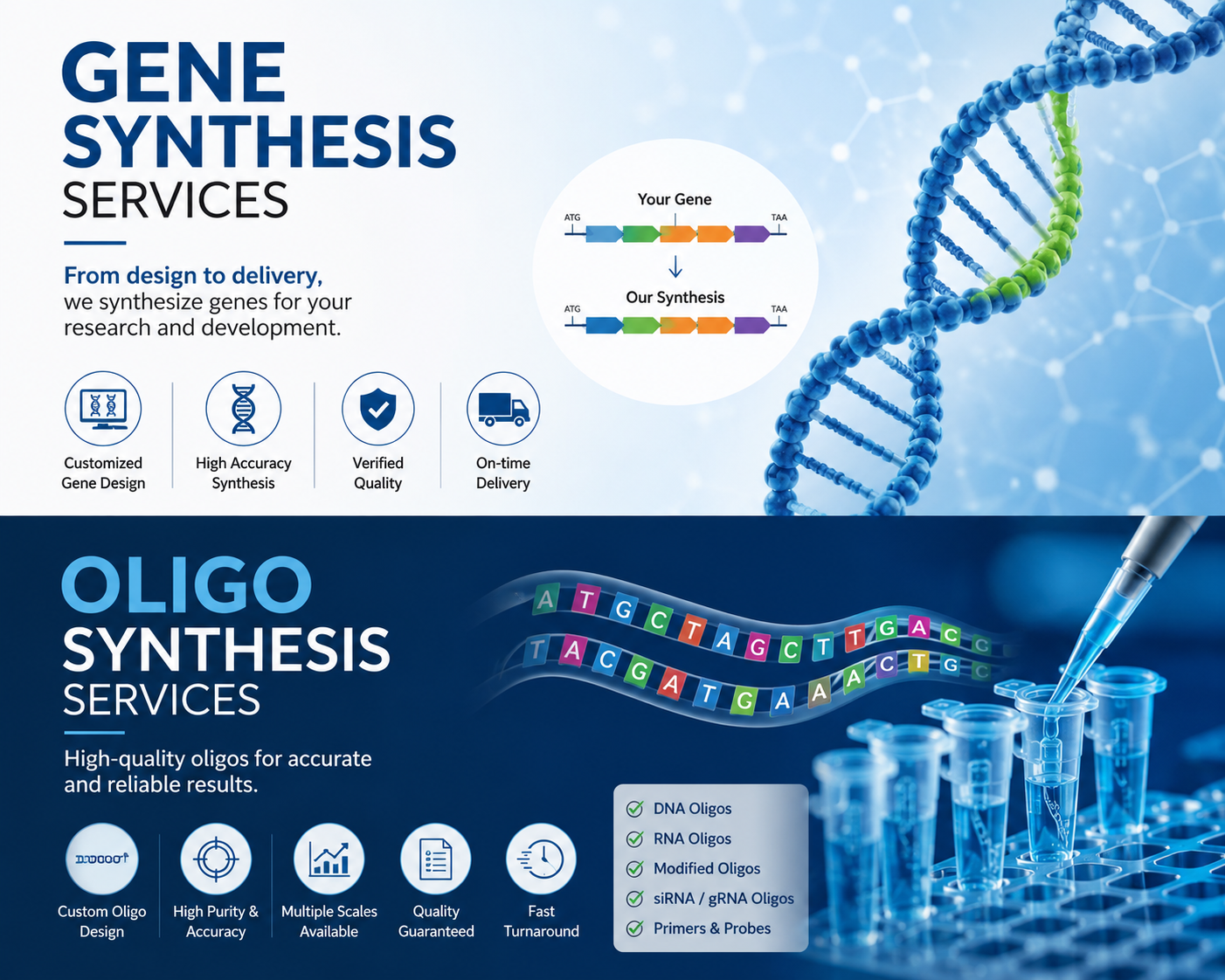
Modern life science research depends on the ability to design, create, and modify DNA with speed and precision. From developing diagnostic assays to engineering recombinant proteins, researchers need reliable access to custom genetic materials. This is where oligo synthesis services and gene synthesis services have become essential tools for laboratories, biotechnology companies, pharmaceutical developers, and academic institutions.
Although both technologies involve custom DNA production, they serve different research requirements. Understanding their applications, advantages, and differences can help scientists select the right solution for their projects.
What Are Oligo Synthesis Services?
Oligo synthesis services produce short, single-stranded DNA sequences called oligonucleotides, or oligos. These custom DNA fragments are chemically synthesized according to a researcher’s specific sequence requirements.
Oligos are widely used in molecular biology because they can be designed for highly targeted applications. Depending on the project, researchers may request standard or modified oligonucleotides with specialized purification and quality-control requirements.
Common applications include:
- PCR primers for DNA amplification
- DNA sequencing primers
- Probes for molecular diagnostics
- Gene editing experiments
- Cloning workflows
- Genotyping and mutation analysis
- Synthetic biology research
- Next-generation sequencing applications
The flexibility of custom oligo production allows researchers to obtain DNA sequences tailored to individual experiments rather than relying solely on commercially available materials.
Why Researchers Use Custom Oligonucleotides
The main benefit of custom oligo production is precision. Researchers can specify the sequence, length, modifications, and purification requirements according to their experimental goals.
For example, fluorescent labels can be incorporated into certain oligos for detection applications, while other chemical modifications may improve stability or enable specialized research workflows. High-quality synthesis and purification are particularly important when oligos are used in sensitive downstream applications.
What Are Gene Synthesis Services?
Gene synthesis services involve constructing longer DNA sequences based on a digitally designed genetic sequence. Instead of producing individual short oligos for separate steps, researchers can order a complete gene or DNA construct designed for a specific biological purpose.
Gene synthesis can support applications such as:
- Recombinant protein expression
- Synthetic biology
- Vaccine research
- Functional genomics
- Protein engineering
- Metabolic pathway development
- Genetic circuit design
- Research and development in biotechnology
A major advantage of gene synthesis is the ability to create DNA sequences that may not be readily available from natural sources. Researchers can also optimize sequences for specific experimental systems, helping improve the efficiency of downstream research.
From Digital Design to Functional DNA
The gene synthesis process typically begins with sequence design. Researchers define the desired genetic sequence and may incorporate features needed for their intended application. Depending on the project, this can include expression-related elements, sequence optimization, or specific mutations.
The final DNA construct can then be delivered in a format suitable for downstream laboratory work, such as cloning or expression studies.
Oligo Synthesis vs. Gene Synthesis: What Is the Difference?
While both services provide custom DNA, their applications and production approaches differ.
| Feature | Oligo Synthesis Services | Gene Synthesis Services |
| Typical product | Short DNA sequences | Longer custom DNA constructs |
| Common use | Primers, probes, assays | Gene expression and synthetic biology |
| Design flexibility | High for short sequences | High for complete genetic designs |
| Typical applications | PCR, sequencing, diagnostics | Protein expression, engineering |
| Starting point | Specific oligonucleotide sequence | Designed gene or DNA sequence |
| Best suited for | Targeted molecular workflows | Complex genetic projects |
Choosing between these services depends largely on the research objective. A laboratory developing a PCR assay may need custom primers, while a biotechnology team studying protein expression may require a complete synthetic gene.
How to Choose the Right DNA Synthesis Partner
Selecting a reliable provider is an important part of any molecular biology project. Quality, accuracy, turnaround time, and technical support can all influence research outcomes.
1. Evaluate Sequence Quality
High-quality DNA synthesis should be supported by appropriate quality-control processes. Researchers should consider whether the provider offers sequence verification and suitable purification options for their application.
2. Review Customization Options
Different projects require different specifications. Look for providers that can accommodate custom sequences, modifications, optimization, and various delivery formats.
3. Consider Turnaround Time
Research timelines can be demanding. Efficient production and predictable delivery schedules can help laboratories maintain project momentum.
4. Examine Technical Expertise
A provider with strong experience in synthetic biology and molecular genetics may be better equipped to support complex requirements.
5. Assess Scalability
A small academic project and a commercial biotechnology program may have very different production needs. Choosing a provider capable of scaling services can make future project expansion easier.
Key Benefits of Modern DNA Synthesis
Advances in synthetic biology have made custom DNA production increasingly accessible. Modern oligo synthesis services and gene synthesis services can help researchers reduce manual laboratory work and accelerate experimental development.
Key advantages include:
- Faster access to customized genetic materials
- Greater flexibility in sequence design
- Support for complex molecular biology workflows
- Reduced dependence on naturally available DNA templates
- Improved reproducibility between experiments
- Easier development of engineered genetic constructs
These benefits are particularly valuable in fast-moving fields where researchers need to move from experimental concepts to laboratory testing efficiently.
Applications Across Life Science Research
Custom DNA synthesis has applications across numerous scientific disciplines. In pharmaceutical research, synthetic genes can support protein development and biological studies. In diagnostics, oligos are frequently used in amplification and detection workflows.
In academic research, scientists can use custom DNA sequences to investigate gene function, study mutations, or develop new experimental models. Meanwhile, synthetic biology researchers may combine multiple designed DNA elements to explore new biological systems.
The growing adoption of these technologies reflects a broader shift toward more programmable and design-driven life science research.
FAQ: Oligo and Gene Synthesis Services
1. What are oligo synthesis services?
They are customized DNA production services used to create short oligonucleotide sequences for applications such as PCR, sequencing, and molecular detection.
2. What are gene synthesis services?
They produce longer, custom-designed DNA sequences that can be used in applications including recombinant protein research and synthetic biology.
3. Are oligo and gene synthesis the same?
No. Oligo synthesis generally focuses on shorter DNA sequences, while gene synthesis creates longer genetic constructs.
4. What are oligos commonly used for?
Oligos are commonly used as PCR primers, sequencing primers, probes, and other research tools.
5. Why is gene synthesis useful?
Gene synthesis allows researchers to obtain customized DNA sequences designed for specific experimental objectives.
6. Can genes be sequence optimized?
Depending on the provider and project requirements, gene sequences may be optimized for particular research applications or expression systems.
7. How important is DNA quality?
DNA quality is critical because impurities or sequence errors can affect downstream experiments and research reproducibility.
8. How do researchers choose between oligo and gene synthesis?
The choice depends on the project’s requirements. Short targeted applications often use oligos, while larger genetic designs may require gene synthesis.
9. Who uses custom DNA synthesis?
Academic laboratories, biotechnology companies, pharmaceutical researchers, diagnostic developers, and synthetic biology teams all use custom DNA synthesis.
10. What should researchers consider when selecting a provider?
Important factors include quality control, customization options, technical expertise, scalability, turnaround time, and customer support.
https://newsgrow.blogspot.com/2026/06/oligo-synthesis-services-accelerate.html