The plastics processing sector is witnessing a steady shift toward more efficient, flexible, and material-specific production systems. As manufacturers work with recycled polymers, advanced compounds, fillers, masterbatch, and high-performance plastics, selecting the right extrusion technology has become increasingly important.
At the center of this discussion are the twin extruder and single extruder. Both technologies have long-established positions in plastics manufacturing, but changing material requirements are making their individual strengths more significant.
Rather than replacing one another, the two systems are increasingly being selected according to specific production objectives. A manufacturer producing standard plastic pipes may prioritize stable output and straightforward operation, while a compound producer may require intensive mixing and precise ingredient distribution.
This difference is shaping how extrusion equipment is being evaluated across the industry.
Extrusion Moves Beyond Basic Plastic Shaping
Extrusion was once commonly viewed as a straightforward process of melting plastic and pushing it through a die. Modern manufacturing requirements have expanded that definition.
Today’s extrusion lines can perform several operations during a single continuous process, including:
- Feeding raw materials
- Melting polymers
- Blending different resins
- Incorporating additives
- Dispersing pigments
- Mixing mineral fillers
- Removing moisture
- Eliminating volatile substances
- Building melt pressure
The required combination of these operations often determines whether a twin extruder or single extruder is more suitable.
Single Extruder Continues to Support High-Volume Manufacturing
The single extruder remains one of the industry’s most widely recognized polymer-processing machines.
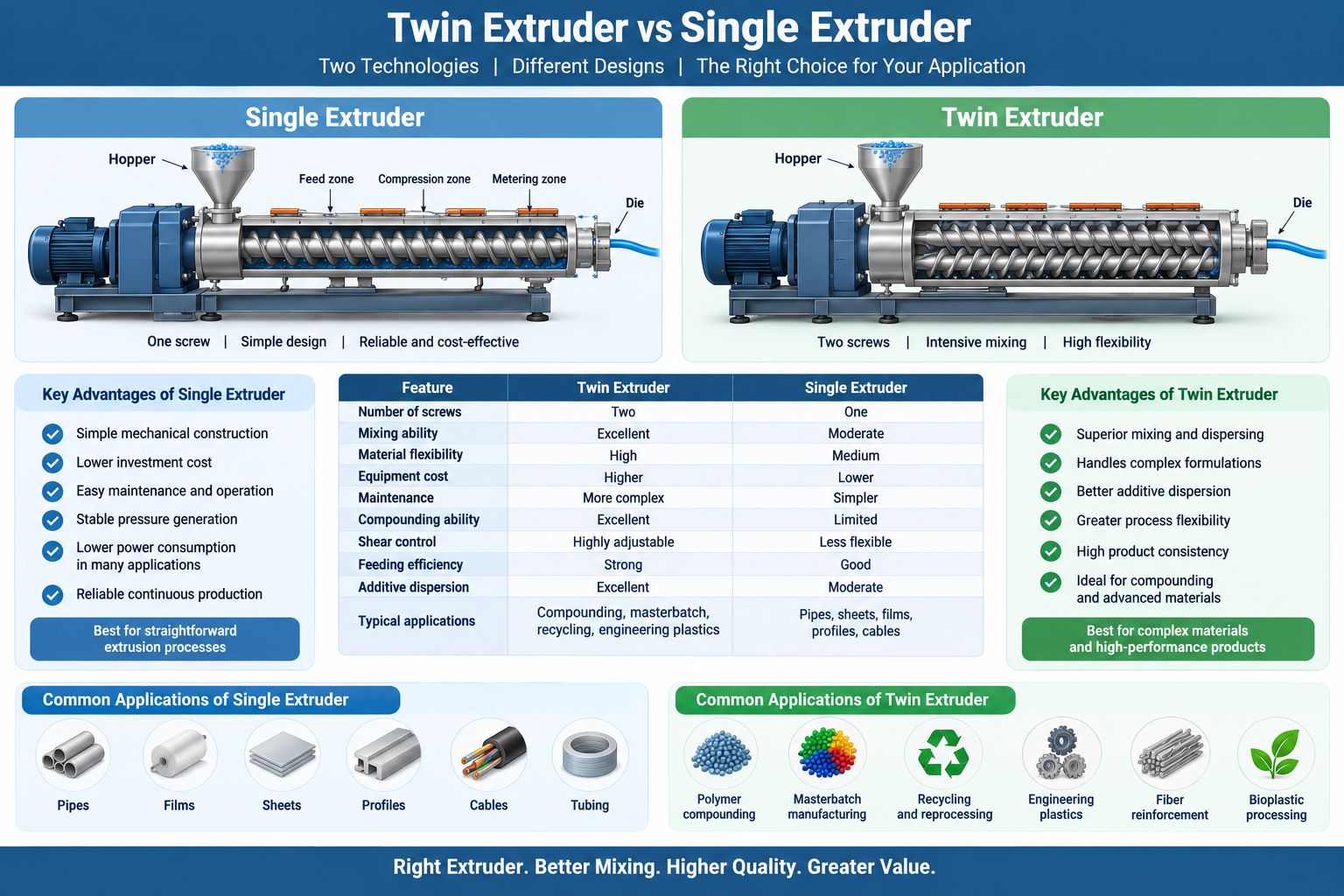
Its operating principle is relatively straightforward. One screw rotates inside a temperature-controlled barrel, transporting raw material from the feeding area toward the extrusion die.
As material moves forward, it is heated, compressed, melted, and homogenized.
For many manufacturing operations, this is exactly what is required.
The technology offers several practical benefits:
- Relatively simple construction
- Consistent material flow
- Stable melt pressure
- Straightforward operation
- Easier troubleshooting
- Lower maintenance complexity
- Competitive investment cost
These characteristics help explain why single-screw technology continues to have a strong industrial presence.
Conventional Plastic Products Remain a Major Single-Screw Market
A single extruder is particularly effective when manufacturers are processing polymers that have already been formulated.
In such situations, extensive ingredient mixing may not be necessary.
The technology is commonly used for:
- Plastic pipes
- Plastic profiles
- Plastic sheets
- Blown films
- Cast films
- Plastic tubing
- Cable insulation
- Extrusion coating
For these products, consistent melting and stable material delivery can be more important than intensive compounding capability.
Complex Polymer Formulations Increase Twin Extruder Demand
The processing challenge changes significantly when manufacturers begin combining multiple materials.
A modern polymer formulation might contain resin, pigments, mineral fillers, glass fibers, stabilizers, flame retardants, lubricants, and impact modifiers.
Simply melting these ingredients together may not produce the required material consistency.
This is where the twin extruder becomes important.
Instead of one screw, twin-screw technology uses two screws working inside the same barrel. Their interaction produces more complex material movement and stronger mixing.
Twin-Screw Processing Brings Mixing Into Focus
The ability to mix different ingredients effectively is one of the most important reasons manufacturers use a twin extruder.
Material does not simply move forward. It can repeatedly change direction locally, divide between channels, recombine, and experience controlled mechanical forces.
This helps processors manage two critical forms of mixing.
Distribution Creates Formulation Consistency
Distributive mixing ensures ingredients are spread throughout the compound.
Consider a formulation containing a small percentage of performance additive. If that additive becomes concentrated in certain areas, final material properties may vary.
Effective distribution helps create greater consistency.
Dispersion Addresses Particle Agglomeration
Some pigments and fillers can form clusters.
Dispersive mixing applies mechanical stress to these agglomerates, helping break them down and distribute smaller particles through the polymer.
This can be important for color quality, mechanical properties, surface appearance, and downstream processing.
Twin Extruder and Single Extruder Serve Different Priorities
| Industry Requirement | Twin Extruder | Single Extruder |
| Basic melting | Excellent | Excellent |
| Intensive mixing | Excellent | Moderate |
| Compounding | Highly suitable | Limited |
| Stable pressure | Good | Excellent |
| Filler processing | Highly suitable | Application-dependent |
| Equipment simplicity | Moderate | High |
| Initial cost | Generally higher | Generally lower |
| Formulation flexibility | High | Moderate |
| Maintenance complexity | Higher | Lower |
| Conventional extrusion | Suitable | Highly suitable |
The comparison demonstrates why manufacturers increasingly evaluate equipment according to application rather than simply production capacity.
Masterbatch Sector Relies on Better Dispersion
The masterbatch industry provides a clear example of why mixing performance matters.
Masterbatch contains concentrated pigments or functional additives within a polymer carrier. The concentrate is later added to another polymer during manufacturing.
Poorly dispersed pigment can create inconsistent coloration, while uneven additive distribution can influence final product performance.
The twin extruder is widely used in this sector because its screw configuration can provide the mixing intensity necessary for concentrated formulations.
Filled Polymers Add Another Processing Challenge
Mineral-filled polymers are increasingly used where manufacturers need specific performance or economic characteristics.
Common fillers include:
- Calcium carbonate
- Talc
- Silica-based materials
- Glass fibers
- Natural fibers
- Other mineral additives
High filler concentrations can alter viscosity and material flow.
Twin-screw technology can provide dedicated feeding and mixing zones to help incorporate these ingredients into the polymer.
Screw Configuration Becomes a Critical Engineering Decision
Industry attention is also moving toward screw configuration rather than simply screw quantity.
A typical single extruder screw has zones designed for feeding, compression, melting, and metering.
Many twin-screw machines provide modular configurations.
Different elements can be positioned along the screw shaft to perform specific functions.
These may include:
- Conveying elements
- Kneading blocks
- Mixing elements
- Reverse elements
- High-shear zones
This allows processors to adjust how material behaves during different stages of extrusion.
Recycling Industry Creates New Processing Requirements
The expanding use of recycled polymers is adding another dimension to extrusion equipment selection.
Recycled feedstock is not always as predictable as virgin polymer.
Depending on its source, recycled plastic may contain:
- Moisture
- Printing ink
- Residual contamination
- Mixed polymer grades
- Volatile compounds
- Variations in particle size
A single extruder can provide effective processing where recycled material is relatively clean and consistent.
More complicated recycling processes may benefit from twin-screw systems capable of greater mixing, blending, and material modification.
Degassing Technology Gains Greater Attention
Moisture and volatile compounds can create significant problems during extrusion.
If gases remain trapped inside molten polymer, manufacturers may experience bubbles, surface defects, odors, or inconsistent physical properties.
Modern extrusion systems can therefore include venting and vacuum systems.
A properly configured twin extruder can provide dedicated degassing sections where unwanted volatile components are removed before final processing.
This capability can be particularly valuable for recycled or moisture-sensitive materials.
Energy Efficiency Is Being Measured Differently
Energy costs remain an important concern for plastics manufacturers, but comparing machine motor ratings alone does not provide a complete picture.
The single extruder can deliver highly efficient operation when used for straightforward production.
Twin-screw equipment may consume more power in certain applications, but it can potentially perform several operations that would otherwise require separate processing stages.
Manufacturers are therefore increasingly interested in energy consumed per kilogram of acceptable finished material.
This measurement accounts for productivity and product quality rather than installed power alone.
Production Quality Becomes as Important as Output
Maximum kilograms per hour have traditionally been an important equipment specification.
However, high output means little if manufacturers experience excessive rejection, unstable production, or inconsistent quality.
Companies evaluating a twin extruder or single extruder increasingly consider:
- Acceptable finished output
- Material waste
- Production downtime
- Changeover time
- Energy consumption
- Maintenance frequency
- Product consistency
- Operator requirements
- Spare-part availability
- Overall production cost
These factors provide a more realistic picture of manufacturing performance.
Frequently Asked Questions
Why is a single extruder still widely used?
A single extruder offers reliable melting, stable output, relatively simple operation, and economical processing for many conventional plastic products.
Why are twin extruders used for compounding?
They provide stronger mixing and greater flexibility for incorporating fillers, pigments, fibers, modifiers, and functional additives.
Which technology is better for plastic pipes?
Single-screw extrusion is widely used for many PE and PP pipe manufacturing applications.
What is the advantage of two screws?
Two interacting screws can provide improved material conveying, distribution, dispersion, and control over complex formulations.
Are twin extruders used for masterbatch?
Yes. A twin extruder is commonly used where concentrated pigments and additives require effective dispersion.
Can single extruders process recycled material?
Yes. Suitability depends on the quality, consistency, moisture level, contamination, and processing requirements of the recycled feedstock.
Which extruder requires more maintenance?
Twin-screw equipment generally requires more specialized maintenance because it contains additional screw and gearbox components.
Does a twin extruder always consume more energy?
Not necessarily in terms of overall process efficiency. Energy should be evaluated against output, product quality, and processing operations performed.
Why is screw configuration important?
Screw configuration affects material flow, melting, shear, mixing intensity, residence time, pressure, and final processing stability.
Which machine should a manufacturer purchase?
The decision should depend on raw material, product specifications, mixing requirements, capacity, energy consumption, maintenance, and future production plans.
Read more – https://tandtlawassociates.com/twin-extruder-vs-single-extruder-deep-guide-to-extrusion-technology/