
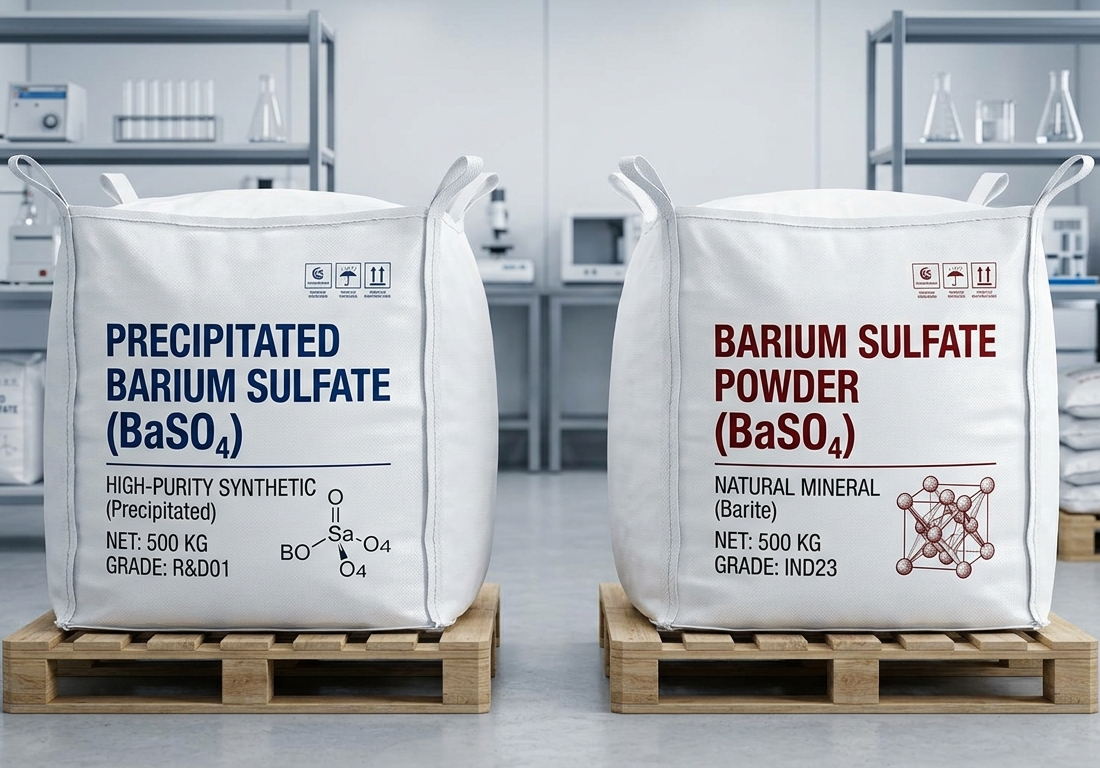
Among these materials, Precipitated Barium Sulfate and Barium Sulfate Powder are widely used across coatings, plastics, inks, rubber, ceramics, and numerous industrial formulations.
Although both materials are based on barium sulfate, their manufacturing methods, particle characteristics, purity, and intended applications can differ considerably. Understanding these distinctions helps manufacturers choose an appropriate grade for their production requirements rather than selecting an industrial filler based solely on price.
Understanding Precipitated Barium Sulfate
Precipitated Barium Sulfate is a synthetically produced form of barium sulfate developed through a controlled chemical precipitation process. This manufacturing method makes it possible to achieve relatively consistent particle characteristics, controlled purity, and predictable performance.
Its naturally white appearance, chemical stability, low solubility, and useful density make it suitable for formulations where product appearance and physical properties are important.
Manufacturers commonly consider precipitated grades when developing products such as:
- Industrial paints and protective coatings
- Powder coatings
- Printing inks
- Engineering plastics
- Rubber compounds
- Pigment preparations
- Adhesive and sealant formulations
- Speciality masterbatches
The performance of the material ultimately depends on parameters such as particle size distribution, surface properties, purity, moisture level, and compatibility with the surrounding formulation.
What Is Barium Sulfate Powder?
Barium Sulfate Powder is a general term referring to powdered barium sulfate supplied for industrial applications. Depending on the supplier and production process, it may include processed natural barite or synthetically manufactured material.
Industrial users often choose the powder because it can provide a combination of chemical inertness, density, whiteness, filling capability, and dimensional stability.
In many formulations, it is not simply used to increase volume. Selecting an appropriate Barium Sulfate Powder can influence processing behaviour, surface finish, mechanical characteristics, coating performance, and overall production economics.
Important Material Characteristics
When evaluating a barium sulfate grade, manufacturers should examine more than the product name. Important specifications can include:
- Particle size and distribution
- Barium sulfate content
- Whiteness and brightness
- Moisture percentage
- Oil absorption
- Specific gravity
- Residue or coarse particle content
- Surface treatment
- Chemical purity
- Batch-to-batch consistency
These factors determine how effectively the powder works within a specific industrial system.
Why Particle Control Matters
Particle characteristics can significantly influence dispersion, surface smoothness and processing behaviour. A carefully controlled fine powder may be preferred in applications requiring smooth surfaces and consistent formulation performance.
However, finer is not automatically better. Manufacturers should select particle characteristics according to the resin, pigment system, processing equipment and final product requirements.
Precipitated Barium Sulfate vs Standard Barium Sulfate Powder
Despite their chemical similarity, the two materials may serve different manufacturing priorities.
| Parameter | Precipitated Barium Sulfate | General Barium Sulfate Powder |
| Production | Controlled synthetic precipitation | Natural processing or synthetic production |
| Particle Consistency | Usually highly controlled | Depends on grade and manufacturing process |
| Purity | Often selected for higher-purity applications | Varies according to source and grade |
| Appearance | Typically clean and white | Can vary by product |
| Common Use | Higher-performance formulations | General and specialised industrial applications |
| Selection Basis | Dispersion, finish, consistency | Density, filler performance, economics |
Neither material should automatically be considered superior. The right choice depends on the application and measurable technical requirements.
Role in Paints and Coatings
Paint and coating manufacturers are major users of Precipitated Barium Sulfate because mineral extenders can contribute to formulation balance while supporting desirable surface properties.
A carefully selected grade may help manufacturers achieve good dispersion, surface uniformity, film consistency, and pigment distribution.
Applications include automotive coatings, industrial paints, powder coatings, primers, protective finishes and decorative systems.
For premium coating applications, formulators should evaluate how the material interacts with binders, pigments and other additives instead of considering loading level independently.
Application in Plastics and Masterbatches
Barium Sulfate Powder is also used in thermoplastic and masterbatch manufacturing where manufacturers require mineral loading, density modification, dimensional performance or consistent processing characteristics.
Typical applications can include:
- Polypropylene products
- Polyethylene compounds
- Engineering plastics
- Colour masterbatches
- Functional masterbatches
- Injection-moulded components
- Extruded plastic products
Uniform dispersion is particularly important because excessive agglomeration can influence surface quality and processing stability.
Use in Printing Ink Manufacturing
Printing ink formulations require careful control over pigment dispersion, rheology and finished appearance. Fine Precipitated Barium Sulfate may function as an inorganic extender in selected ink systems.
Its suitability depends on particle properties, binder compatibility and the printing technology being used.
Rather than replacing key pigments indiscriminately, formulators should test the material within the complete ink formulation to determine its influence on colour development, viscosity and print characteristics.
Applications in Rubber Manufacturing
Rubber manufacturers may incorporate Barium Sulfate Powder into compounds where mineral filling, density and processing characteristics are required.
Potential applications include industrial rubber components, technical mouldings, sheets, seals and specialised compounds.
The correct loading should be established through formulation trials because filler concentration can influence hardness, flexibility, processing behaviour and other mechanical characteristics.
Benefits of Choosing a Suitable Grade
A properly specified barium sulfate material can provide manufacturers with several practical advantages.
- Consistent mineral filling
- Good chemical stability
- Useful density characteristics
- Controlled particle options
- Compatibility with numerous industrial systems
- Good whiteness in suitable grades
- Potential improvement in surface characteristics
- Greater formulation flexibility
However, benefits vary according to grade and application. Technical data and production trials should always guide purchasing decisions.
How to Select a Reliable Barium Sulfate Supplier
Purchasing decisions should consider technical reliability as well as price. A low-cost product that creates inconsistent dispersion or production variation may ultimately increase manufacturing costs.
Before selecting a supplier, request:
- Technical data sheets
- Typical particle-size specifications
- Chemical analysis information
- Safety documentation
- Packaging information
- Samples for laboratory testing
- Batch consistency information
- Recommended storage conditions
Manufacturers requiring large quantities should conduct both laboratory evaluation and production-scale trials before approving a new material.
Frequently Asked Questions
1. What is Precipitated Barium Sulfate?
Precipitated Barium Sulfate is synthetically manufactured barium sulfate produced through a controlled precipitation process, allowing manufacturers to achieve defined purity and particle characteristics.
2. Where is Barium Sulfate Powder commonly used?
It is commonly used in coatings, plastics, rubber, printing inks, masterbatches, adhesives, ceramics and other industrial formulations.
3. Is precipitated barium sulfate the same as barite?
No. Barite is a naturally occurring mineral containing barium sulfate, while precipitated material is manufactured chemically under controlled conditions.
4. Why is particle size important?
Particle size influences dispersion, surface characteristics, processing behaviour and compatibility with other formulation ingredients.
5. Can it be used in powder coatings?
Yes. Suitable precipitated grades are used in various powder-coating formulations, subject to compatibility and performance testing.
6. Is Barium Sulfate Powder soluble in water?
Barium sulfate has very low water solubility, one reason it is useful in many industrial formulations.
7. Can it be used as a filler in plastics?
Yes. Selected grades are used as functional mineral fillers in plastic compounds and masterbatches.
8. How should manufacturers choose a grade?
Selection should consider purity, particle size, whiteness, moisture, density, surface properties, processing requirements and final product performance.
9. Does every application require precipitated material?
No. Standard industrial barium sulfate may be suitable for many applications. Higher-specification applications may benefit from carefully controlled precipitated grades.
10. Should manufacturers request samples before bulk purchasing?
Yes. Laboratory and production testing help confirm whether the material performs properly with existing raw materials and equipment.