
While chemical purity remains important, manufacturers are increasingly recognising that powder dispersion, particle consistency, and formulation stability can significantly influence finished-product quality.
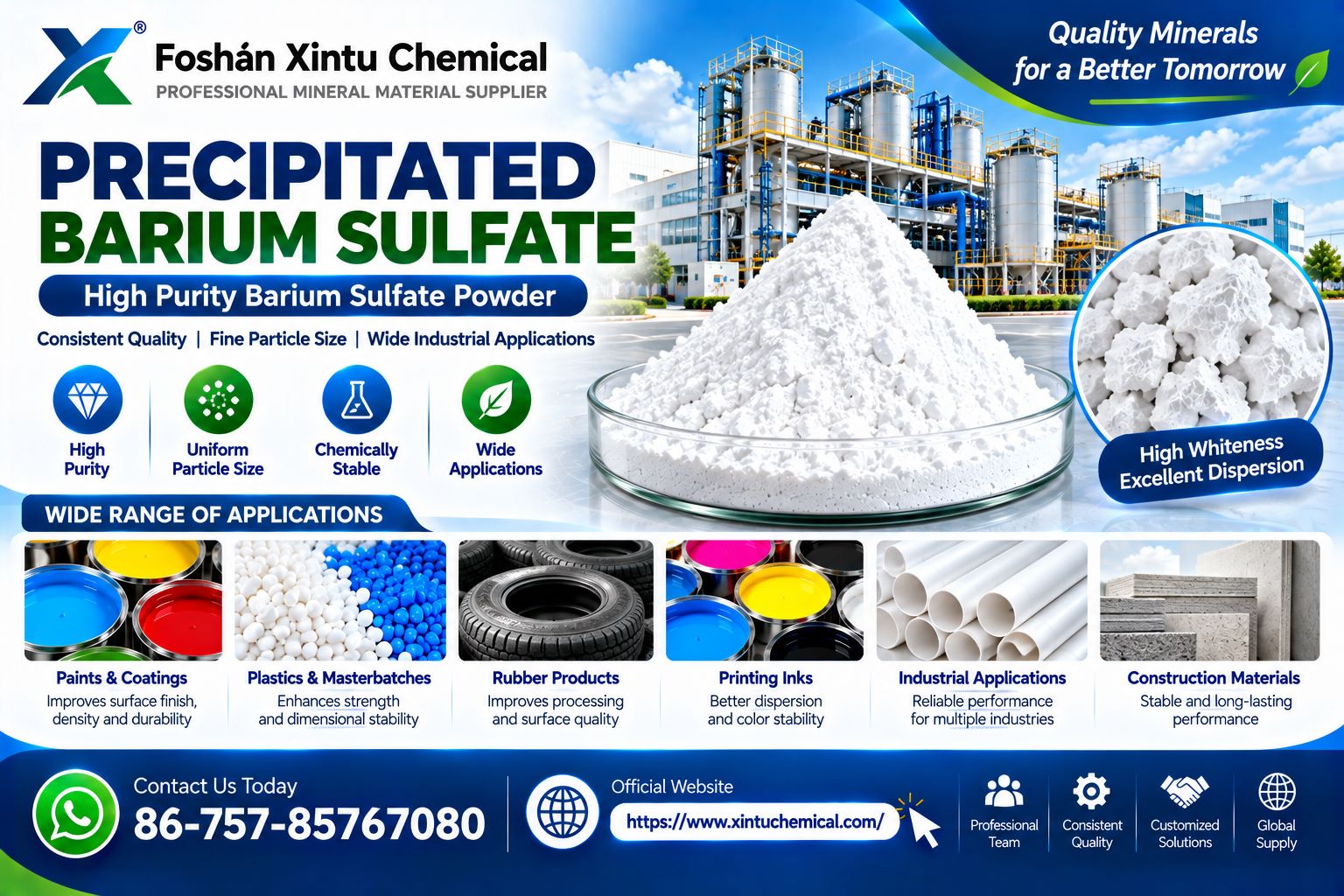
Precipitated Barium Sulfate is a synthetic inorganic material used in selected paints, coatings, plastics, printing inks, and specialty industrial formulations. Its controlled particle characteristics and chemical stability make it suitable for applications requiring carefully selected functional fillers.
Meanwhile, Barium Sulfate Powder remains an important material category for manufacturers seeking to balance performance requirements with processing efficiency.
For industrial formulators, the critical question is not simply whether a powder meets its technical specifications, but whether it performs consistently throughout the entire manufacturing process.
Why Powder Dispersion Is Becoming a Manufacturing Priority
Industrial formulations frequently contain multiple ingredients with different physical and chemical characteristics.
Achieving a consistent product requires these ingredients to be distributed appropriately within the formulation.
Poor powder dispersion may contribute to visible defects, inconsistent viscosity, settling, or changes in surface appearance.
These problems can create additional processing requirements and increase manufacturing costs.
This highlights the importance of evaluating mineral powders under realistic production conditions.
Understanding Precipitated Barium Sulfate
Precipitated Barium Sulfate is a chemically manufactured form of barium sulfate, represented by the molecular formula BaSO₄.
Unlike naturally processed barite powder, precipitated grades are produced through controlled chemical reactions that form solid barium sulfate particles.
Manufacturing and finishing conditions can influence particle size, purity, and other material characteristics.
The resulting powder may be suitable for industrial applications requiring selected physical properties.
Important Characteristics
- Chemical Stability: Supports compatibility with many suitable industrial formulations.
- High Density: Useful in applications requiring increased material density.
- Low Water Solubility: Contributes to stability under appropriate conditions.
- Particle Uniformity: Can support predictable processing characteristics.
- Whiteness: Relevant to selected coating and plastic applications.
- Grade Flexibility: Different specifications may support different manufacturing needs.
Actual performance varies according to the product grade and formulation.
Why Dispersion Quality Affects Finished Products
Dispersion involves distributing powder particles throughout a liquid or other processing medium.
In coating formulations, inadequate dispersion may result in agglomerates, uneven appearance, or undesirable surface characteristics.
In printing inks, poor distribution can affect consistency and processing performance.
Effective dispersion depends on several factors, including particle size, surface characteristics, formulation ingredients, and mixing conditions.
However, additional mixing does not always resolve dispersion problems.
Excessive processing can increase energy consumption without delivering proportional improvements.
Manufacturers should establish suitable dispersion procedures through application-specific testing.
Understanding Particle Agglomeration
Fine industrial powders may contain particles that form larger clusters, commonly called agglomerates.
These clusters can influence how effectively the material distributes during manufacturing.
Agglomeration behaviour depends on particle interactions, powder characteristics, and processing conditions.
For some applications, poorly dispersed agglomerates may produce unwanted surface defects or inconsistent mechanical properties.
This encourages formulators to examine both powder specifications and practical processing results.
How Barium Sulfate Powder Influences Formulation Stability
Barium Sulfate Powder can affect formulation behaviour through its density, particle characteristics, and interactions with other ingredients.
In liquid formulations, the high density of barium sulfate makes sedimentation an important consideration.
Depending on particle size, viscosity, and formulation design, particles may gradually settle during storage.
Suitable dispersants, rheology modifiers, and processing methods can help manage stability, but their effectiveness must be verified experimentally.
The goal is to maintain acceptable product characteristics throughout the intended storage and handling conditions.
A stable appearance alone does not necessarily confirm that every performance requirement has been satisfied.
Important Tests for Evaluating Powder Performance
Manufacturers should select analytical methods according to their intended product applications.
| Testing Parameter | Manufacturing Importance |
| Particle Size Distribution | Helps assess powder characteristics and dispersion requirements |
| Chemical Purity | Confirms relevant composition specifications |
| Whiteness | Supports appearance evaluation where required |
| Moisture Content | Helps identify potential handling or processing concerns |
| Dispersion Evaluation | Examines behaviour within the intended formulation |
| Sedimentation Testing | Assesses settling tendencies in suitable liquid systems |
| Viscosity Measurement | Supports evaluation of formulation flow behaviour |
These tests provide different information and should not be treated as interchangeable.
Applications in High-Quality Coating Formulations
Paint and coating manufacturers use suitable mineral fillers to influence physical properties, processing behaviour, and overall formulation performance.
Precipitated barium sulfate may contribute to surface appearance, filling characteristics, and selected mechanical properties.
However, these effects depend on the complete formulation.
For example, binder selection, pigment concentration, and dispersing additives can influence how the filler performs.
Manufacturers developing premium coatings should therefore evaluate powder compatibility rather than assuming that a higher-purity grade will automatically improve every property.
Representative coating trials remain essential.
Supporting Consistency in Plastic Compounding
Plastic manufacturers may incorporate barium sulfate into selected polymers to adjust density, appearance, or other material characteristics.
During compounding, the distribution of filler particles can influence the consistency of finished plastic materials.
Poor dispersion may contribute to local variations in product properties.
Processing conditions, filler loading, polymer characteristics, and suitable additive selection all influence the outcome.
Manufacturers should evaluate the powder’s compatibility with the intended polymer before approving commercial production.
Why Batch Consistency Matters to Industrial Buyers
Industrial production depends on obtaining raw materials that perform predictably.
Variations between powder batches may affect processing behaviour even when the products share the same commercial description.
For this reason, buyers should establish agreed acceptance criteria with suppliers.
Important purchasing considerations include:
- Reviewing particle size and purity specifications.
- Confirming relevant quality documentation.
- Evaluating representative powder samples.
- Checking packaging and storage requirements.
- Establishing procedures for reporting quality concerns.
- Comparing material performance through suitable production trials.
Consistent communication between purchasing, quality, and production teams can improve raw material management.
Storage and Handling Considerations
Industrial powders should be stored according to supplier recommendations and applicable workplace requirements.
Poor storage conditions may introduce moisture, contamination, or packaging damage.
These factors can influence material handling and manufacturing suitability.
Appropriate dust-control systems and protective measures should also be considered during powder transfer and processing.
Manufacturers should consult the relevant safety data sheet before handling industrial-grade materials.
Careful storage practices support product integrity and reduce avoidable manufacturing difficulties.
Frequently Asked Questions (FAQs)
1. What is Precipitated Barium Sulfate?
It is a chemically manufactured form of barium sulfate used as a functional inorganic filler in selected industrial formulations.
2. Why is dispersion important for Barium Sulfate Powder?
Proper dispersion helps distribute powder particles throughout a formulation and can reduce undesirable processing or surface defects.
3. Can precipitated barium sulfate improve coating quality?
Suitable grades can support selected coating characteristics, but results depend on particle properties, additives, processing conditions, and formulation design.
4. Does barium sulfate powder settle in liquid formulations?
It can settle because of its high density. Sedimentation depends on particle characteristics, formulation viscosity, and other factors.
5. How should manufacturers evaluate barium sulfate suppliers?
They should review technical specifications, batch consistency, analytical documentation, sample performance, and suitability for their intended applications.
Media Contact
Department: Specialty Mineral Fillers and Industrial Chemical Enquiries
Contact: +86-757-85767080
Email: sales@xintuchemical.com
Official Website: https://www.xintuchemical.com/
Read More:-