
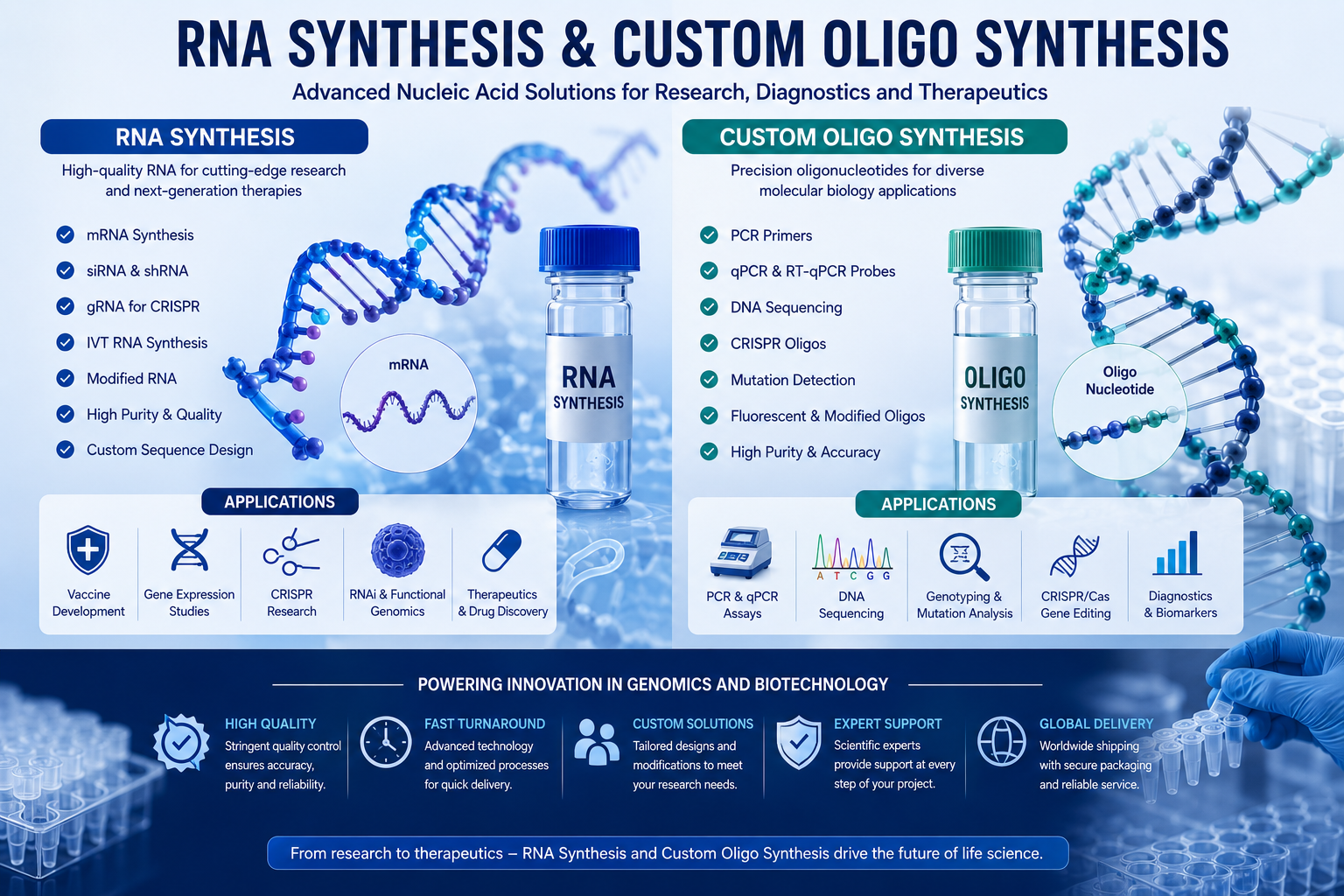
Modern life-science research is becoming increasingly precise. From developing next-generation vaccines and RNA therapeutics to studying gene expression and creating advanced diagnostic tools, researchers need reliable access to high-quality nucleic acids. Two technologies at the center of this transformation are RNA synthesis and custom oligo synthesis.
Although RNA molecules and synthetic oligonucleotides serve different purposes, they often work together in research and development workflows. Researchers can use custom-designed oligos for gene regulation, sequencing, cloning, and detection, while synthesized RNA can support protein expression, functional studies, therapeutic development, and vaccine research.
The growing demand for personalized molecular tools has also increased the importance of specialized synthesis providers. By combining sequence design, chemical synthesis, purification, quality control, and analytical characterization, modern synthesis services can help researchers move more efficiently from an experimental concept to a functional biological application.
This article explores how RNA and oligonucleotide synthesis work, their major applications, key differences, and the factors researchers should consider when selecting a synthesis partner.
What Is RNA Synthesis?
RNA synthesis is the process of producing RNA molecules with a defined nucleotide sequence for research, diagnostic, therapeutic, or biotechnology applications.
RNA, or ribonucleic acid, plays a central role in biology. It helps transfer genetic information, regulate gene activity, and participate in cellular processes. Some RNA molecules also have direct therapeutic potential.
Depending on the research objective, synthesized RNA may include:
- Messenger RNA (mRNA)
- Small interfering RNA (siRNA)
- MicroRNA-related molecules
- Guide RNA
- Long non-coding RNA
- Self-amplifying RNA
- Other specialized RNA constructs
The ability to produce RNA with a specific sequence allows researchers to investigate biological pathways and develop molecular tools tailored to particular applications.
How Does RNA Synthesis Work?
The exact production workflow depends on the type of RNA being created and its intended use. In many research settings, DNA templates are first designed to encode the desired RNA sequence. RNA can then be produced through enzymatic transcription using an appropriate polymerase system.
A typical workflow may include:
- Sequence design – The desired RNA sequence is planned according to the intended application.
- Template preparation – A DNA template containing the target sequence is generated.
- In vitro transcription – The DNA template is used to produce RNA.
- RNA purification – Unwanted components and impurities are removed.
- Quality assessment – The RNA is evaluated for identity, integrity, purity, and concentration.
- Final formulation – The RNA may be prepared for storage or downstream applications.
For more complex projects, additional steps may be required to improve RNA stability, translation efficiency, or biological performance.
Understanding Custom Oligo Synthesis
Custom oligo synthesis refers to the production of synthetic oligonucleotides according to a researcher’s specified nucleotide sequence.
Oligonucleotides are short DNA or RNA molecules that can be designed for highly specific biological functions. Because their sequence can be customized, they are widely used in molecular biology, genetic research, diagnostics, biotechnology, and pharmaceutical development.
Custom oligos may be designed as:
- DNA oligonucleotides
- RNA oligonucleotides
- Primers
- Probes
- siRNA-related sequences
- Antisense oligonucleotides
- Gene-editing components
- Sequencing adapters
- Specialized modified oligos
The ability to request a specific sequence makes custom oligo synthesis a practical solution when commercially available molecules do not meet the requirements of a particular experiment.
Why RNA Synthesis and Custom Oligo Synthesis Matter
The growing importance of RNA synthesis and custom oligo synthesis reflects a broader shift toward precision biology.
Instead of relying exclusively on naturally occurring biological materials, researchers can now design molecular tools according to their exact scientific objectives.
These technologies are supporting innovation in areas such as:
- Gene expression research
- Molecular diagnostics
- RNA therapeutics
- Vaccine development
- Genomics
- Cancer research
- Gene regulation
- CRISPR research
- Next-generation sequencing
- Drug discovery
For researchers, the major advantage is control. A specific nucleotide sequence can be designed, produced, purified, and tested for use in a targeted experiment.
Major Applications of RNA Synthesis
RNA technology has expanded rapidly across both research and commercial biotechnology.
1. mRNA Research and Therapeutics
Messenger RNA carries genetic information that cells can use to produce proteins.
Researchers use synthesized mRNA to investigate protein expression and explore potential applications in therapeutic development.
mRNA-based approaches have attracted significant attention in areas including:
- Vaccines
- Protein replacement
- Cancer immunotherapy research
- Regenerative medicine
- Rare disease research
The ability to rapidly design and produce RNA sequences has made mRNA technology an important platform for modern biotechnology.
2. RNA Interference Research
Small interfering RNA, commonly known as siRNA, can be used to investigate gene function by reducing the expression of specific genes.
Researchers can design RNA sequences targeting particular transcripts and use them to study biological pathways.
This technology is valuable for:
- Gene function studies
- Target validation
- Drug discovery
- Disease mechanism research
3. Gene Editing
RNA molecules play important roles in several gene-editing systems.
For example, guide RNA can help direct genome-editing machinery toward a specific genetic sequence.
Custom-designed RNA components can therefore support research involving gene editing and functional genomics.
4. Molecular Diagnostics
Synthetic RNA and oligonucleotides are widely used in diagnostic assay development.
They can serve as:
- Detection probes
- Positive controls
- Reference materials
- Amplification components
- Assay standards
The ability to design sequences that recognize specific genetic targets makes nucleic acid synthesis valuable in diagnostic research.
Applications of Custom Oligo Synthesis
Custom oligonucleotides are among the most versatile tools in molecular biology.
PCR Primers
PCR primers are short DNA sequences designed to amplify specific regions of genetic material.
Researchers can order primers based on their exact target sequence, making custom oligo synthesis essential for PCR-based experiments.
Hybridization Probes
Oligonucleotide probes can be designed to recognize specific nucleic acid sequences.
They are commonly used in molecular detection and diagnostic workflows.
Sequencing
Custom oligos can support sequencing applications by acting as primers, adapters, or other sequence-specific components.
Gene Regulation
Antisense oligonucleotides and other synthetic nucleic acids can be designed to investigate or influence gene expression.
Gene Editing
Specialized oligonucleotides can support certain genome-editing and gene-engineering workflows.
The exact design depends on the editing technology and experimental objective.
RNA Synthesis vs. Custom Oligo Synthesis
While both technologies involve nucleic acids, they are not interchangeable.
| Feature | RNA Synthesis | Custom Oligo Synthesis |
| Primary material | RNA molecules | Short DNA or RNA sequences |
| Common applications | mRNA, RNA research, therapeutics | Primers, probes, gene regulation |
| Production approach | Often enzymatic transcription | Typically chemical synthesis |
| Molecular size | Can range from short to long RNA | Usually shorter sequences |
| Main advantage | Produces functional RNA molecules | Highly flexible sequence customization |
| Typical uses | Protein expression, RNA biology | PCR, sequencing, diagnostics |
| Modifications | May include specialized RNA features | Can include chemical modifications |
The right choice depends on the biological question and the intended application.
How to Choose the Right Synthesis Service
Selecting a synthesis provider involves more than comparing product catalogs. Researchers should evaluate the provider’s ability to meet technical and quality requirements.
Consider Sequence Requirements
The first consideration is the sequence itself.
Researchers should determine:
- DNA or RNA
- Required sequence length
- Quantity needed
- Purity level
- Intended application
- Required modifications
Understanding these factors before ordering can help prevent delays and unnecessary costs.
Evaluate Purification Options
Different applications require different levels of purity.
Common purification approaches may include:
- Desalting
- Cartridge purification
- HPLC
- PAGE
For routine applications, standard purification may be sufficient. More demanding experiments may require higher-purity products.
Review Quality Control
A reliable synthesis provider should have appropriate quality-control processes.
Depending on the product, quality assessment may include analysis of:
- Identity
- Purity
- Concentration
- Integrity
- Molecular weight
Quality control is particularly important when synthetic nucleic acids are being used in sensitive research or advanced development programs.
Consider Modifications
Some applications require chemically modified oligonucleotides or specially designed RNA molecules.
Possible modifications can be used to alter characteristics such as stability, detection, or functionality.
Researchers should confirm that their selected provider can support the modifications required for their project.
The Role of Quality in RNA and Oligo Manufacturing
Quality is one of the most important considerations in nucleic acid synthesis.
A sequence that is technically correct but contains significant impurities may affect experimental outcomes.
For this reason, researchers should consider a provider’s:
- Manufacturing capabilities
- Quality-control procedures
- Purification technologies
- Analytical methods
- Documentation
- Technical support
- Production scalability
For research teams working on demanding projects, reliable quality can be just as important as speed and price.
Challenges in RNA Synthesis and Oligo Production
Despite rapid technological progress, nucleic acid synthesis can involve several challenges.
RNA Stability
RNA is generally more susceptible to degradation than DNA. Careful handling, purification, storage, and formulation are therefore important.
Sequence Complexity
Certain sequences may be difficult to synthesize or produce efficiently.
Secondary structures, repetitive regions, and unusual sequence characteristics can affect synthesis and downstream performance.
Purity Requirements
Different experiments require different purity levels. Selecting an inappropriate purification method may affect results.
Scale-Up
Producing a small amount of material for research is different from manufacturing larger quantities.
Organizations developing commercial or clinical applications may require a provider with scalable production capabilities.
Best Practices for Ordering Custom Nucleic Acids
Researchers can improve their experience with synthesis services by preparing carefully before placing an order.
A Practical Checklist
- Define the intended application.
- Confirm the exact sequence.
- Determine whether DNA or RNA is required.
- Select the appropriate synthesis scale.
- Identify required purification levels.
- Specify any chemical modifications.
- Confirm quality-control requirements.
- Review storage and handling recommendations.
- Consider delivery timelines.
- Ensure the provider offers appropriate technical support.
Clear specifications can reduce errors and help ensure that the final product is suitable for its intended use.
The Future of RNA Synthesis and Custom Oligo Synthesis
The future of nucleic acid technology is closely connected to the growth of precision medicine and advanced molecular biology.
As researchers gain a better understanding of genetics and disease mechanisms, the demand for sequence-specific biological tools is expected to continue.
Several areas are likely to influence future development:
- AI-assisted sequence design
- RNA-based therapeutics
- Personalized medicine
- Advanced gene editing
- Synthetic biology
- Next-generation diagnostics
- Precision oncology
- High-throughput screening
As these fields develop, RNA synthesis and custom oligo synthesis will continue to provide researchers with the molecular building blocks needed to explore new biological possibilities.
Frequently Asked Questions
1. What is RNA synthesis?
RNA synthesis is the process of producing RNA molecules with a specific nucleotide sequence for research, diagnostic, therapeutic, or biotechnology applications.
2. What is custom oligo synthesis?
Custom oligo synthesis is the production of short DNA or RNA molecules based on a sequence specified by the researcher.
3. What is the difference between RNA and oligonucleotides?
RNA is a broad class of biological molecules, while an oligonucleotide generally refers to a relatively short nucleic acid sequence. Synthetic RNA can be produced as an oligonucleotide or as a longer RNA molecule.
4. What are custom oligos used for?
Custom oligos are commonly used for PCR, sequencing, molecular diagnostics, gene regulation, hybridization assays, and various molecular biology applications.
5. What are the major applications of synthesized RNA?
Synthesized RNA can support mRNA research, RNA interference studies, gene-editing research, vaccine development, diagnostics, and therapeutic development.
6. How are custom oligonucleotides produced?
Many oligonucleotides are produced through automated chemical synthesis, followed by purification and quality-control analysis.
7. How is RNA produced for research?
Depending on the RNA type, it may be produced through methods such as in vitro transcription or chemical synthesis.
8. Why is purification important?
Purification helps remove unwanted synthesis byproducts and impurities that could interfere with downstream experiments.
9. Can RNA be chemically modified?
Yes. Depending on the application, RNA may incorporate specific modifications designed to influence stability, functionality, or other properties.
10. How do I select a nucleic acid synthesis provider?
Consider the provider’s synthesis capabilities, sequence options, purification methods, quality-control standards, modifications, scalability, technical support, and delivery requirements.
https://newsgrow.blogspot.com/2026/06/rna-synthesis-and-custom-oligo_0865989415.html