
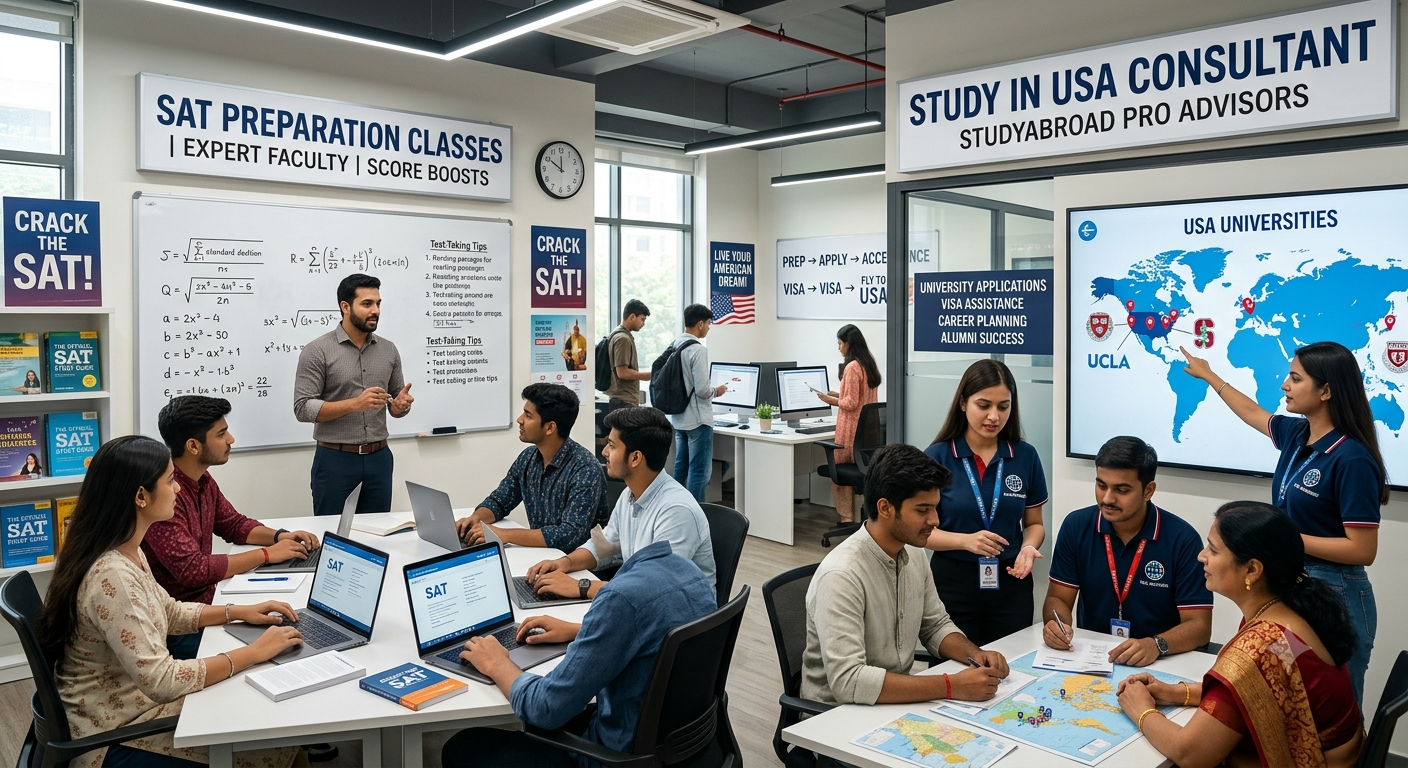
Studying in the United States is a goal for thousands of ambitious students who want access to globally recognized universities, innovative academic programs, and diverse career opportunities. However, getting admission to a U.S. university requires more than strong academic performance. Students often need to understand standardized testing, university selection, application requirements, essays, recommendation letters, financial planning, and visa procedures.
This is where professional SAT Preparation Classes and a reliable Study in USA Consultant can make the journey more organized and manageable. While SAT preparation focuses on strengthening academic and test-taking skills, an experienced education consultant helps students navigate the broader U.S. admission process.
Understanding the SAT and Its Role in U.S. Admissions
The SAT is a standardized college admission test designed to assess skills relevant to university-level study. Its primary areas include Reading and Writing and Math. Depending on the university, program, and applicant profile, SAT scores may be considered alongside grades, extracurricular activities, essays, recommendations, and other achievements.
It is important to understand that the SAT is only one part of a student’s overall application. Some universities have test-optional or test-flexible policies, while others may consider scores when evaluating applicants for specific programs or scholarships.
Therefore, students should research each university’s current testing policy before deciding whether to take the exam.
Why Start SAT Preparation Early?
Effective preparation is not simply about memorizing formulas or answering hundreds of practice questions. Students need time to identify weaknesses, improve foundational concepts, develop exam strategies, and become comfortable with timed practice.
Professional SAT Preparation Classes can help students with:
- Understanding the SAT structure and question patterns
- Strengthening mathematics fundamentals
- Improving reading comprehension and vocabulary in context
- Developing grammar and writing skills
- Learning time-management techniques
- Reviewing practice-test performance
- Identifying recurring mistakes
- Building confidence through structured preparation
A diagnostic test at the beginning can help establish a realistic starting point. Students can then create a preparation plan based on their target universities and current performance.
What Makes Effective SAT Preparation Classes Different?
Not every student learns at the same pace or in the same way. A strong SAT coaching program should therefore combine structured teaching with personalized feedback.
Key Features to Look For
1. Diagnostic Assessment
A baseline assessment helps determine a student’s strengths and weaknesses. Instead of following a generic study schedule, students can focus on the areas where improvement is most valuable.
2. Experienced Instructors
Qualified instructors should understand the SAT format and be capable of explaining difficult concepts in simple, practical ways. They should also teach students how to analyze questions rather than rely exclusively on memorization.
3. Practice Tests and Performance Tracking
Regular mock exams provide an opportunity to measure progress. A useful program should analyze incorrect answers and identify patterns in mistakes.
4. Personalized Study Plans
A student preparing for an exam six months away may require a different strategy from someone with only eight weeks remaining. Personalized scheduling can make preparation more efficient.
5. Digital and Adaptive Learning Resources
Online practice tools, question banks, video lessons, and performance analytics can complement classroom instruction and allow students to revise at their convenience.
SAT Preparation: Self-Study vs Coaching
Students often wonder whether they should prepare independently or join formal coaching. Both approaches can work, depending on learning style, discipline, available time, and academic foundation.
| Factor | Self-Study | SAT Preparation Classes |
| Flexibility | Very high | Structured schedule |
| Personal guidance | Limited | Instructor support |
| Accountability | Self-managed | Regular monitoring |
| Practice analysis | Often basic | Usually more detailed |
| Peer learning | Limited | Available in group classes |
| Suitable for | Highly disciplined learners | Students needing structure |
A blended approach can also be effective. Students may attend classes for difficult concepts while using online resources for additional practice.
The Role of a Study in USA Consultant
Preparing for the SAT is only one component of studying in America. A Study in USA Consultant can guide students through the wider application process, helping them understand how different pieces of their profile fit together.
University Selection
The United States has thousands of higher education institutions, ranging from large research universities to liberal arts colleges and specialized institutions. Selecting the right university should involve more than looking at rankings.
Students should consider:
- Intended major and course availability
- Academic entry requirements
- Tuition and estimated living expenses
- Scholarships and financial aid
- Location and campus environment
- Internship and career opportunities
- International student support
- Test policies and application deadlines
A good consultant helps students create a balanced university shortlist rather than applying randomly.
Application Strategy
U.S. applications can require careful preparation. Depending on the institution, students may need academic transcripts, test scores, essays, recommendation letters, extracurricular details, and proof of English proficiency.
An education consultant can help students organize deadlines and understand application requirements while ensuring that the student’s application remains authentic and reflects their own achievements and goals.
How SAT Coaching and U.S. Admission Consulting Work Together
The strongest results often come from treating test preparation and admission planning as connected processes.
For example, a student may initially identify a group of target universities. Their testing requirements and academic expectations can then influence the SAT preparation strategy. At the same time, the student’s academic record, interests, activities, and career goals can help shape the university list.
A coordinated approach may follow these steps:
- Evaluate the student’s academic profile.
- Conduct an SAT diagnostic assessment.
- Identify suitable U.S. universities.
- Set realistic score and application goals.
- Begin structured SAT preparation.
- Build a balanced university shortlist.
- Prepare application materials and essays.
- Submit applications before deadlines.
- Review admission decisions and financial options.
- Complete visa and pre-departure preparation.
This integrated process can reduce confusion and help students make informed decisions.
Choosing the Right Study in USA Consultant
Questions Students Should Ask
Before selecting an overseas education consultant, students and parents should ask:
- Does the consultant understand U.S. university admissions?
- Do they provide personalized university recommendations?
- Are their services transparent about fees?
- Can they explain application deadlines clearly?
- Do they help students understand scholarship opportunities?
- How do they support essay and application preparation?
- Do they provide visa guidance?
- Can they explain the difference between universities and programs?
- Do they offer reliable SAT preparation or partner with qualified trainers?
- Do they avoid making unrealistic admission promises?
Students should be cautious of agencies that guarantee admission or claim that a particular SAT score automatically ensures acceptance. U.S. admissions decisions are often holistic and can vary significantly between institutions.
Building a Strong U.S. University Profile
A competitive application is usually broader than a test score. Students can strengthen their profile by developing meaningful academic and extracurricular experiences.
Important areas may include:
- Strong academic performance
- Relevant extracurricular involvement
- Leadership and community participation
- Academic competitions or projects
- Internships or research exposure
- Well-written personal essays
- Strong recommendation letters
- Demonstrated interest in the chosen field
The goal should be to create a consistent story about who the student is, what they have achieved, and why they want to study a particular subject.
Frequently Asked Questions
1. What are SAT Preparation Classes?
They are structured courses designed to help students improve their SAT knowledge, problem-solving skills, test strategies, and exam performance.
2. When should I start SAT preparation?
Many students benefit from starting several months before their intended test date, allowing enough time for learning, practice, and revision.
3. Is the SAT required for every U.S. university?
No. Testing policies differ by university and may change. Students should always check official admission requirements.
4. Can international students take the SAT?
Yes. International students can take the SAT through available testing arrangements in their region.
5. What does a Study in USA Consultant do?
A consultant can provide guidance on university selection, applications, documentation, scholarships, and other stages of the international admission journey.
6. Can consultants guarantee U.S. admission?
No reputable consultant should guarantee admission. Universities make independent decisions based on their own criteria.
7. Should I choose SAT coaching before selecting universities?
Ideally, students should explore university requirements early so preparation goals align with their intended applications.
8. Do SAT scores guarantee scholarships?
No. Scholarship decisions vary by university and may consider academic performance, extracurricular achievements, financial need, or other factors.
9. Can a consultant help with application essays?
Many consultants provide guidance on essays and personal statements. Students should ensure that all submitted work accurately represents their own experiences and voice.
10. When should I contact a U.S. education consultant?
Starting early is generally beneficial because students need time to research universities, prepare tests, organize documents, and meet deadlines.
https://newsgrow.blogspot.com/2026/06/sat-preparation-classes-help-students.html