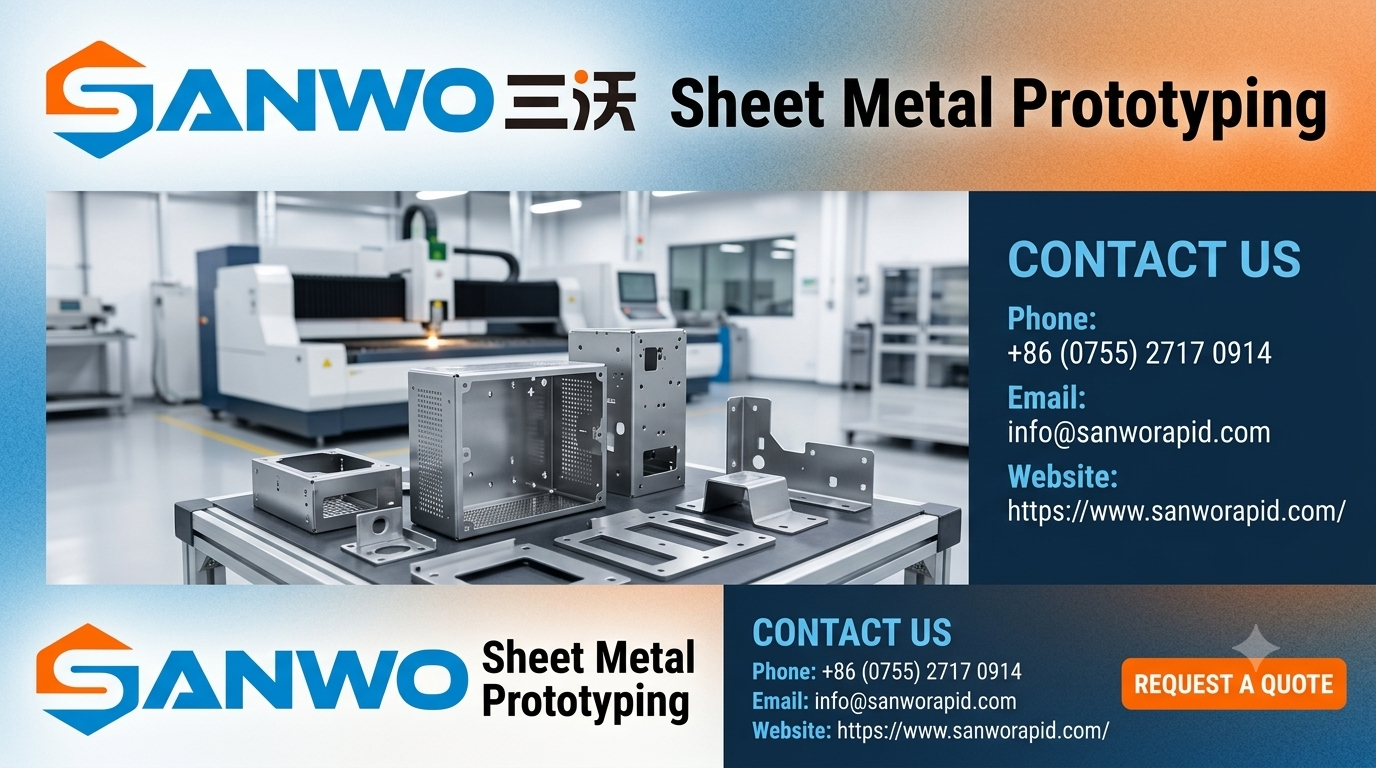
In today’s competitive manufacturing industry, sheet metal prototyping has become an essential step for companies aiming to reduce development time, validate designs, and launch high-quality products faster. Whether you’re developing industrial equipment, automotive components, consumer electronics, or medical devices, an accurate prototype minimizes costly design errors before full-scale production.
With over two decades of expertise in precision manufacturing, Sanwo Rapid delivers reliable sheet metal prototyping solutions that help engineers and product developers move from concept to production with confidence.
What Is Sheet Metal Prototyping?
Sheet metal prototyping is the process of creating functional metal parts from flat metal sheets using manufacturing methods such as laser cutting, CNC punching, bending, welding, and surface finishing. Unlike plastic prototypes, sheet metal prototypes closely replicate the strength, durability, and performance of production-grade components.
These prototypes are commonly manufactured using aluminum, stainless steel, carbon steel, brass, and copper, depending on the application’s performance requirements.
Why Sheet Metal Prototyping Matters
A well-produced prototype allows manufacturers to verify dimensions, assembly fit, structural integrity, and product functionality before investing in expensive tooling.
Key benefits include:
- Faster product validation
- Lower development costs
- Early detection of design flaws
- Improved production readiness
- Better communication between engineering and manufacturing teams
For example, an electronics manufacturer can prototype an aluminum enclosure to evaluate heat dissipation and component placement before mass production, avoiding costly redesigns later.
Common Manufacturing Processes
| Process | Primary Purpose | Best Application |
| Laser Cutting | Precision material cutting | Complex profiles and tight tolerances |
| CNC Punching | Fast hole and slot creation | High-volume prototype features |
| Sheet Metal Bending | Forming precise angles | Brackets, enclosures, frames |
| Welding | Permanent assembly | Structural components |
| Surface Finishing | Improve appearance and durability | Consumer and industrial products |
Choosing the right combination of processes ensures prototypes accurately reflect the final manufactured part.
Materials Comparison
| Material | Advantages | Typical Applications |
| Aluminum | Lightweight, corrosion-resistant | Electronics, aerospace |
| Stainless Steel | Strong, durable, corrosion-resistant | Medical and food equipment |
| Carbon Steel | High strength, economical | Machinery and industrial parts |
| Brass | Attractive finish, easy machining | Electrical connectors |
| Copper | Excellent conductivity | Electrical and thermal applications |
Material selection should always align with the product’s functional and environmental requirements.
Practical Tips for Better Sheet Metal Prototypes
To maximize prototype quality:
- Design with realistic bend radii.
- Minimize unnecessary welds.
- Choose production-grade materials whenever possible.
- Maintain consistent material thickness.
- Review tolerance requirements before fabrication.
- Collaborate with experienced manufacturing engineers early in the design stage.
These practices reduce production challenges and improve the transition from prototype to mass manufacturing.
Why Choose Sanwo Rapid?
Sanwo Rapid combines advanced fabrication equipment with experienced engineering support to deliver high-quality sheet metal prototypes with fast turnaround times. From design evaluation to precision fabrication and finishing, every project is managed with a focus on accuracy, efficiency, and manufacturability.
Whether you require a single functional prototype or multiple design iterations, Sanwo Rapid provides customized solutions that help reduce development risks while maintaining exceptional quality standards.
Frequently Asked Questions
How long does sheet metal prototyping take?
Most projects can be completed within a few days, depending on design complexity, material availability, and finishing requirements.
Which industries use sheet metal prototyping?
Automotive, aerospace, electronics, robotics, telecommunications, medical equipment, renewable energy, and industrial machinery manufacturers all rely on sheet metal prototyping.
Can prototypes use production materials?
Yes. Using the same materials intended for final production provides more accurate testing and performance evaluation.
What file formats are accepted?
Most manufacturers accept CAD formats such as STEP, IGES, DWG, DXF, and SolidWorks files for prototype fabrication.
Final Thoughts
High-quality sheet metal prototyping is more than a manufacturing step—it’s a strategic investment that improves product quality, reduces development costs, and shortens time to market. By partnering with an experienced manufacturer like Sanwo Rapid, businesses gain access to precision engineering, expert guidance, and dependable fabrication capabilities that transform innovative ideas into production-ready products with confidence.
Contact – +86 (0755) 2717 0914
Email ID – info@sanworapid.com
Website – https://www.sanworapid.com/