
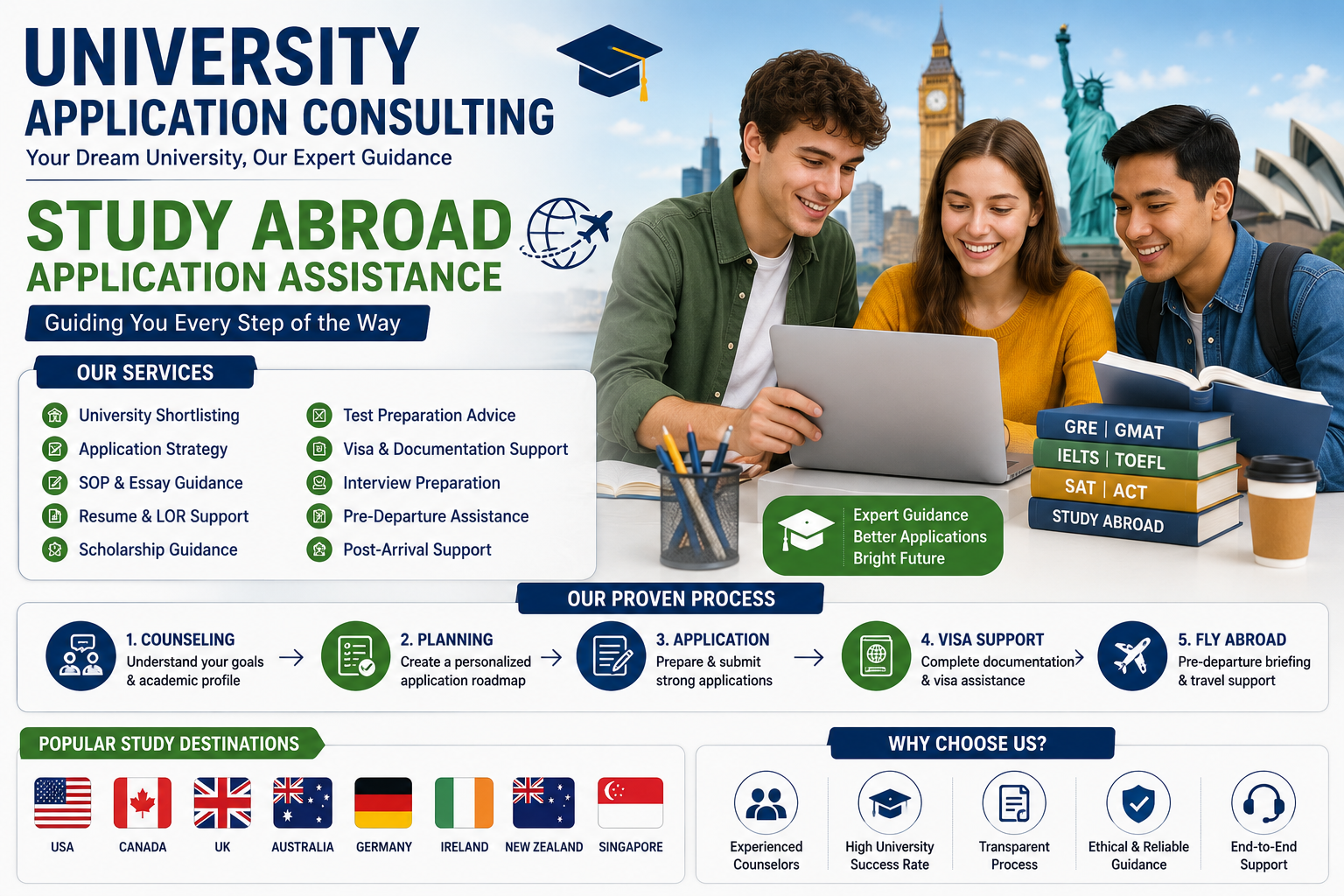
Applying to university can be exciting, but the process becomes considerably more complicated when you are applying to institutions in another country. From choosing suitable universities and understanding entry requirements to preparing personal statements, organising documents and meeting application deadlines, even a strong student can benefit from professional guidance.
University Application Consulting provides structured support throughout this process. Rather than simply submitting an application on a student’s behalf, a good consultant helps applicants understand their options, present their academic profile effectively and avoid common application mistakes.
For students planning to study overseas, Study Abroad Application Assistance can make the application journey more organised, informed and manageable.
What Is University Application Consulting?
University Application Consulting is a professional guidance service that helps students plan, prepare and manage their university applications.
Depending on the student’s needs, consulting may include:
- University and course selection
- Eligibility and entry requirement assessment
- Application strategy
- Personal statement or statement of purpose guidance
- CV and academic profile review
- Application form support
- Document preparation and checking
- Scholarship and funding guidance
- Application deadline planning
- Interview preparation
- Pre-departure guidance
The exact level of support varies between providers. Students should therefore confirm what is included before choosing a consultancy service.
Why Do Students Need Professional University Application Support?
Choosing a university is not simply about finding a well-known institution. Students need to consider whether a particular course matches their academic background, career objectives, budget and future plans.
A professional consultant can help students compare these factors before they commit to an application.
For example, two universities may offer similar business degrees but have different entry requirements, tuition fees, course structures, application deadlines and graduate opportunities. Understanding these differences can help a student make a more informed decision.
Professional guidance can also reduce avoidable errors, such as:
- Applying for courses without meeting the stated requirements
- Missing important deadlines
- Submitting incomplete documentation
- Using generic personal statements
- Failing to tailor applications to individual universities
- Overlooking scholarship opportunities
- Selecting universities without considering realistic admission prospects
The objective should not be to promise admission. It should be to help students build stronger, more appropriate applications based on their individual circumstances.
What Does Study Abroad Application Assistance Include?
Study Abroad Application Assistance can cover different stages of the international university application process.
1. Student Profile Assessment
The process should begin with understanding the applicant.
This may include reviewing:
- Academic qualifications
- Grades and academic performance
- English-language proficiency
- Work or internship experience
- Extracurricular activities
- Career interests
- Preferred study destination
- Budget
- Intended intake
This information helps establish a realistic application strategy.
2. University and Course Selection
Selecting the right university is one of the most important parts of the process.
A consultant may help students create a shortlist based on factors such as:
- Course curriculum
- Entry requirements
- Location
- Tuition fees
- Scholarships
- Course duration
- Application deadlines
- Academic reputation
- Career relevance
- Student preferences
A strong shortlist generally includes a sensible mix of options rather than relying entirely on highly competitive institutions.
3. Application Requirements Review
Each university can have its own application requirements.
Depending on the destination and programme, students may need academic transcripts, certificates, identification documents, English-language test results, references, a CV, personal statement or other supporting materials.
A document review helps ensure that the application is complete and consistent before submission.
4. Personal Statement and SOP Guidance
A personal statement or Statement of Purpose is an opportunity for the applicant to explain their academic interests, motivation and future goals.
Effective application writing should be:
- Specific
- Authentic
- Relevant to the selected programme
- Clearly structured
- Free from unnecessary repetition
- Consistent with the student’s academic background
Professional guidance should help students communicate their own experiences rather than replacing their voice with generic content.
5. Application Form Assistance
Application forms can contain detailed questions about education, qualifications, employment, achievements and other information.
Consultants can help students understand what information is required, identify inconsistencies and review applications before submission.
This can be particularly useful for students applying to several universities with different processes.
6. Application Deadline Management
International applications often involve multiple deadlines.
Students may need to keep track of:
- University application deadlines
- Scholarship deadlines
- English-language test dates
- Document submission dates
- Interview dates
- Offer response deadlines
A structured application timeline can help prevent last-minute problems.
7. University Interview Preparation
Some universities or programmes may require interviews.
Interview preparation can involve discussing:
- Why the student selected the course
- Why they chose the university
- Their academic interests
- Career plans
- Previous experience
- Motivation for studying abroad
Mock interviews can help students practise presenting their answers clearly and confidently.
Who Can Benefit from University Application Consulting?
University application support can be useful for a wide range of applicants, including:
- Undergraduate students
- Postgraduate applicants
- International students
- Students applying for competitive programmes
- Students applying to multiple countries
- Students changing academic fields
- Students looking for scholarships
- Parents seeking structured guidance for their children
It can be particularly valuable when the student or family is unfamiliar with the application system of the chosen study destination.
How to Choose the Right University Application Consultant
Not every consultancy offers the same level of service. Before engaging a provider, students should consider several factors.
Check the Scope of Services
Ask exactly what the consultancy covers.
Does it provide only university selection, or does it also support application forms, personal statements, document reviews and interviews?
Look for Transparent Communication
A professional consultant should explain the process, expected timelines and responsibilities clearly.
Be cautious of anyone guaranteeing admission, visas or scholarships. University decisions depend on individual applications and institutional requirements.
Assess the Quality of Guidance
Good advice should be personalised.
If every student receives the same university list or identical application strategy, the service may not be sufficiently tailored.
Understand the Fees
Request a clear explanation of consultancy fees and what is included. Also clarify whether university application fees, test fees, translation costs or other expenses are separate.
University Application Consulting vs DIY Applications
Students can certainly apply independently. In some cases, this may be the preferred option.
However, professional consulting can provide additional value when the process is complex or when students need help developing an application strategy.
| Self-Managed Application | Professional Consulting |
| Student manages the entire process | Consultant provides structured guidance |
| Independent university research | Assisted university and course selection |
| Student checks requirements | Professional review of requirements |
| Student prepares documents | Document checking and application guidance |
| Independent deadline tracking | Structured application timeline |
| Independent interview preparation | Interview preparation and practice |
The right choice depends on the student’s confidence, experience, time and application complexity.
Common Mistakes Students Should Avoid
Even academically strong applicants can make avoidable mistakes.
Applying to Too Many Unrelated Courses
A long list of applications does not automatically create a stronger strategy. Courses should make sense in relation to the student’s background and career direction.
Using a Generic Personal Statement
Admissions teams want to understand the applicant’s motivation and suitability for the programme. A statement that could apply to any university may not communicate genuine interest effectively.
Ignoring Entry Requirements
Students should check official university requirements before applying. These may include specific subjects, grades, qualifications, English-language requirements or other conditions.
Leaving Applications Until the Last Minute
Last-minute applications can create unnecessary pressure, particularly when references, transcripts or test results are required.
Focusing Only on Rankings
University rankings can be useful for comparison, but they should not be the only consideration. Course content, cost, location, academic fit and career goals also matter.
A Practical University Application Timeline
A typical application journey can be organised into several stages.
6–12 months before the intended intake
Research destinations, courses, universities, entry requirements and approximate costs.
4–8 months before application deadlines
Prepare required tests, documents, CVs and application materials.
2–6 months before deadlines
Finalise the university shortlist and prepare individual applications.
Before submission
Review every application, check supporting documents and confirm deadlines.
After submission
Monitor application portals, respond to university requests and prepare for possible interviews.
The exact timeline varies by country, university and intake, so applicants should always verify dates directly with their chosen institutions.
Frequently Asked Questions About University Application Consulting
What is university application consulting?
University Application Consulting is professional guidance designed to help students select suitable universities and prepare, review and manage their applications.
Is university application consulting worth it?
It can be worthwhile for students who need help with university selection, application strategy, documentation, personal statements, deadlines or interview preparation. The value depends on the quality and scope of the service.
Can a consultant guarantee university admission?
No responsible consultant should guarantee admission. Final decisions are made by universities according to their own admission criteria.
What documents are usually required for studying abroad?
Requirements vary by university and programme but may include academic transcripts, certificates, identification documents, English-language test results, CVs, references and personal statements.
Can consultants help with scholarship applications?
Many providers offer scholarship guidance, but students should confirm whether scholarship research and application support are included in the service.
When should I start my university application?
Ideally, students should begin researching well before the application deadline. Starting several months in advance gives them time to compare courses, complete tests, prepare documents and improve their applications.
Is Study Abroad Application Assistance only for international students?
No. The term generally refers to support for students applying to study outside their current country of education or residence, but the specific eligibility and requirements depend on the destination.