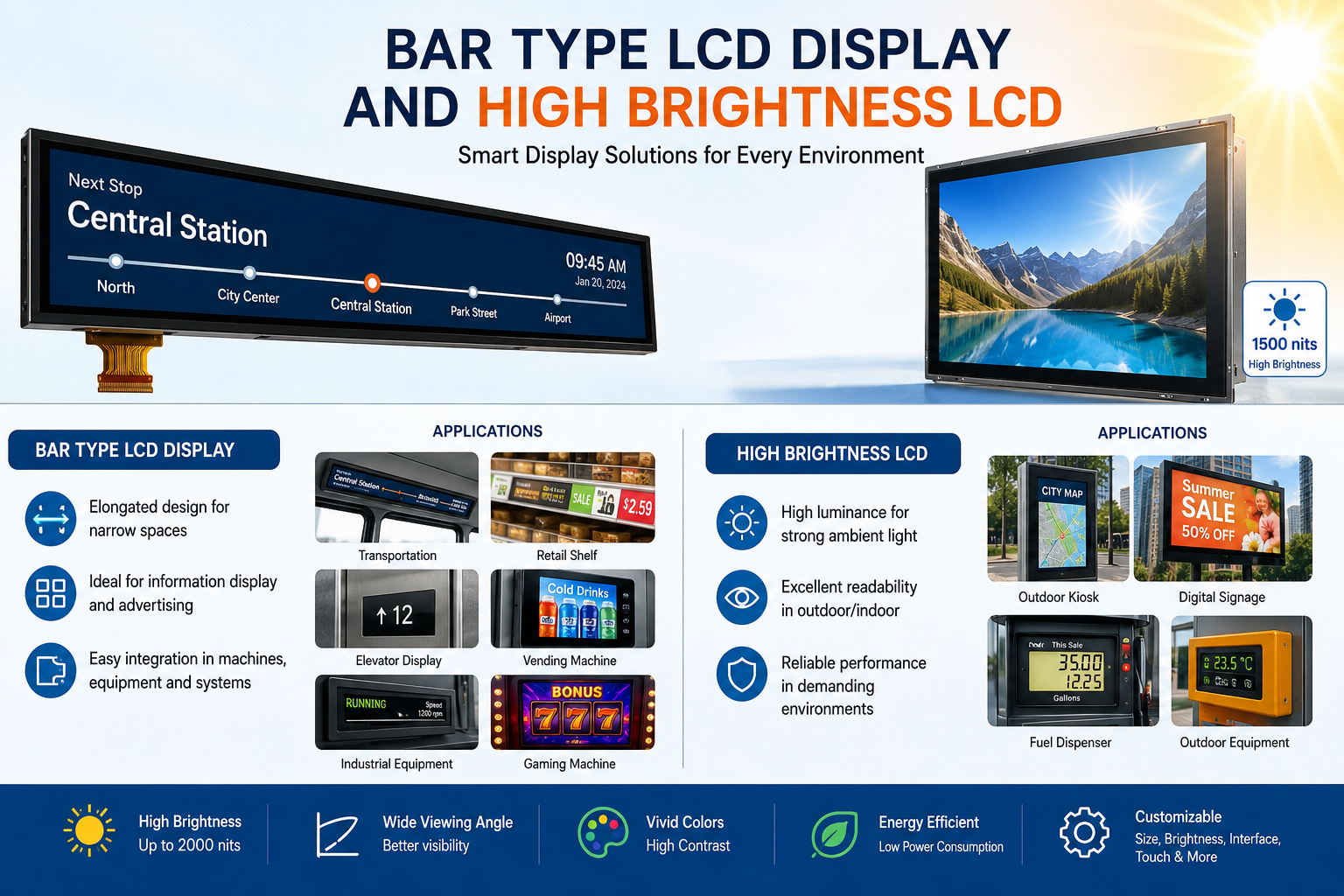
From transportation systems to retail shelves and outdoor kiosks, specialized formats are becoming essential. Two technologies are the bar type LCD display and High Brightness LCD. Each solves a different visual challenge where standard monitors may not provide the right shape, visibility, durability, or viewing experience.
What Is a Bar Type LCD Display?
A bar type LCD display is an ultra-wide or stretched LCD screen with a long, narrow aspect ratio. Unlike conventional 16:9 displays, it fits spaces where height is limited but horizontal communication is important.
Typical applications include:
- Digital shelf labels and advertising
- Transportation information systems
- Elevator displays
- Gaming and vending machines
- Industrial control panels
- Restaurant menu strips
- Smart appliances
- Wayfinding boards
How Does a Bar Type LCD Display Work?
The working principle is similar to a standard TFT LCD. Liquid crystals control light passing through pixels, while a backlight provides illumination. The main differences are panel dimensions, resolution, controller configuration, and mechanical design.
A professional bar type LCD display may use LVDS, HDMI, MIPI, or eDP. Models may support touch, custom glass, optical bonding, and wide-temperature operation.
Important Technical Features
Before choosing a stretched LCD, evaluate:
- Native resolution
- Viewing angle
- Interface compatibility
- Operating temperature
- Backlight lifetime
- Touch requirements
- Mechanical dimensions
- Power consumption
What Is a High Brightness LCD?
A High Brightness LCD is designed to remain visible in strong ambient light. Standard displays may appear washed out near windows, under intense lighting, or outdoors. High-brightness panels use stronger LED backlighting and optimized optical structures to deliver clearer content.
Brightness is measured in nits. A typical indoor monitor may provide around 250–400 nits, while a High Brightness LCD may offer 700, 1000, 1500, or more depending on the environment.
Where High Brightness LCD Screens Are Used
Common applications include:
- Outdoor kiosks
- EV charging stations
- Marine equipment
- Railway displays
- ATM machines
- Industrial terminals
- Medical equipment
- Outdoor advertising
- Vehicle dashboards
- Sunlight-readable systems
For exposed environments, brightness should be considered together with anti-glare treatment, temperature control, UV resistance, and enclosure protection.
Bar Type LCD Display vs High Brightness LCD
| Feature | Bar Type LCD Display | High Brightness LCD |
| Primary purpose | Wide-format content | Visibility in strong light |
| Shape | Long and narrow | Standard or custom |
| Brightness | Standard to high | Usually high |
| Main use | Shelves, transport, panels | Outdoor systems |
| Customization | Strong size flexibility | Strong optical options |
| Touch support | Available | Available |
These technologies are not competitors. A project can combine a bar type LCD display with high-brightness backlighting, creating a stretched screen that performs well in bright environments.
Main Benefits of Bar Type LCD Technology
The biggest advantage is efficient use of space. Manufacturers can integrate information screens into narrow product designs without redesigning the enclosure.
Other benefits include:
- Modern appearance
- Efficient horizontal information display
- Flexible installation
- Custom sizes and resolutions
- Industrial system compatibility
- Optional touch functionality
Main Benefits of High Brightness LCD Technology
The main benefit of a High Brightness LCD is readability. A brighter panel maintains stronger perceived contrast as ambient light increases.
Additional advantages include:
- Improved sunlight visibility
- Better outdoor interaction
- Clearer graphics and text
- Enhanced operational usability
- Flexible kiosk integration
- Reliable performance in demanding lighting
Higher brightness may increase power usage and heat, so thermal management remains important.
Factors to Consider Before Choosing an LCD
Choosing the correct panel requires more than comparing size and price.
Brightness Level
Indoor installations may need moderate brightness, while semi-outdoor and outdoor applications usually require higher luminance.
Viewing Environment
Consider sunlight, reflected light, viewing distance, angle, dust, moisture, vibration, and temperature.
Interface and Controller
Confirm that the panel works with the system controller. HDMI suits signage, while LVDS, MIPI, or eDP may suit embedded products.
Touch Technology
Capacitive touch is common for modern products, while resistive touch remains useful in some industrial environments.
Long-Term Reliability
Check LED lifespan, operating temperature, warranty, availability, and manufacturer support. Industrial projects often need stable long-term supply.
How to Select the Right Display Supplier
A reliable supplier should provide more than a panel catalogue. Look for engineering support, clear datasheets, customization, quality testing, and responsive technical communication.
Before production, request samples and verify:
- Display dimensions
- Optical performance
- Color consistency
- Interface compatibility
- Brightness stability
- Touch accuracy
- Thermal behavior
- Mechanical fit
Frequently Asked Questions
1. What is a bar type LCD display?
It is a long, narrow LCD designed for spaces where standard screen proportions are unsuitable.
2. Can bar displays support touch?
Yes. Many can use capacitive or resistive touch panels.
3. What is considered a High Brightness LCD?
Definitions vary, but panels around 700 nits or above are commonly marketed as high brightness.
4. Is high brightness enough for outdoor use?
No. Reflection, contrast, bonding, anti-glare treatment, temperature, and sunlight direction also matter.
5. Can a bar LCD also be high brightness?
Yes. High-brightness backlighting can be integrated into stretched LCD designs.
6. Which interface is best?
It depends on the host system. HDMI, LVDS, MIPI, and eDP are widely used.
7. Are customized sizes available?
Yes. Suppliers may customize dimensions, cover glass, touch, brightness, and mechanical structures.
8. Does higher brightness consume more power?
Usually yes. Stronger backlighting requires more energy and can produce more heat.
9. What industries use stretched LCD displays?
Retail, transportation, automation, hospitality, gaming, vending, and smart-device industries use them.
10. How can display lifespan be improved?
Proper cooling, stable power, suitable brightness control, protection, and correct temperatures help extend service life.