
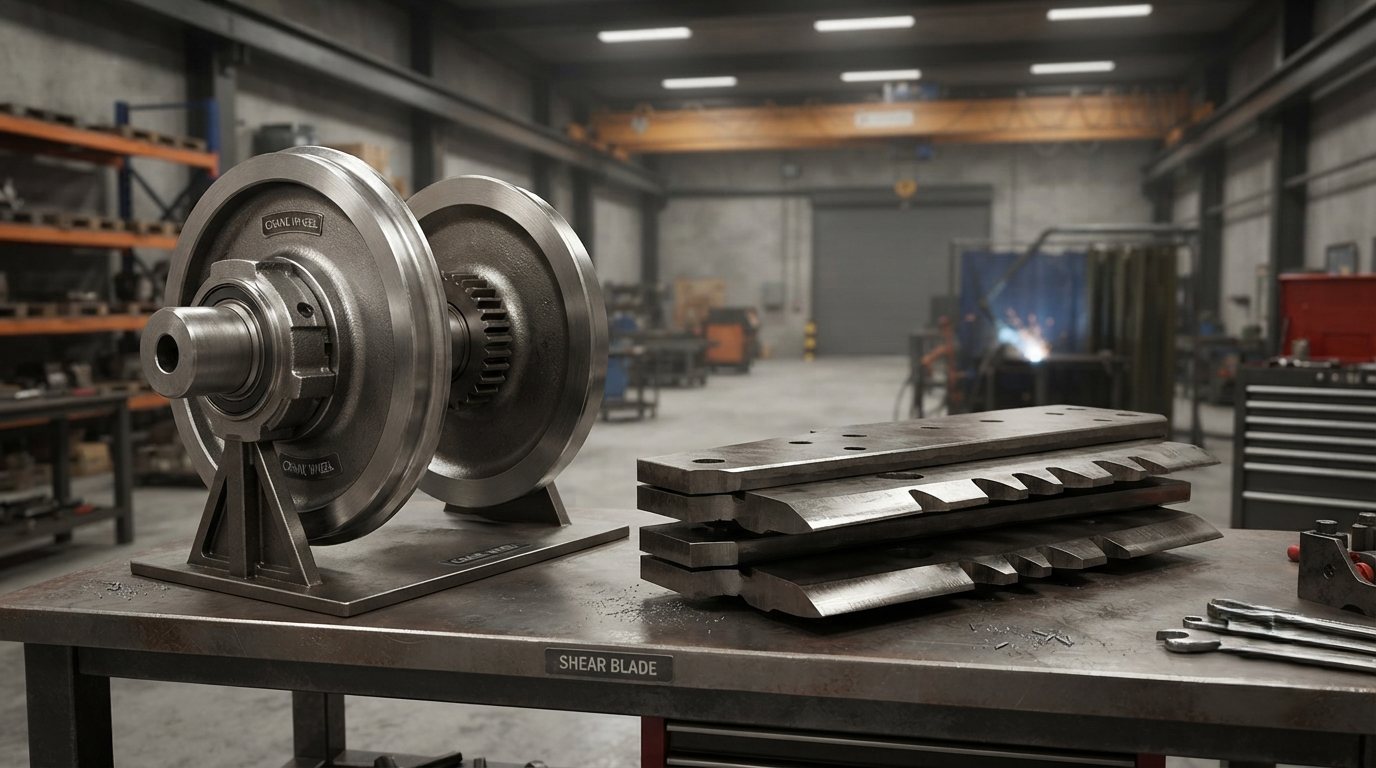
Modern industrial operations depend on machines that work continuously under demanding conditions. From lifting heavy materials in manufacturing plants to cutting thick metal sheets in fabrication units, every component plays a role in maintaining productivity and operational reliability.
Two such important components are the Crane Wheel and Shear Blade. They perform completely different jobs, yet both directly influence machine efficiency, maintenance costs, safety, and production quality.
Understanding how these components work, what materials are used, and how to choose the right specifications can help businesses avoid unnecessary downtime and extend equipment life.
The Role of Crane Wheels in Heavy-Duty Operations
A Crane Wheel is designed to support and move cranes along a rail system. It is commonly found in overhead cranes, EOT cranes, gantry cranes, transfer trolleys, and other material-handling equipment.
During operation, crane wheels carry the combined weight of the crane structure and the load being transported. This creates continuous pressure on the wheel tread and flange.
Because of this, crane wheels must be manufactured with excellent dimensional accuracy and high-strength materials.
Key qualities of a reliable crane wheel include:
- High load-bearing capacity
- Excellent wear resistance
- Accurate tread profile
- Proper flange dimensions
- Strong fatigue resistance
- Smooth rolling movement
- Long service life
A poorly manufactured wheel can lead to vibration, uneven movement, rail damage, and increased maintenance requirements.
Common Types of Crane Wheels
Crane systems do not all use the same wheel design. The correct type depends on the equipment configuration and operating environment.
Common crane wheel designs include:
- Single-flange wheels
- Double-flange wheels
- Flangeless wheels
- Forged steel wheels
- Cast steel wheels
- Heat-treated crane wheels
- Custom-manufactured wheels
A double-flange Crane Wheel, for example, provides guidance on both sides of the rail, while a single-flange design may be more suitable for specific track arrangements.
For specialized equipment, custom manufacturing is often necessary to match existing dimensions and machine requirements.
Why Material Selection Matters for Crane Wheels
Material selection has a direct effect on wheel durability.
Carbon steel and alloy steel are widely used for crane wheels because they provide a combination of strength, toughness, and resistance to wear.
Forged steel wheels are commonly preferred in demanding applications because the forging process can improve structural integrity and fatigue strength.
Heat treatment may also be applied to increase surface hardness.
The objective is to create a wheel with:
- A hard and wear-resistant tread
- A strong internal structure
- Good resistance to impact
- Stable performance under repeated loads
This balance is especially important in steel plants, ports, heavy engineering facilities, warehouses, and manufacturing units.
Understanding the Function of a Shear Blade
A Shear Blade is a precision cutting tool used in industrial shearing machines.
Instead of removing material through grinding or sawing, a shear blade separates metal by applying concentrated force between two cutting edges.
Shear blades are commonly used to cut:
- Mild steel
- Stainless steel
- Aluminum
- Copper
- Brass
- Sheet metal
- Metal plates
- Industrial alloys
They are widely installed in hydraulic shearing machines, guillotine machines, fabrication equipment, and metal-processing lines.
What Makes a Good Shear Blade?
A quality Shear Blade needs both hardness and toughness.
Hardness helps the cutting edge stay sharp, while toughness allows the blade to resist cracking or breaking under repeated impact.
Important blade characteristics include:
- High edge hardness
- Good wear resistance
- Accurate straightness
- Strong impact resistance
- Precise blade geometry
- Stable dimensional accuracy
- Resistance to chipping
A blade that is extremely hard but lacks toughness may become brittle. On the other hand, a blade that is too soft may wear quickly.
For this reason, proper material selection and heat treatment are essential.
Materials Commonly Used for Shear Blades
Different cutting applications require different blade materials.
| Material | Main Advantage | Common Application |
| Carbon Tool Steel | Economical | Light-duty cutting |
| Alloy Tool Steel | Balanced durability | General fabrication |
| D2 Tool Steel | High wear resistance | High-volume cutting |
| High-Speed Steel | Excellent edge retention | Difficult materials |
| Special Alloy Steel | Customized properties | Heavy-duty operations |
The best material depends on sheet thickness, material hardness, production volume, cutting frequency, and machine configuration.
Crane Wheel and Shear Blade: Different Jobs, Similar Quality Requirements
Although a Crane Wheel and Shear Blade serve different purposes, both require precision manufacturing.
| Feature | Crane Wheel | Shear Blade |
| Main Purpose | Supports crane travel | Cuts metal |
| Primary Stress | Compression and rolling | Cutting and impact |
| Key Requirement | Strength and durability | Hardness and sharpness |
| Common Material | Carbon or alloy steel | Tool or alloy steel |
| Common Wear | Tread and flange | Cutting edge |
| Maintenance | Alignment inspection | Sharpening and clearance |
Both components can affect the performance of surrounding machinery if they are poorly designed or incorrectly installed.
Choosing the Right Crane Wheel
Before selecting a Crane Wheel, several technical details should be reviewed.
Important considerations include:
- Maximum operating load
- Wheel diameter
- Rail dimensions
- Tread width
- Flange size
- Bore diameter
- Crane travel speed
- Operating temperature
- Duty cycle
- Surface hardness
Buyers should ideally provide technical drawings or verified measurements when ordering replacement wheels.
This reduces the risk of installation problems and ensures better compatibility with the crane system.
Choosing the Right Shear Blade
Selecting a Shear Blade requires a clear understanding of the cutting application.
Important factors include:
- Type of material being cut
- Material thickness
- Material hardness
- Machine model
- Blade dimensions
- Required cutting quality
- Production frequency
- Blade clearance
- Tool steel grade
- Heat-treatment requirements
Choosing a blade based only on price may lead to faster wear and frequent replacements.
A blade matched correctly to the application can improve both productivity and cut quality.
How Maintenance Extends Component Life
Even high-quality industrial components require proper maintenance.
For crane wheels, maintenance teams should regularly inspect:
- Tread wear
- Flange condition
- Rail alignment
- Wheel alignment
- Bearings
- Shafts
Uneven wheel wear can indicate alignment problems or crane skewing.
For shear blades, regular inspection should focus on:
- Cutting-edge condition
- Burr formation
- Blade clearance
- Mounting bolts
- Blade alignment
- Cutting pressure
Sharpening the blade at the right time can help prevent unnecessary stress on the machine.
Industries That Depend on These Components
A Crane Wheel is widely used in:
- Steel plants
- Power plants
- Warehouses
- Shipyards
- Ports
- Foundries
- Construction facilities
- Heavy manufacturing units
A Shear Blade is commonly used in:
- Metal fabrication
- Automotive production
- Steel processing
- Recycling plants
- Machinery manufacturing
- Sheet metal workshops
- Industrial engineering facilities
Their importance becomes even greater in facilities where production runs continuously.
Frequently Asked Questions
1. What is the main function of a Crane Wheel?
A Crane Wheel supports the crane and enables smooth movement along a rail track.
2. Which material is commonly used for crane wheels?
Carbon steel and alloy steel are frequently used because of their strength and wear resistance.
3. Why do crane wheel flanges wear?
Flange wear can result from misaligned rails, crane skewing, incorrect wheel alignment, or side loading.
4. Can crane wheels be custom-made?
Yes. Crane wheels can be manufactured according to drawings, dimensions, materials, and hardness requirements.
5. What is a Shear Blade?
A Shear Blade is an industrial cutting tool used to separate metal through shearing force.
6. Which steel is suitable for shear blades?
Tool steels, alloy steels, D2, and HSS may be used depending on the cutting application.
7. Can shear blades be sharpened?
Yes. Many industrial blades can be re-ground several times if sufficient material remains.
8. What causes a shear blade to wear quickly?
Incorrect blade clearance, hard materials, high cutting frequency, and poor blade quality can accelerate wear.
9. Why is blade clearance important?
Correct clearance improves cutting quality and reduces stress on both the blade and machine.
10. Can shear blades cut stainless steel?
Yes, provided the blade material and machine settings are suitable for the required grade and thickness.