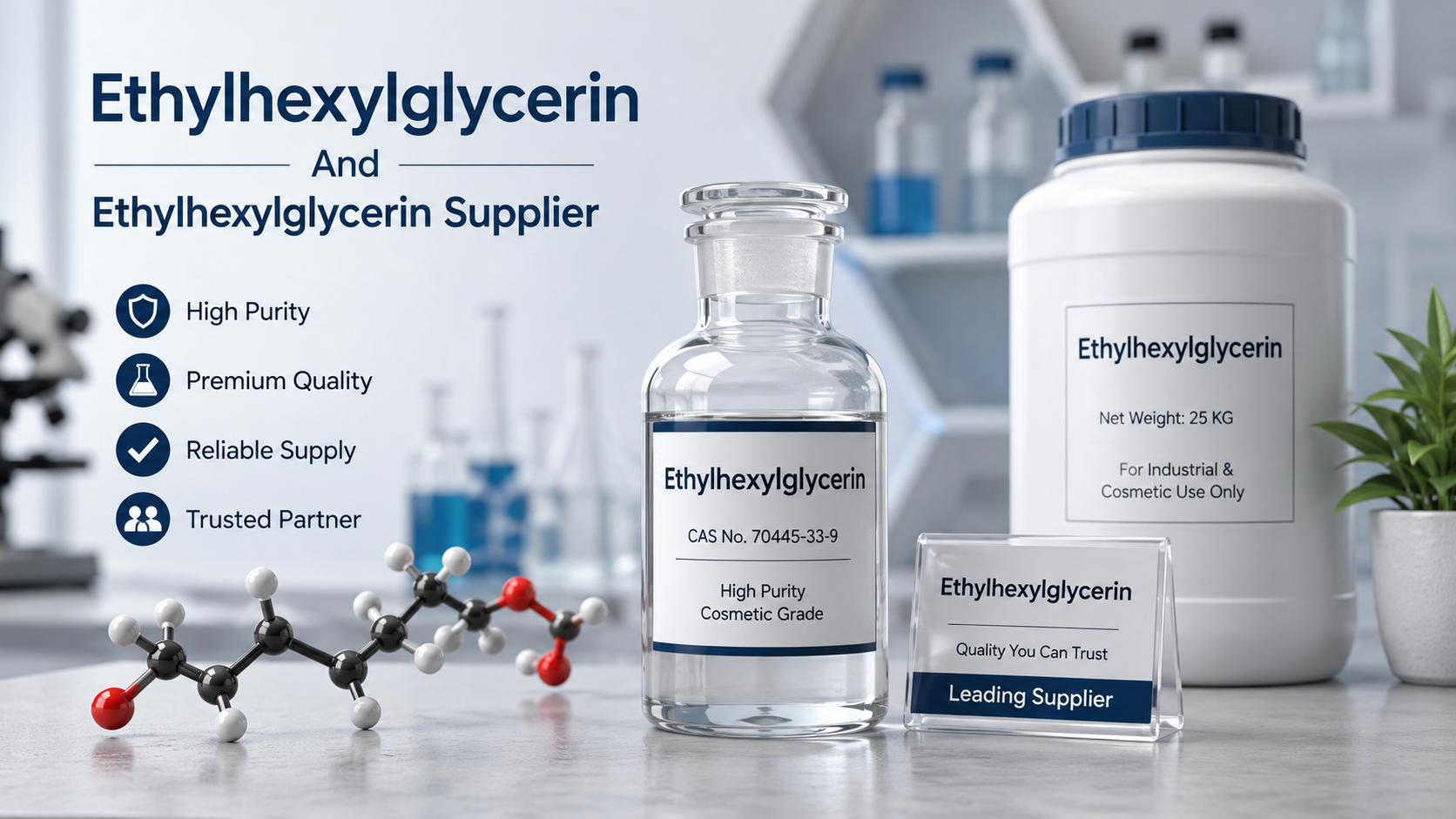
The personal care industry is continuously evolving as manufacturers search for ingredients that improve product performance without unnecessarily complicating formulations. Modern skincare, haircare, hygiene, and cosmetic products must offer good sensory appeal, strong stability, effective preservation, and reliable shelf life. Ethylhexylglycerin has emerged as a valuable multifunctional ingredient that helps formulators address several of these requirements.
Rather than serving only one purpose, Ethylhexylglycerin can contribute to preservation support, skin conditioning, deodorizing performance, and formulation efficiency. At the same time, the quality of the ingredient can vary depending on manufacturing standards and supply conditions. This makes choosing the right Ethylhexylglycerin Supplier an important commercial and technical decision for cosmetic manufacturers.
What Makes Ethylhexylglycerin a Multifunctional Ingredient?
Ethylhexylglycerin is a glycerin-derived ingredient widely used in personal care and cosmetic formulations. Its chemical structure gives it properties that allow it to perform several functions within a finished product.
Its most recognized applications include:
- Supporting preservative systems
- Conditioning the skin
- Improving formulation performance
- Supporting deodorant applications
- Enhancing the efficiency of selected antimicrobial systems
This combination of functions makes Ethylhexylglycerin particularly attractive for formulators seeking ingredients that can deliver more than one benefit.
Instead of adding multiple ingredients for separate purposes, manufacturers may use multifunctional materials to develop more streamlined formulations.
Why Preservation Support Matters in Cosmetic Products
Many cosmetic products contain significant amounts of water. Moisturizers, shampoos, conditioners, serums, cleansers, and body lotions can therefore provide an environment where microorganisms may grow if the formulation is not adequately protected.
Preservation helps maintain microbiological quality throughout the intended shelf life of a product.
However, preservation is not simply about adding a single preservative. A complete preservation strategy may involve:
- Antimicrobial ingredients
- Good manufacturing practices
- Suitable product pH
- Hygienic packaging
- Chelating agents
- Preservation boosters
- Microbiological testing
Ethylhexylglycerin is often incorporated as part of this wider system.
How Ethylhexylglycerin Supports Preservative Systems
Ethylhexylglycerin is frequently described as a preservative booster because it can support the performance of other antimicrobial ingredients.
Its action is associated with interactions involving microbial cell membranes. By influencing membrane integrity, it can help make certain microorganisms more vulnerable to the antimicrobial activity of other preservative components.
This is one reason why Ethylhexylglycerin is commonly found in combination with phenoxyethanol and similar preservation systems.
The exact effectiveness, however, depends on the formulation.
Factors such as product pH, water activity, surfactants, emulsifiers, botanical extracts, packaging, and usage conditions can all influence preservation.
Therefore, formulators should validate the complete finished product rather than assuming that ingredient inclusion automatically guarantees protection.
Ethylhexylglycerin in Skin Care Formulations
Skin feel is an important aspect of modern cosmetic product development.
Consumers often judge a moisturizer or serum not only by its claimed benefits but also by how it spreads, absorbs, and feels after application.
Ethylhexylglycerin can contribute to skin-conditioning characteristics in suitable formulations.
It is commonly considered for products such as:
- Facial moisturizers
- Day and night creams
- Body lotions
- Serums
- Facial cleansers
- Hand creams
- Sunscreen formulations
- Makeup products
Its multifunctionality helps formulators balance preservation needs with sensory expectations.
Hair Care Applications
Haircare formulations also require reliable preservation, particularly when water is a major component.
Shampoos and conditioners may contain surfactants, conditioning agents, botanical extracts, proteins, and other ingredients that need microbiological protection.
Ethylhexylglycerin can be incorporated into haircare preservation strategies where technically appropriate.
Common applications may include:
- Shampoos
- Hair conditioners
- Hair masks
- Scalp care products
- Leave-in formulations
- Styling products
The complete formula should always be tested for stability and preservation effectiveness.
Importance in Deodorant Development
Deodorant products represent another important application area.
Body odor often develops when microorganisms present on the skin break down components found in perspiration.
Ethylhexylglycerin may help support deodorizing formulations by influencing microbial activity.
This makes it useful in selected:
- Roll-on deodorants
- Underarm creams
- Deodorant sprays
- Personal hygiene formulations
- Body care products
Manufacturers should still evaluate finished product performance under realistic conditions to determine whether the formulation delivers the required deodorizing effect.
Ethylhexylglycerin Compared With Conventional Preservatives
Ethylhexylglycerin should not automatically be treated as a direct substitute for every traditional preservative.
Its major value frequently comes from supporting a properly designed preservation system.
| Feature | Traditional Preservative | Ethylhexylglycerin |
| Direct antimicrobial function | Primary role | Supporting role |
| Preservative boosting | Varies | Important application |
| Skin conditioning | Usually limited | Useful benefit |
| Deodorant support | Ingredient dependent | Possible application |
| Multifunctionality | Often narrower | Relatively broad |
The ideal preservation strategy depends on the specific product rather than a universal formula.
Why Supplier Quality Directly Affects Manufacturing
Choosing an experienced Ethylhexylglycerin Supplier is important because raw material variation can affect finished product consistency.
Manufacturers often produce thousands of units from a single formulation. Even minor differences in raw material quality may influence appearance, viscosity, odor, stability, or performance.
A professional supplier should therefore maintain controlled specifications and consistent quality systems.
Important considerations include:
- Product purity
- Defined specifications
- Batch consistency
- Traceability
- Storage control
- Packaging integrity
- Technical support
- Reliable transportation
Supplier selection should be treated as part of quality assurance rather than simply purchasing.
Documents Buyers Should Request
Technical documentation helps manufacturers evaluate whether a raw material matches their requirements.
A qualified Ethylhexylglycerin Supplier should typically be able to provide relevant documents according to customer and regulatory needs.
Common documents may include:
- Certificate of Analysis
- Safety Data Sheet
- Technical Data Sheet
- Product specifications
- Storage recommendations
- Handling information
- Regulatory declarations where applicable
Documentation also helps quality-control teams compare incoming material with approved specifications.
Why Batch-to-Batch Consistency Matters
Consistency is essential in commercial cosmetic production.
If raw materials vary significantly between batches, manufacturers may experience changes in:
- Viscosity
- Appearance
- Odor
- Product texture
- Stability
- Preservation behavior
Reliable supplier quality-control systems reduce the likelihood of these variations.
This is especially important for companies manufacturing the same cosmetic product continuously over long periods.
Testing Required Before Commercial Production
Even when using high-quality Ethylhexylglycerin, manufacturers should validate their finished formulation.
Important evaluations can include:
- Stability testing
- Microbiological testing
- Preservative challenge testing
- Packaging compatibility testing
- Temperature stability testing
- Sensory evaluation
Challenge testing is particularly valuable because it evaluates whether the complete preservation system can control microorganisms introduced under standardized test conditions.
A preservation system should therefore be considered proven only after appropriate testing.
How to Select the Right Ethylhexylglycerin Supplier
Supplier evaluation should combine technical, commercial, and logistical criteria.
Manufacturers should consider whether a supplier can consistently support long-term production rather than focusing only on the initial purchase price.
A good Ethylhexylglycerin Supplier should provide:
- Reliable quality
- Complete documentation
- Clear specifications
- Consistent supply
- Professional packaging
- Technical communication
- Fast response to quality queries
- Suitable order quantities
- Traceable batches
- Dependable delivery schedules
Strong supplier relationships can also reduce production risks caused by shortages or inconsistent materials.
Future Role of Ethylhexylglycerin in Personal Care
Cosmetic formulation is gradually shifting toward multifunctional and performance-driven ingredient systems.
Brands want formulations that are effective, elegant, stable, and practical to manufacture.
Ingredients that support several formulation objectives can therefore become increasingly important.
Ethylhexylglycerin fits this direction because it can support preservation while also contributing conditioning and deodorizing benefits.
As personal care manufacturing becomes more sophisticated, suppliers may also be expected to provide greater technical transparency, documentation, and regulatory support.
Frequently Asked Questions
1. What is Ethylhexylglycerin used for?
It is mainly used as a preservative booster and skin-conditioning ingredient in cosmetic and personal care products.
2. Is Ethylhexylglycerin used in skincare products?
Yes. It can be found in moisturizers, creams, serums, cleansers, lotions, and other skincare formulations.
3. Can Ethylhexylglycerin be used in shampoos?
Yes, it may be included in haircare preservation systems where suitable.
4. Is it commonly combined with phenoxyethanol?
Yes. Ethylhexylglycerin is frequently used with phenoxyethanol in cosmetic preservation systems.
5. Can it completely replace preservatives?
Not necessarily. It is commonly used as part of a broader preservation system.
6. Does it provide conditioning benefits?
Yes. Ethylhexylglycerin can contribute to skin-conditioning properties in suitable formulations.
7. Can it be used in deodorants?
Yes. It may support deodorizing formulations by helping influence microbial activity.
8. Why is supplier selection important?
Supplier quality affects raw material purity, consistency, documentation, and manufacturing reliability.
9. What documents should manufacturers check?
Common documents include the Certificate of Analysis, Safety Data Sheet, technical specifications, and relevant regulatory information.
10. Is challenge testing necessary?
Yes. Preservative challenge testing is important for verifying the microbiological protection of finished formulations.