
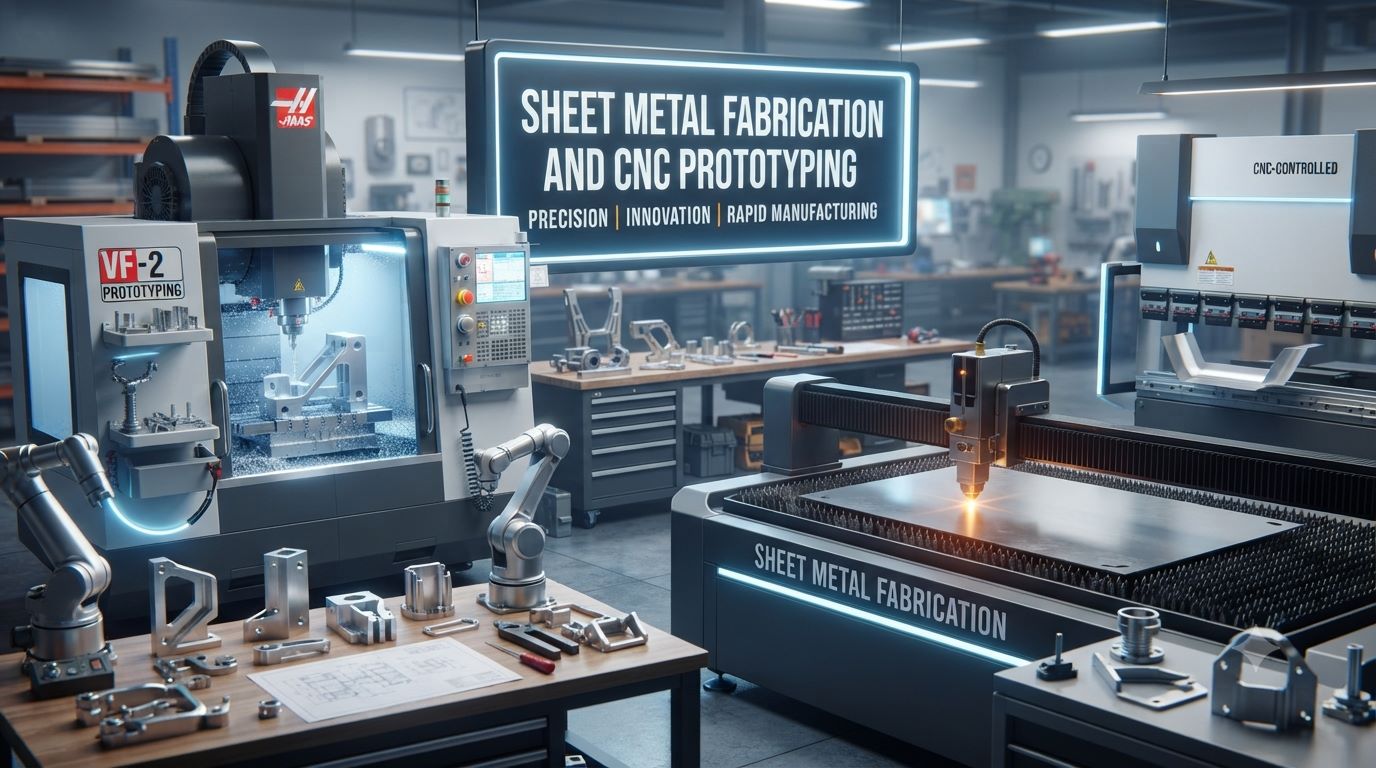
Two technologies are sheet metal fabrication and CNC prototyping. Sheet metal processes suit enclosures and formed structures, while CNC machining suits solid parts and components requiring detailed geometry.
Understanding both processes helps engineers reduce risk, control cost, and move from concept to production efficiently.
What Is Sheet Metal Fabrication?
Sheet metal fabrication transforms flat metal sheets into finished components through cutting, bending, punching, forming, welding, and finishing. Common materials include stainless steel, mild steel, aluminum, galvanized steel, brass, and copper.
The workflow usually starts with a CAD model or flat pattern. Laser cutting, punching, or waterjet cutting creates the profile. Press brakes form bends, while welding, riveting, or threaded inserts support assembly. Powder coating, anodizing, plating, or painting can improve appearance and corrosion resistance.
Important Design Considerations
Good sheet metal fabrication design should consider material thickness, bend radius, hole position, flange length, hardware clearance, and assembly method. Features too close to bend lines can distort during forming, so sufficient bend clearance is important.
Practical Design Tip
Using consistent sheet thickness and standardized bend radii can simplify tooling and improve repeatability.
What Is CNC Prototyping?
CNC prototyping uses computer numerical control machines to remove material from a solid block, plate, bar, or billet until the required geometry is produced. Milling uses rotating tools, while CNC turning rotates the workpiece against cutting tools.
This process is valuable when prototypes must closely represent final parts in strength, dimensions, surface quality, and material behavior. CNC machining works with aluminum, steel, brass, copper, stainless steel, and engineering plastics. It is commonly used for functional prototypes, jigs, fixtures, and lower-volume components.
Main Benefits of CNC Prototyping
CNC prototyping offers several advantages:
- High dimensional accuracy
- Production-grade materials
- Strong mechanical properties
- Repeatable prototype batches
- Fast design validation
- Good surface quality
- Support for drilling, threading, pockets, and slots
CNC-machined parts can often be assembled, load-tested, sealed, fastened, and evaluated under realistic conditions.
Sheet Metal Fabrication vs CNC Prototyping
| Factor | Sheet Metal Fabrication | CNC Prototyping |
| Starting material | Flat metal sheet | Solid block, plate, or bar |
| Main operations | Cutting, bending, forming | Milling, turning, drilling |
| Best for | Enclosures, brackets, panels | Precision solid components |
| Material use | Efficient for thin structures | Material removed as chips |
| Geometry | Folded and formed shapes | Detailed machined geometry |
| Typical use | Structural assemblies | Functional prototypes |
Neither process is universally better. The choice depends on geometry, tolerance, thickness, strength, quantity, finish, and budget.
When Both Processes Work Together
Many products need both technologies. An electronics enclosure may use sheet metal fabrication for the chassis, while heat sinks, mounting blocks, shafts, or precision interfaces are created through CNC prototyping.
This combined approach works well for industrial automation, robotics, automotive testing, aerospace hardware, electronics, laboratory instruments, and custom machinery.
How to Reduce Manufacturing Cost
For sheet metal parts, reduce unnecessary bends, simplify welded assemblies, use common thicknesses, and keep features away from bend zones.
For CNC parts, avoid deep cavities, very thin walls, unnecessary tight tolerances, tiny internal radii, and difficult-to-reach features. CNC design guidance also highlights hole depth, thread selection, wall geometry, and feature accessibility because they affect machining time and tooling.
A design-for-manufacturability review can identify expensive features before production.
Choosing the Right Material
Material selection should match the application.
- Aluminum: lightweight, corrosion resistant, and machinable
- Stainless steel: durable for demanding environments
- Mild steel: strong, economical, and easy to fabricate
- Galvanized steel: useful where corrosion protection is needed
- Brass: machinable and suitable for fittings
- Engineering plastics: useful for lightweight prototypes and insulation
Consider strength, weight, temperature, corrosion, conductivity, machinability, formability, and finishing requirements.
Quality Control
Inspection should verify critical dimensions, hole locations, bend angles, threads, surface finish, and assembly fit. Overly tight tolerances can increase cost, so focus inspection on features that affect function.
Frequently Asked Questions
1. What is sheet metal fabrication used for?
It is used for brackets, housings, panels, frames, cabinets, guards, ducts, and machine covers.
2. What is CNC prototyping?
It creates prototype parts with computer-controlled milling, turning, drilling, and related machining operations.
3. Which process offers higher precision?
CNC machining generally suits detailed precision features, while sheet metal accuracy depends on cutting, forming, material behavior, and bend count.
4. Can aluminum be used in both processes?
Yes. Aluminum is widely used for fabricated sheet parts and CNC-machined prototypes.
5. Is CNC prototyping suitable for functional testing?
Yes. It can produce strong parts for fit, assembly, mechanical, and performance testing.
6. Can sheet metal parts include threaded hardware?
Yes. Threaded inserts, weld nuts, captive fasteners, and similar hardware can be integrated.
7. What design files are commonly required?
Manufacturers commonly use 3D CAD models and 2D drawings showing tolerances, threads, finishes, and special requirements.
8. How can prototype cost be reduced?
Simplify geometry, specify realistic tolerances, select standard materials, minimize setups, and request DFM feedback.
9. Can CNC machining support low-volume production?
Yes. CNC machining is often used for prototypes, bridge production, fixtures, and low-volume end-use parts.
10. Which process should I choose?
Thin folded structures usually favor sheet metal, while solid components with detailed geometry generally favor CNC machining.