Imagine visiting a dental clinic where there are no messy impression trays, no uncomfortable impression material, and no waiting days for physical models to travel between the clinic and laboratory.
Instead, a dentist uses a compact digital scanner to capture the patient’s teeth and oral structures, creating a highly detailed digital model within minutes.
This is no longer a vision of the future.
Digital dentistry is already changing the way dental professionals diagnose, plan, design, and deliver treatment. At the heart of this transformation is 3D scanning technology.
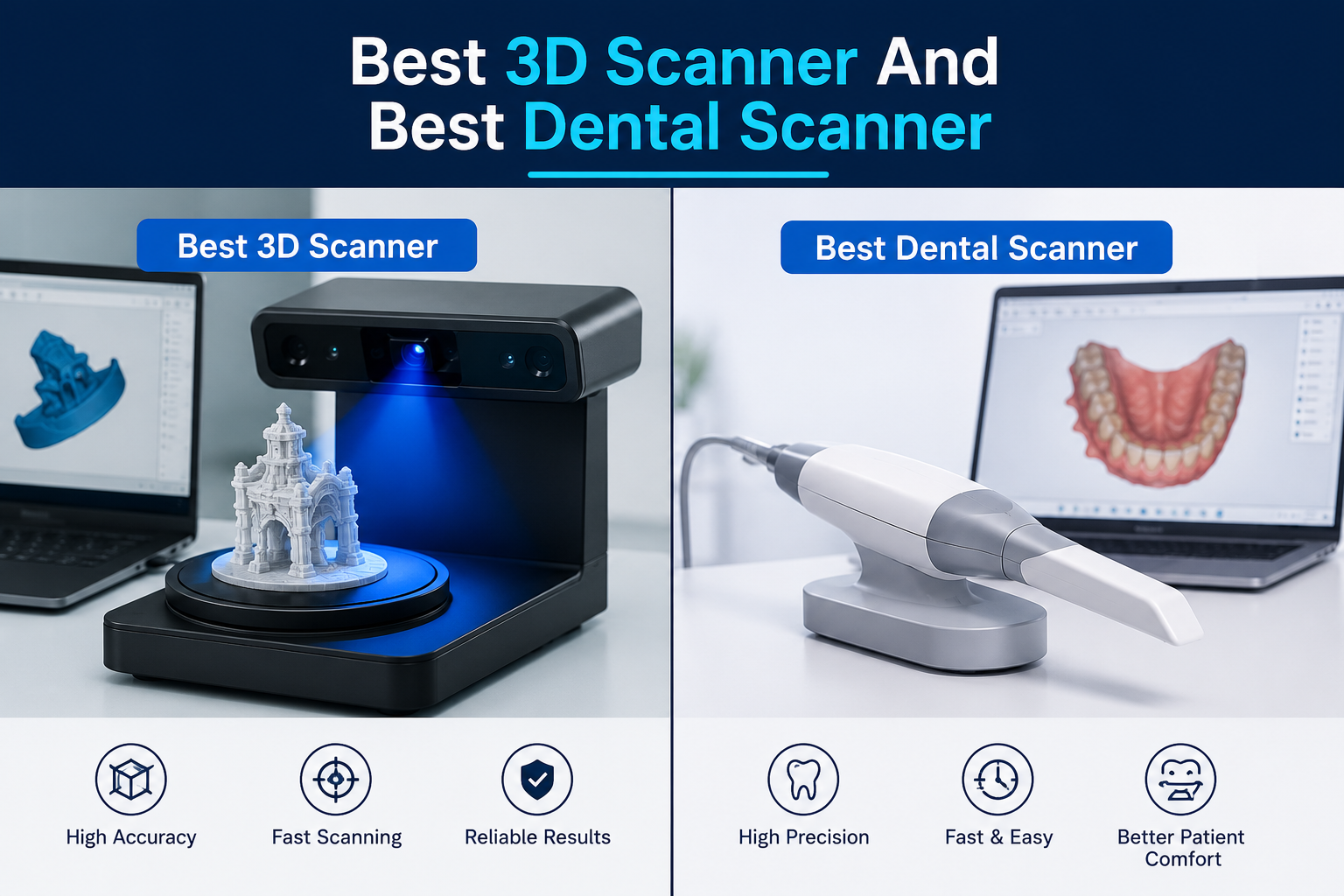
But with so many scanning systems available today, choosing the right one can be challenging. Should a clinic invest in the Best 3D Scanner or focus specifically on finding the Best Dental Scanner?
The answer depends on what the practice actually needs.
Why 3D Scanning Has Become So Important in Dentistry
Traditional dental impressions have been used successfully for many years. However, they are not always the most comfortable experience for patients.
Impression materials can feel unpleasant, and the process requires careful handling to prevent distortion or damage. Physical impressions also need to be transported and stored, which can add time and complexity to the workflow.
Digital scanning provides a different approach.
An intraoral scanner captures the geometry of the patient’s mouth and converts it into a digital 3D model. This information can then be reviewed, shared, designed, and manufactured using digital systems.
Today, digital scans can support many dental applications, including:
- Crowns and bridges
- Dental implants
- Clear aligners
- Orthodontic treatment
- Restorative dentistry
- Prosthodontics
- Digital smile design
- Dental models
- CAD/CAM manufacturing
- 3D printing
The biggest advantage is that the digital scan can become the starting point for an entire treatment workflow.
What Is the Best 3D Scanner for Dental Professionals?
The phrase Best 3D Scanner sounds simple, but there is no single scanner that is perfect for every user.
Think about it this way.
A general dentist may want a scanner that is lightweight, affordable, fast, and easy to operate.
An orthodontist may care more about patient visualization and software features.
An implant specialist may need advanced full-arch scanning capabilities.
A dental laboratory may prioritize accuracy, open file formats, and CAD/CAM compatibility.
This is why choosing the Best 3D Scanner should always begin with understanding the user’s requirements.
The best scanner is the one that solves a specific problem and integrates smoothly into the existing workflow.
Speed Matters in a Busy Dental Clinic
Time is valuable in every dental practice.
When dentists scan multiple patients every day, scanning efficiency can have a direct impact on productivity.
A fast scanner can help reduce the time required to capture digital impressions and may make appointments more streamlined.
However, speed alone should not determine the buying decision.
A scanner that captures data quickly but requires frequent rescanning may not provide the efficiency a clinic expects.
The ideal solution combines:
- Fast data acquisition
- Stable scanning
- Reliable image capture
- Easy-to-use software
- Minimal rescanning
For many practices, the right balance between speed and accuracy is more important than simply choosing the fastest device available.
Accuracy Is at the Heart of Digital Dentistry
When searching for the Best Dental Scanner, accuracy should always be a major consideration.
The digital scan may be used as the foundation for restorations, orthodontic appliances, implant planning, and other dental applications.
If the initial digital data is unreliable, problems can potentially appear later in the workflow.
However, accuracy should always be evaluated according to the clinical application.
A scanner suitable for routine restorative dentistry may not have the same requirements as a system designed for complex full-arch implant procedures.
Dental professionals should therefore look beyond advertising claims and consider independent evidence, clinical validation, and real-world performance.
Don’t Forget About Ergonomics
A scanner can have impressive specifications, but if it is uncomfortable to use, it may become a frustrating tool.
Dental professionals often work for long hours and may perform multiple scans in a single day.
This makes ergonomics particularly important.
When evaluating the Best 3D Scanner, consider:
- Device weight
- Handle design
- Balance
- Cable placement
- Scanner tip size
- Ease of movement
- Overall grip comfort
A lightweight scanner can be particularly attractive for busy practices where clinicians regularly perform long scanning sessions.
In many situations, the most useful scanner is not necessarily the one with the longest feature list. It is the one that feels comfortable and natural in the hands of the person using it.
Wired or Wireless: Which Scanner Should You Choose?
Another important decision is whether to choose a wired or wireless scanner.
Wired scanners offer continuous operation without battery concerns. They can be a practical option for clinics where reliability and uninterrupted scanning are priorities.
Wireless scanners offer greater freedom of movement and can reduce cable clutter around the dental chair.
However, wireless systems may require battery management and can sometimes be heavier due to integrated batteries and communication components.
Neither option is universally better.
The best choice depends on the clinic’s environment and the preferences of the dental team.
Software Can Make or Break the Digital Workflow
Many people focus heavily on hardware when comparing the Best Dental Scanner.
But the software behind the scanner can be equally important.
A modern dental scanning platform may allow users to:
- Review digital scans
- Edit captured data
- Remove unwanted areas
- Manage patient cases
- Share files with laboratories
- Export scan data
- Connect with CAD/CAM systems
- Support digital treatment planning
Good software should make the scanning process feel simple rather than complicated.
Before investing in a scanner, clinics should explore the software interface and understand how easily it integrates with their existing digital workflow.
Why Open Connectivity Is Becoming More Important
Digital dentistry is no longer limited to one device or one company.
A dental clinic may work with external laboratories, CAD designers, milling centers, and 3D printing providers.
This makes digital connectivity increasingly important.
The Best 3D Scanner for one clinic may be the system that provides the greatest flexibility to share data across different platforms.
Open file formats and broad compatibility can help practices avoid unnecessary restrictions.
Before buying a scanner, ask:
Can this system easily communicate with the other technologies we already use?
If the answer is no, even an advanced scanner may create unnecessary workflow challenges.
How 3D Scanners Are Supporting Implant Dentistry
Implant dentistry is one area where digital scanning technology is developing rapidly.
Simple cases can often be managed with established digital workflows, but complex full-arch cases may require more advanced technologies.
In these situations, accurate digital information is critical.
Some advanced workflows combine intraoral scanning with technologies such as photogrammetry to capture implant positions and support demanding restorative procedures.
These developments are helping move implant dentistry toward increasingly digital workflows.
However, practices should evaluate these technologies carefully and consider their specific clinical needs, available training, supporting evidence, and overall return on investment.
The Best Dental Scanner Depends on Your Specialty
There is no universal definition of the Best Dental Scanner.
Different dental professionals have different priorities.
General Dentists
General practices may benefit from scanners that are:
- Easy to learn
- Comfortable to hold
- Fast
- Reliable
- Cost-effective
Orthodontists
Orthodontic practices may place greater importance on:
- Fast scanning
- Digital model management
- Patient visualization
- Treatment planning software
- Clear aligner workflows
Dental Laboratories
Laboratories may prioritize:
- High-quality digital data
- Open file formats
- CAD/CAM compatibility
- Efficient case management
- Easy file transfer
Implant Specialists
Implant-focused practices may need:
- Advanced full-arch capabilities
- High-quality digital data
- Implant workflow support
- Integration with planning software
The key is to choose a scanner based on the actual work being performed—not simply the brand name or price.
The Digital Workflow Is Bigger Than the Scanner
One of the biggest changes in modern dentistry is the move toward connected digital workflows.
The process may look something like this:
Scan → Plan → Design → Manufacture → Deliver
The initial digital scan can become the foundation for several stages of treatment.
The same data may support restoration design, orthodontic planning, implant workflows, or 3D printing.
This can reduce physical handling and make communication between dental clinics and laboratories more efficient.
The scanner is therefore not an isolated device.
It is one part of a larger digital ecosystem.
Is the Most Expensive Scanner the Best?
Not necessarily.
Price does not automatically equal performance or value.
A high-end scanner may provide advanced features that are extremely useful for an implant specialist but unnecessary for a general dentist.
At the same time, a more affordable scanner may offer excellent value for routine clinical applications but lack features required for complex procedures.
Before selecting the Best 3D Scanner, dental professionals should consider the total value of the technology.
Ask yourself:
- How many scans will we perform each day?
- What treatments will the scanner support?
- Do we need wireless functionality?
- Will we use the scanner for full-arch cases?
- Which software platforms do we already use?
- Do we work with external dental laboratories?
- Are subscription fees acceptable?
- How much training will our team need?
- Can the system grow with our practice?
These questions can help identify the right solution more effectively than comparing prices alone.
What Does the Future Hold for Dental Scanning?
The future of digital dentistry looks increasingly intelligent and connected.
New scanning technologies are expected to focus on faster processing, improved accuracy, better ergonomics, and smarter software.
Artificial intelligence may play a larger role in helping clinicians identify scanning issues, process digital data, and improve workflow efficiency.
Cloud-based collaboration may also make it easier for dentists and laboratories to exchange information in real time.
At the same time, 3D printing and digital manufacturing are becoming more closely connected with scanning technology.
The long-term goal is clear: create a seamless digital journey from the patient’s mouth to the final dental solution.
How to Select the Right Scanner
Choosing the Best Dental Scanner does not have to be complicated if the process is approached systematically.
Start by identifying your needs.
Then compare scanners based on:
- Clinical application
- Scanning accuracy
- Scanning speed
- Ergonomic design
- Software capabilities
- Data compatibility
- Wireless or wired operation
- Laboratory integration
- Total ownership cost
- Future scalability
This approach helps dental practices avoid choosing technology simply because it is popular or heavily marketed.
Read more – https://freeseobacklinks.info/digital-dentistry-enters-a-new-era-as-3d-scanning-redefines-dental-care/
https://newsgrow.blogspot.com/2026/07/best-3d-scanner-and-best-dental-scanner.html