It’s Friday night at a busy restaurant. Every table is occupied. Orders are flying into the kitchen. Customers are waiting for their meals, and the service team is moving at full speed.
But there’s one problem.
The kitchen is downstairs.
The dining area is upstairs.
Every plate has to make the journey between the two floors.
Now imagine the same situation in a hotel, hospital, warehouse, or large home. Every day, people need to move supplies, laundry, equipment, food, and other materials between floors.
A passenger lift can move people.
But should you really use it for everything?
That’s where a dumbwaiter lift can become a surprisingly valuable part of a building’s infrastructure.
What Exactly Is a Dumbwaiter Lift?
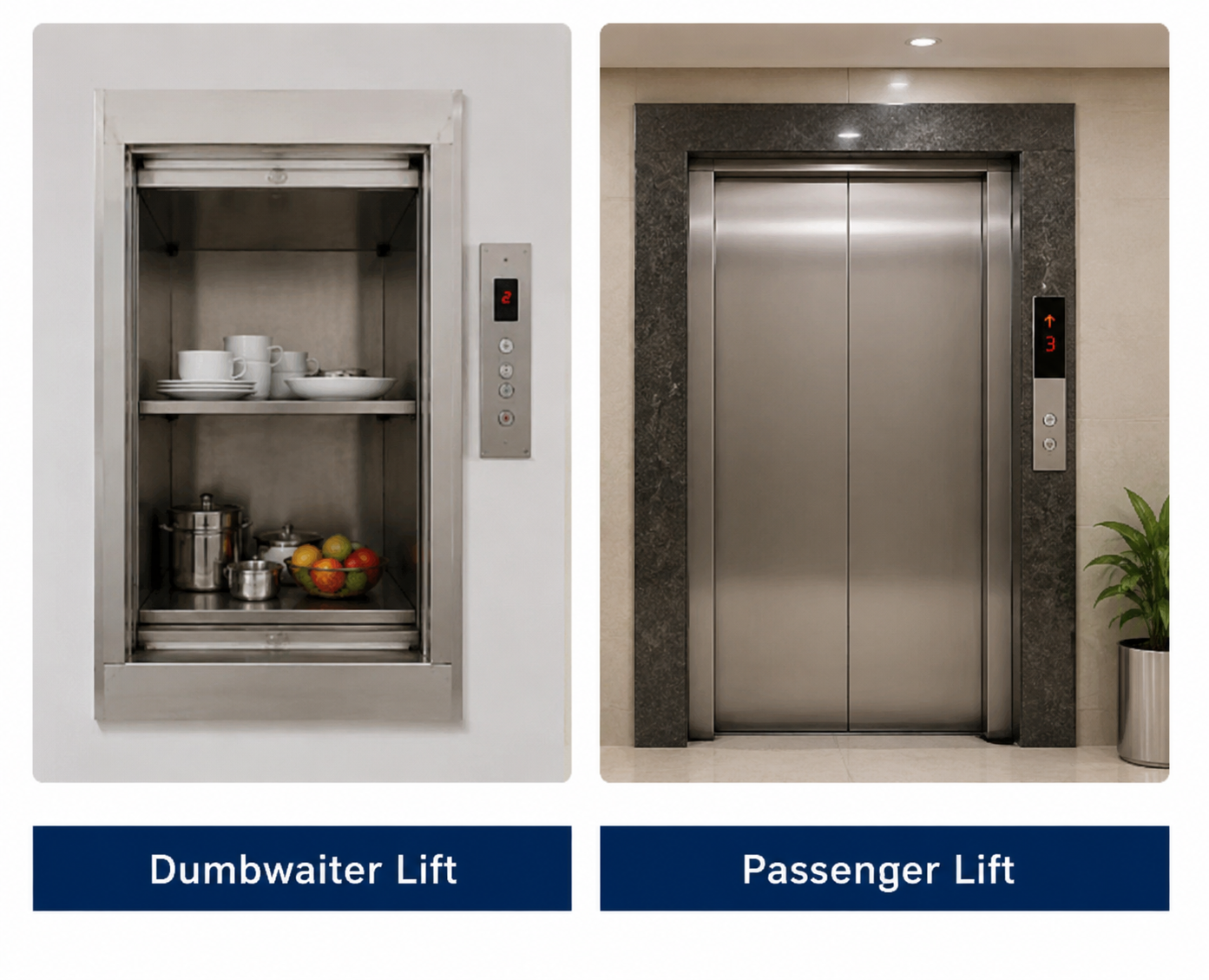
A dumbwaiter lift is a compact lifting system designed primarily to move goods and materials between floors.
It works like a small internal delivery system.
Instead of employees carrying suitable items up and down stairs, the goods can be loaded into the lift and transported vertically to another designated level.
Depending on the application, a dumbwaiter may be used to transport:
- Food
- Dishes
- Laundry
- Cleaning supplies
- Documents
- Small packages
- Medical supplies
- Laboratory materials
- Retail products
- Household goods
The exact load capacity and dimensions depend on the equipment design and intended application.
The important point is that the system is designed for goods—not for passengers.
The Passenger Lift Has a Different Job
A passenger lift is designed specifically for people.
It provides a safe and convenient way for building occupants to travel between floors.
Think about:
- Office workers going to meetings
- Hotel guests reaching their rooms
- Residents entering their apartments
- Customers visiting shopping centers
- Patients and visitors moving through healthcare facilities
The passenger lift is built around human transportation.
The dumbwaiter lift is built around material transportation.
They may both travel vertically, but their jobs are completely different.
That’s why comparing the two isn’t really about deciding which one is “better.”
It’s about asking a more important question:
What exactly are you trying to move?
When Carrying Things Becomes a Business Problem
Carrying a box upstairs once isn’t a big deal.
Doing it 50 times a day is another story.
In businesses where materials constantly move between floors, manual transportation can quietly consume a huge amount of time.
Employees may spend part of their shifts:
- Walking between floors
- Carrying supplies
- Transporting food
- Moving laundry
- Delivering stock
- Returning empty containers
Over time, these small trips add up.
A dumbwaiter lift can help reduce this unnecessary movement by creating a dedicated route for suitable goods.
This doesn’t just save time.
It can help employees spend more of their working hours on tasks that actually require their attention.
The Restaurant That Never Stops Moving
Restaurants are one of the clearest examples of where dumbwaiters can make a difference.
In a multi-floor restaurant, the kitchen and dining areas may be separated by one or more levels.
During quiet hours, carrying food upstairs might seem easy.
During peak hours, it’s a completely different story.
The staff are already busy.
The stairs become crowded.
Orders need to arrive quickly.
A dumbwaiter lift can support the movement of suitable food, dishes, and supplies between designated areas.
Instead of sending a staff member on another trip, the restaurant has a dedicated vertical transportation route.
The result can be a smoother workflow and fewer unnecessary journeys.
For restaurants, hotels, and catering operations, that can make a real difference during the busiest part of the day.
Hotels: Where Efficiency Happens Behind the Scenes
Hotel guests rarely think about how supplies move through a building.
But hotel operations depend on constant internal transportation.
Laundry needs to move.
Supplies need to be delivered.
Food and service items need to reach different areas.
Cleaning materials need to be available where staff need them.
A dumbwaiter lift can support these behind-the-scenes activities by providing a dedicated route for suitable goods.
Meanwhile, the passenger lift remains available for guests and staff who need to travel between floors.
This separation can help create a more organized operation.
Guests get a smoother experience.
Staff get a more efficient workflow.
And the building makes better use of its vertical space.
Hospitals: Moving Supplies Without Creating Extra Traffic
Hospitals are busy environments where logistics can be just as important as patient care.
Medical supplies, clean materials, equipment, and other items may need to move between different departments and floors.
Using a dedicated goods transportation system can help reduce unnecessary manual carrying and movement through public areas.
Depending on the hospital’s procedures, different transportation routes may also be used for different types of materials.
For example, clean supplies and used materials may require separate handling processes.
A dumbwaiter lift can support these workflows when the system is properly designed for the intended application.
The result is a more organized approach to internal material movement.
Warehouses Are Going Up
Warehouses used to be thought of as huge spaces spread across one floor.
Today, that’s changing.
Businesses are increasingly looking upward.
Mezzanine floors, multi-level storage, and vertical inventory systems allow companies to make better use of expensive floor space.
But vertical storage creates a challenge.
Products have to move between levels.
For smaller and suitable loads, a dumbwaiter lift can provide an efficient solution.
Instead of repeatedly carrying boxes between floors, employees can use dedicated lifting equipment.
For heavier or larger loads, however, a freight or goods lift may be more suitable.
The key is matching the equipment to the job.
What Makes a Good Dumbwaiter Lift?
Not every building needs the same type of system.
Before choosing a dumbwaiter, consider what you actually need it to do.
Capacity
How heavy are the items?
A restaurant may need to move food and dishes, while a warehouse may require a higher-capacity system.
Choose the capacity based on the maximum intended load and applicable requirements.
Cabin Size
Weight isn’t the only consideration.
The items must physically fit inside the cabin.
Measure the largest objects you expect to transport before selecting the equipment.
Travel Distance
How many floors will the lift serve?
A system serving two floors may have very different requirements from one serving six or more levels.
Frequency of Use
Will the lift operate a few times per hour or continuously throughout the day?
High-frequency applications may require equipment designed for more intensive operation.
Door Configuration
The door arrangement affects loading and unloading.
The appropriate configuration depends on the building layout, available space, equipment design, and applicable safety requirements.
Maintenance
A lift is a long-term investment.
Regular inspection and maintenance are essential for reliable operation and safety.
Don’t Make the Mistake of Choosing the Wrong Lift
Here’s a simple rule:
If people need to move, think passenger lift.
If suitable goods need to move, think dumbwaiter lift.
If heavy industrial loads need to move, consider a dedicated freight or goods lift.
Trying to make one system handle every type of transportation may not be the most efficient approach.
The smartest buildings often use different systems for different purposes.
This creates a transportation network where people and materials can move without getting in each other’s way.
The Real Value Isn’t the Lift—It’s the Time You Get Back
The biggest advantage of a dumbwaiter lift isn’t simply that it moves a box from Floor 1 to Floor 3.
It’s the time it saves.
Think about all the trips employees make during a typical day.
One trip may take five minutes.
Another may take ten.
Multiply that across an entire team and an entire year.
Suddenly, those small journeys represent a significant amount of lost productivity.
A properly designed dumbwaiter system can help reduce some of that repetitive movement.
The result can be:
- Faster internal logistics
- Less manual carrying
- Better staff productivity
- Reduced unnecessary movement
- Improved workflow
- More efficient use of building space
That’s why a small lift can have a surprisingly large impact.
A Smarter Future for Vertical Transportation
The future of elevators isn’t about choosing between people and goods.
It’s about giving each one the right system.
A passenger lift can move people safely and efficiently.
A dumbwaiter lift can support the movement of suitable goods.
A freight lift can handle heavier materials.
Automated systems can manage specialized logistics.
Together, these technologies can create a more efficient building where every type of movement has a purpose-built solution.
As businesses continue to optimize space and productivity, dedicated material transportation will become increasingly important.
https://newsgrow.blogspot.com/2026/07/why-moving-walkway-systems-and-quality.html
https://newsgrow.blogspot.com/2026/07/dumbwaiter-lift-vs-passenger-lift-small.html