Imagine walking toward your office door, apartment entrance, hotel room, warehouse, or restricted facility. You don’t reach into your pocket searching for a metal key. You don’t type a password. You simply tap a small card or bring a compact fob near a reader—and the door unlocks.
That simple moment is changing the way businesses and property owners think about security.
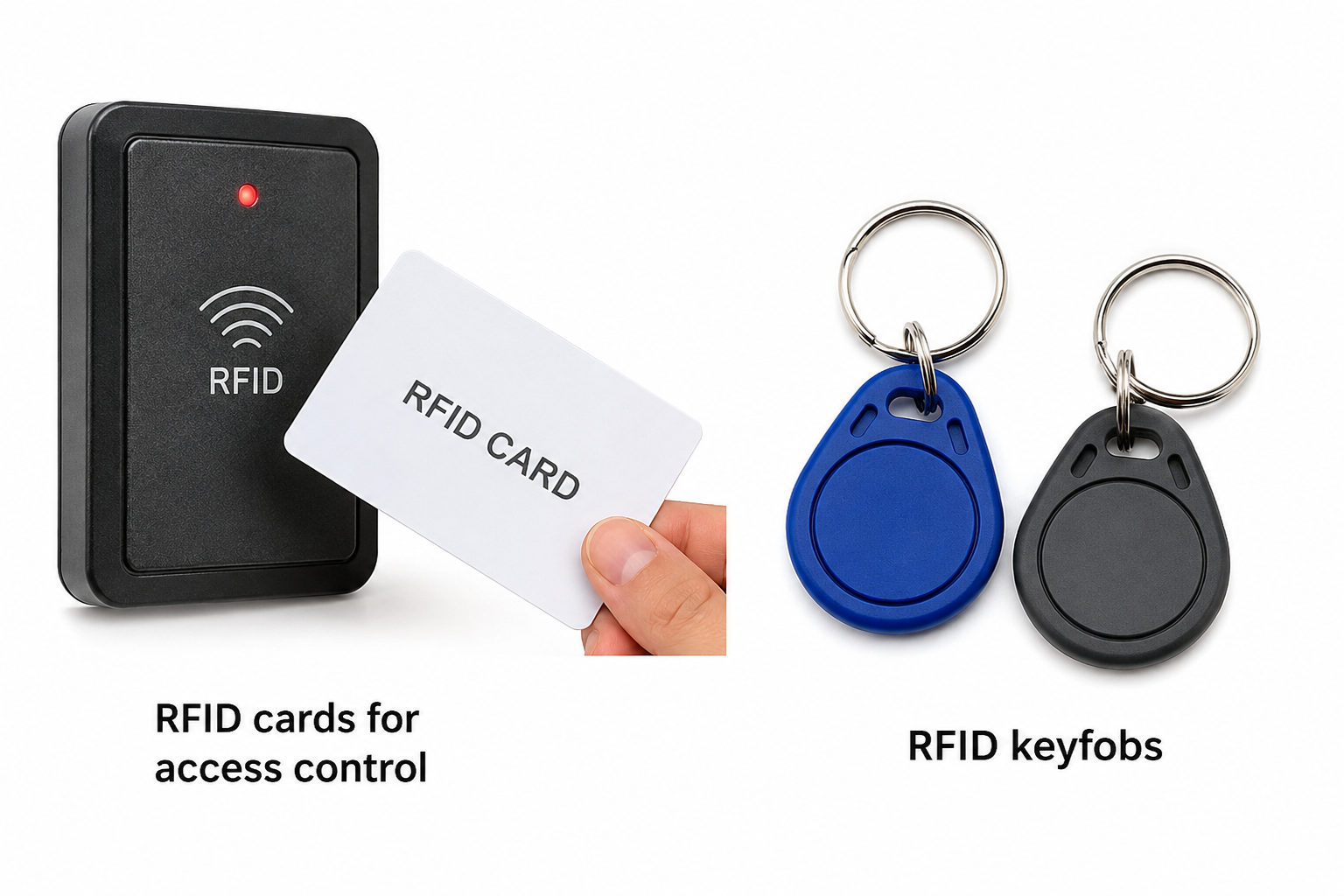
Today, RFID cards for access control and RFID keyfobs are becoming popular solutions for managing who can enter a building, when they can enter, and which areas they are authorized to access. Unlike traditional keys, RFID credentials can be managed electronically, making it easier for organizations to add users, remove permissions, track access activity, and respond quickly when a security issue occurs.
But how does RFID access control actually work? And should you choose an RFID card or an RFID keyfob?
Let’s break it down.
What Are RFID Cards for Access Control?
RFID cards for access control are contactless credentials that use Radio Frequency Identification technology to communicate with an RFID reader.
The card contains an embedded RFID chip and antenna. When the card is presented near a compatible reader, the reader detects the credential and sends the relevant information to an access control system. The system then checks whether the user has permission to enter.
If the credentials are valid, the electronic lock releases.
If access is denied, the door remains secured.
This process happens quickly, often in just a fraction of a second, giving authorized users convenient entry without requiring traditional keys.
The real advantage is not just convenience. RFID access control gives administrators greater control over credentials. Access permissions can often be added, changed, suspended, or revoked without physically replacing the entire locking mechanism.
That makes RFID particularly useful for:
- Corporate offices
- Apartment and residential buildings
- Hotels and hospitality facilities
- Schools and universities
- Hospitals and healthcare facilities
- Warehouses and logistics centers
- Manufacturing plants
- Data centers
- Fitness centers
- Government and commercial facilities
What Are RFID Keyfobs?
RFID keyfobs offer the same basic concept in a smaller and more portable format.
Instead of using a card-sized credential, an RFID keyfob is a compact device that can be attached to a keyring, carried in a pocket, or clipped to a personal ID holder.
The user simply brings the keyfob close to the RFID reader. The reader communicates with the embedded RFID technology, verifies the credential through the access control system, and unlocks the door if authorization is confirmed.
For users who already carry keys, badges, or other everyday items, RFID keyfobs can be an extremely convenient access solution.
They are particularly practical for:
- Employees
- Apartment residents
- Hotel staff
- Maintenance teams
- Contractors
- Security personnel
- Gym members
- Temporary workers
- Visitors with limited access privileges
The biggest benefit is flexibility. Administrators can issue credentials according to individual access requirements rather than giving every person unrestricted access.
RFID Cards vs. RFID Keyfobs: Which One Is Better?
There is no universal winner.
The right option depends on how the access control system will be used.
RFID cards for access control are often ideal when organizations want a professional identification solution. Cards can be printed with employee names, photographs, company branding, job titles, or other visual information.
This makes them useful in offices, schools, hospitals, and large organizations where identification is important.
RFID keyfobs, on the other hand, are compact and easy to carry. They are a strong choice when users need quick access without carrying a larger card.
A simple comparison:
| Feature | RFID Cards | RFID Keyfobs |
| Size | Card-sized | Compact |
| Portability | Easy to carry in wallet or badge holder | Easy to attach to keys |
| Branding | Excellent for logos and employee IDs | Limited surface area |
| Identification | Can include photo and printed details | Usually minimal visual identification |
| Convenience | High | Very high |
| Best for | Offices, schools, hotels, organizations | Apartments, gyms, employees, contractors |
| Access management | Electronic and configurable | Electronic and configurable |
In short, choose RFID cards for access control when identification and professional presentation matter. Choose RFID keyfobs when compact size and everyday convenience are the priority.
Many organizations use both.
How Does an RFID Access Control System Work?
An RFID access control system typically combines several components that work together.
1. RFID Credential
The credential may be an RFID card or an RFID keyfob. It stores the information required by the access control system to identify the user.
2. RFID Reader
The reader is installed near the protected entrance. It detects the RFID credential when it comes within the reader’s operating range.
3. Access Control Panel
The control panel processes the credential information and determines whether access should be granted.
4. Electronic Lock
If authorization is successful, the system sends a command to the electronic locking mechanism, allowing the user to enter.
5. Management Software
Modern systems may include centralized or cloud-based software that allows administrators to manage users, permissions, schedules, and access records.
The entire process is designed to make authorized access fast while keeping restricted areas protected.
Active vs. Passive RFID: What’s the Difference?
RFID technology is generally divided into active and passive systems.
Active RFID devices contain their own power source and can communicate over much greater distances. They are commonly used for applications such as tracking vehicles, equipment, and moving assets.
Passive RFID credentials do not contain their own battery. Instead, they receive energy from the RFID reader when they are brought within the required range.
For everyday building access, passive RFID is commonly used because the credentials are small, lightweight, and convenient.
This makes passive RFID technology a natural fit for RFID cards for access control and RFID keyfobs.
Low-Frequency, High-Frequency, and UHF RFID
Not every RFID system operates in exactly the same way.
Low-Frequency RFID
Low-frequency RFID systems typically operate around 125 kHz and are designed for short-range communication.
The user generally needs to bring the card or fob close to the reader.
This can be useful for controlled entry points where deliberate credential presentation is preferred.
High-Frequency RFID
High-frequency systems commonly operate at 13.56 MHz and can offer greater flexibility. Some technologies in this frequency range can also support NFC-related applications.
These systems are widely used in access control, identification, and other contactless applications.
Ultra-High-Frequency RFID
UHF RFID can provide significantly longer reading distances, depending on the equipment and environment.
However, longer-range communication can also introduce different considerations, including interference and security requirements. UHF is therefore often associated with vehicle identification, gates, asset tracking, and specialized applications rather than conventional door access.
The right RFID frequency depends on the environment, required read range, security architecture, and application.
Why Are RFID Cards and Keyfobs Replacing Traditional Keys?
Traditional keys have one major weakness: once someone has the physical key, they may be able to enter.
If the key is lost, stolen, or copied, the property owner may have to replace the lock or rekey the system.
RFID access control changes that model.
With properly designed electronic access systems, administrators can manage credentials digitally. If an employee leaves the company, access can be revoked. If a contractor only needs access for one week, permissions can be limited. If a visitor requires temporary entry, a temporary credential can be issued.
This creates a more flexible approach to security management.
The benefits can include:
- Faster credential management
- Easier employee onboarding and offboarding
- Centralized access control
- Detailed access event records
- Temporary access permissions
- Reduced dependency on physical keys
- Remote management capabilities in supported systems
- Integration with other security technologies
The Viral Advantage: RFID Turns a Door Into a Data Point
Here’s where RFID access control becomes more interesting.
An RFID door isn’t simply a lock.
It can become part of a larger security ecosystem.
When integrated with suitable access management software, an RFID system may provide information about access events—such as which credential was presented and whether access was granted or denied.
Organizations can potentially connect access control with:
- CCTV systems
- Security alarms
- Visitor management platforms
- Time and attendance systems
- Building management systems
- Cloud-based security dashboards
- Automated notification systems
This means a single access event can become part of a larger security workflow.
For example, an unauthorized credential attempt could trigger an alert for security personnel. In a more integrated environment, the event could also be associated with relevant video footage for investigation.
That is one reason modern access control is moving beyond the simple question of “Does the door open?”
The bigger question is now:
Who entered, when did they enter, where did they go, and what happened next?
RFID Access Control for Checkpoints
RFID technology can also be used to support security patrols.
Imagine a large warehouse, manufacturing plant, or commercial property with multiple sensitive areas.
Security personnel may be required to check specific locations during their shifts. RFID checkpoints can help create a digital record showing when designated areas were visited.
This can provide useful information during security investigations and help organizations understand whether required patrol procedures were completed.
The technology does not replace professional security procedures, but it can support better monitoring and documentation.
What Features Should You Look for?
Choosing an RFID access control system requires more than simply selecting a reader and a card.
Consider the following features.
Automatic Relocking
An automatic relocking function can help ensure that doors do not remain unintentionally unlocked after authorized entry.
Reprogrammable Credentials
For organizations with frequent employee turnover or temporary workers, reprogrammable credentials can make access management easier.
Administrators can update or revoke permissions instead of relying on permanent access credentials.
Anti-Tamper Protection
Anti-tamper functionality can help detect unauthorized attempts to manipulate the reader or access system.
Depending on the system, an event may trigger an alarm or notification.
Mobile and Remote Management
Modern systems may provide web-based dashboards or mobile applications that allow authorized administrators to manage credentials remotely.
This can be especially valuable for businesses with multiple locations.
Visitor Access
A complete access control strategy should also consider visitors, vendors, and contractors.
Some systems can support temporary credentials, PIN codes, digital passes, or other controlled access methods.
This prevents organizations from having to issue permanent credentials to short-term visitors.
How Secure Are RFID Cards and Keyfobs?
RFID technology can offer significant security benefits, but no access control system should be considered automatically secure simply because it uses RFID.
Security depends on the complete system, including the credential technology, encryption, reader design, access management software, installation, and administrative practices.
Organizations should evaluate:
- Credential security
- Encryption capabilities
- Authentication methods
- Lost-card and lost-fob procedures
- User permission management
- Audit logs
- Software updates
- Physical protection of readers and control panels
- Integration with broader security systems
The most important lesson is simple:
RFID is a technology, not a complete security strategy.
A well-designed RFID access control system combines secure credentials with strong administrative controls and appropriate physical security.
The Future of RFID Access Control
The future of access control is becoming increasingly connected.
While RFID cards for access control and RFID keyfobs remain practical and widely useful, organizations are also exploring mobile credentials, biometric authentication, cloud-based access management, and smart building integrations.
The result could be a hybrid security environment in which users choose the most convenient credential for their situation.
An employee might use a physical RFID card.
A maintenance worker might carry an RFID keyfob.
A visitor might receive temporary digital credentials.
An administrator might manage the entire system remotely from a secure dashboard.
This shift is transforming access control from a simple physical lock into an intelligent security platform
https://newsgrow.blogspot.com/2026/07/nfc-tag-china-and-nfc-wristbands-for.html
https://newsgrow.blogspot.com/2026/07/what-is-rfid-door-entry-system.html