Dentistry has always been a field where precision matters. A tiny measurement can affect the fit of a crown, the comfort of an appliance, or the success of a treatment. Today, digital technology is giving dental professionals new ways to achieve that precision while making everyday workflows faster and more efficient.
One of the biggest changes is the shift from traditional physical impressions to digital scanning.
With an intraoral scanner, dentists can capture detailed digital information directly from a patient’s mouth. That information can then be transferred into digital design software and, in suitable workflows, sent to a 3D printer to create customized dental products.
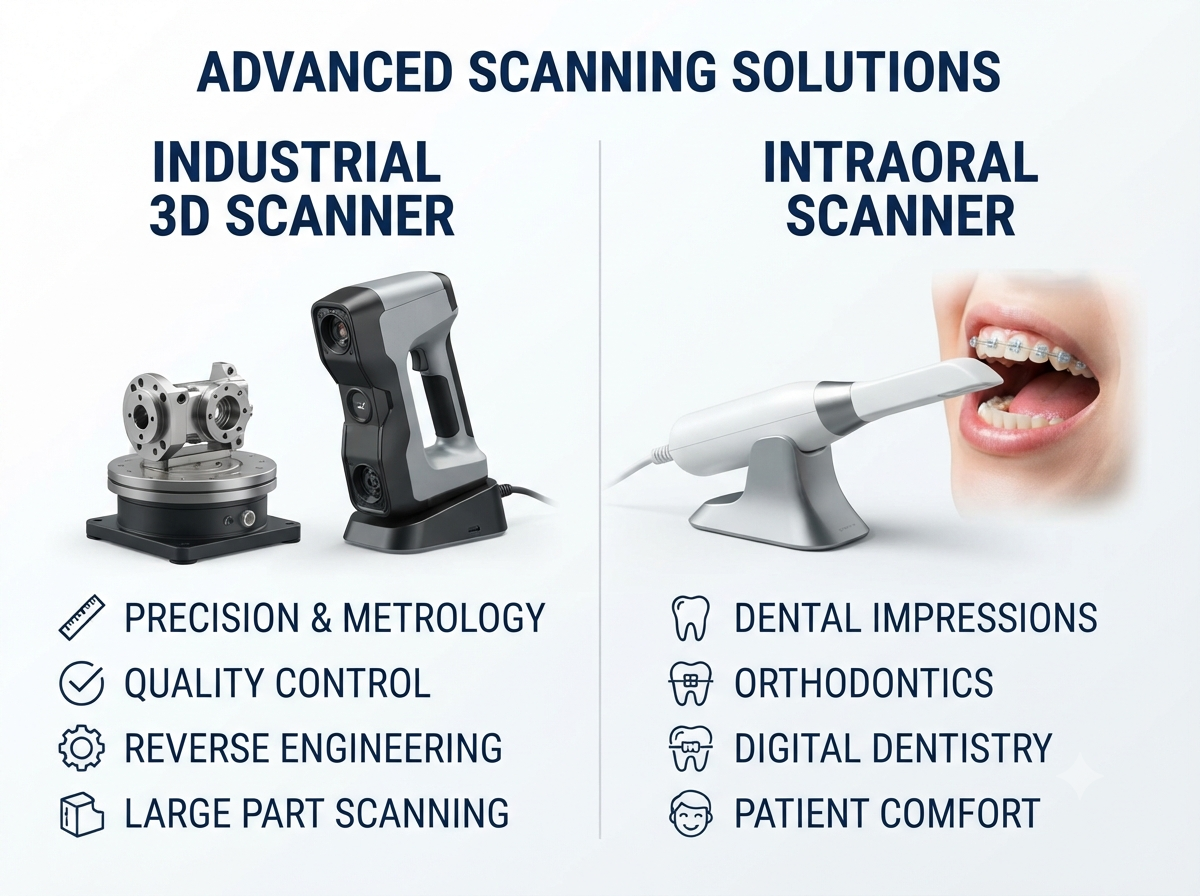
At the same time, the growth of the industrial 3d scanner is demonstrating how high-precision scanning technology is transforming manufacturing, inspection, research, and product development.
Although these scanners serve different purposes, they share a common idea: turning the physical world into useful digital data.
And when digital scanning meets 3D printing, the possibilities for dentistry become even more exciting.
From Traditional Impressions to Digital Scans
For many years, dental impressions were an essential part of treatment planning and restorative procedures. While traditional impression techniques continue to have their place, digital scanning is providing an alternative approach for many modern dental workflows.
An intraoral scanner uses advanced optical technology to capture the patient’s teeth and oral structures and create a digital representation.
Instead of physically transporting an impression to a laboratory, digital data can be stored and transferred electronically.
This can help simplify several parts of the dental workflow.
The process can look something like this:
Patient Scan → Digital Data → CAD Design → 3D Printing → Post-Processing → Dental Application
This connected approach is one of the main reasons digital dentistry is attracting so much attention.
Why 3D Printing Is Becoming Important in Dentistry
3D printing is changing more than just how products are manufactured. It is changing how dental professionals think about production itself.
In a traditional workflow, a dental practice may depend on outside laboratories for certain models, appliances, and temporary solutions.
With suitable equipment and expertise, some of these applications can potentially be produced in-house.
This can give practices greater control over:
- Production schedules
- Design changes
- Manufacturing
- Turnaround times
- Case management
- Customization
The goal isn’t necessarily to eliminate dental laboratories. Instead, digital manufacturing allows practices to determine which applications are better suited for in-house production and which should remain outsourced.
Faster Workflows Can Mean Better Patient Experiences
Patients don’t want to spend more time in the dental chair than necessary.
They also don’t want to attend multiple appointments when a suitable solution could potentially be completed more efficiently.
Digital workflows can help address these expectations.
An intraoral scanner can capture digital impressions without many of the traditional steps associated with physical impression materials. The resulting data can be transferred to design software almost immediately.
From there, the dental team can prepare the digital design and, when appropriate, manufacture the required product using a compatible 3D printer.
For selected cases, this can reduce waiting periods and improve the overall patient journey.
The Intraoral Scanner: Where the Digital Journey Begins
Think of the intraoral scanner as the entry point into a digital dental ecosystem.
It allows dental professionals to capture digital information about a patient’s oral structures and use that data for a variety of applications.
Depending on the equipment and software, digital scans can support:
- Orthodontic treatment planning
- Restorative procedures
- Crown and bridge workflows
- Digital models
- Clear aligner planning
- Appliance design
- Patient communication
- CAD/CAM manufacturing
Another important advantage is the ability to store digital records.
Instead of managing physical impressions that can deteriorate or require physical storage space, digital files can be organized and accessed electronically.
For practices managing a large number of patients, this can contribute to a more organized workflow.
Understanding the Industrial 3D Scanner Connection
The term industrial 3d scanner is usually associated with manufacturing and engineering rather than clinical dentistry.
These scanners are designed to capture detailed information from physical objects, components, and products.
They can support applications such as:
- Quality control
- Reverse engineering
- Dimensional inspection
- Prototyping
- Product development
- Manufacturing analysis
- Research
So, what does this have to do with dentistry?
The connection is digital data.
The same broader principle of capturing a physical object and converting it into a digital model is driving innovation across multiple industries.
In dental manufacturing, laboratories and equipment developers can also benefit from advanced scanning technologies for certain design, development, and manufacturing applications.
As digital workflows continue to expand, the boundaries between healthcare technology and industrial manufacturing are becoming increasingly connected.
3D Printing Applications That Can Add Value to Dental Practices
The real power of 3D printing becomes clear when we look at practical applications.
Dental Models
Dental models are among the most common uses of 3D printing.
A digital impression captured using an intraoral scanner can be converted into a printable file and used to create a physical model.
These models may support:
- Orthodontic treatment
- Restorative planning
- Study purposes
- Retainer production
- Mouth guard workflows
- Patient education
For practices that regularly need models, in-house production can potentially improve turnaround times and reduce dependence on external suppliers.
Occlusal Splints
Occlusal splints are another application that can benefit from digital workflows.
A dentist can capture the patient’s digital information, prepare the design, and send the file to a compatible 3D printer.
This can help streamline production and may offer cost advantages for practices that handle a high volume of cases.
However, the workflow should always follow the manufacturer’s material requirements and applicable clinical standards.
Temporary Restorations
Temporary restorations can sometimes be produced through a combination of digital scanning, CAD design, and 3D printing.
The digital workflow allows the dental team to work from patient-specific data rather than relying entirely on manual fabrication.
For appropriate cases, this may provide a faster route to producing temporary solutions.
Orthodontic Applications
Orthodontics is another area where digital technology is making a major impact.
Digital scans can be used for treatment planning, model creation, and certain appliance workflows.
The ability to digitally store and reproduce patient data can also make case management more convenient.
Patient Education
Not every benefit of 3D printing is directly related to manufacturing.
Sometimes, the biggest advantage is communication.
A physical 3D printed model can help patients understand their dental condition and visualize potential treatment options.
For patients who struggle to understand complex dental explanations, a physical model can make consultations easier to follow.
How Can Dental Practices Improve Their ROI?
The financial benefits of digital dentistry depend heavily on how the technology is implemented.
Simply purchasing a 3D printer isn’t enough.
A practice should first identify where its biggest costs and workflow delays occur.
For example, it may be worth examining:
- Which products are frequently outsourced?
- How much are laboratory services costing?
- Which cases take the longest to complete?
- How often are models required?
- How much time does the team spend on manual processes?
- What applications could realistically be handled in-house?
Once these questions are answered, practices can determine whether investing in scanning and 3D printing technology makes financial sense.
The best ROI usually comes from technology that is used consistently.
A printer sitting unused is an expense.
A well-integrated digital workflow can become a productivity tool.
Choosing the Right Technology
Not every scanner or printer is suitable for every application.
When selecting an intraoral scanner, dental practices may want to consider:
- Scanning speed
- Accuracy
- Ease of operation
- Software integration
- File compatibility
- Learning curve
- Technical support
Similarly, choosing a 3D printer requires careful consideration of:
- Printing accuracy
- Resolution
- Speed
- Material compatibility
- Reliability
- Maintenance
- Post-processing requirements
The cheapest equipment isn’t always the most economical choice in the long run.
For professional dental applications, consistency and reliability can be just as important as the initial purchase price.
Building a Complete Digital Workflow
The strongest results come when every part of the system works together.
A modern digital workflow can involve several connected stages.
Step 1: Capture
The patient is digitally scanned using an intraoral scanner.
Step 2: Process
The digital scan is cleaned, reviewed, and prepared for the next stage.
Step 3: Design
Dental professionals use compatible CAD software to create the required design.
Step 4: Manufacture
The design is sent to a suitable 3D printer.
Step 5: Post-Process
The printed product is washed, cured, polished, or finished according to the material and manufacturer’s instructions.
Step 6: Apply
The completed product is used for its intended dental application in accordance with appropriate clinical protocols.
This type of workflow can help connect diagnosis, design, and manufacturing into a single digital ecosystem.
Is Digital Dentistry the Future?
The answer is increasingly clear: digital technology will continue to play an important role in dentistry.
As artificial intelligence, 3D scanning, CAD software, and additive manufacturing continue to develop, dental professionals will have access to increasingly sophisticated tools.
The intraoral scanner is helping transform how patient data is captured.
3D printing is changing how selected dental products can be manufactured.
And the industrial 3d scanner represents the wider evolution of precision digital capture across manufacturing and engineering.
Together, these technologies reflect a larger movement toward connected, data-driven production.
https://newsgrow.blogspot.com/2026/07/best-3d-scanner-and-best-dental-scanner.html
https://newsgrow.blogspot.com/2026/07/how-3d-scanning-and-3d-printing-are.html