The global demand for lightweight, durable, and versatile materials is encouraging manufacturers to invest in advanced production technologies. Among these technologies, the Non Woven Making Machine is becoming increasingly important for businesses seeking efficient, scalable, and reliable fabric manufacturing solutions. From medical products and hygiene materials to agriculture, construction, filtration, automotive, and packaging, non woven fabrics are now used across a wide range of industries.
As manufacturers focus on improving production efficiency while maintaining consistent product quality, the modern Non Woven Machine is helping transform traditional manufacturing processes. Advanced automation, improved material handling, energy-efficient systems, and flexible production capabilities are allowing manufacturers to respond more effectively to changing market requirements.
Understanding the Growing Importance of Non Woven Manufacturing
Unlike conventional woven fabrics, non woven materials are produced without interlacing yarns. Instead, fibers are bonded through mechanical, thermal, or chemical processes to create a fabric-like material with specific performance characteristics.
This manufacturing approach provides several advantages, including:
- High production efficiency
- Flexible material customization
- Lightweight construction
- Excellent filtration capabilities
- Strong moisture resistance
- Cost-effective large-scale production
- Wide application potential
The increasing adoption of disposable hygiene products, medical textiles, protective materials, filtration media, and sustainable packaging has created new opportunities for non woven fabric manufacturers.
How a Non Woven Making Machine Supports Efficient Production
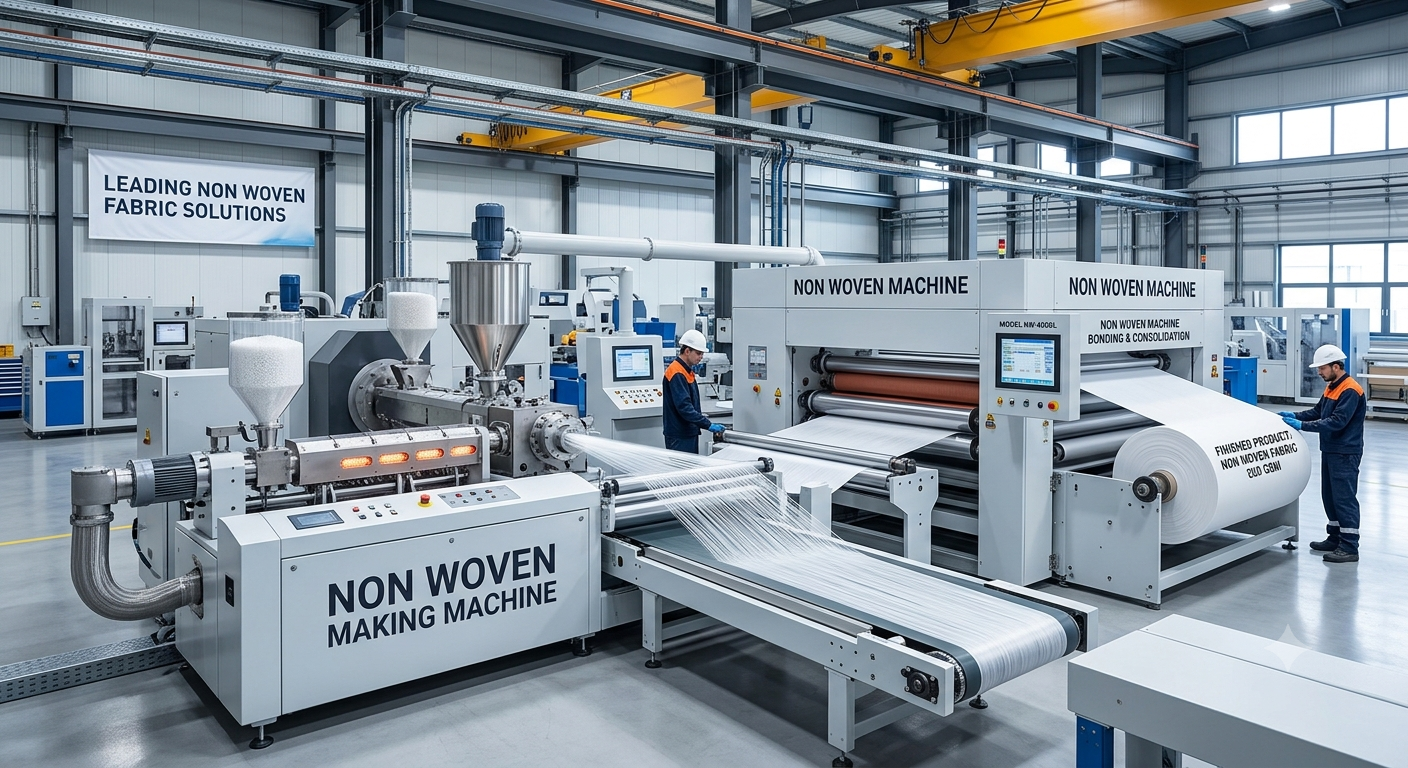
A modern Non Woven Making Machine integrates multiple stages of production into a coordinated manufacturing system. Depending on the technology and final product requirements, the production line may include fiber opening, blending, web formation, bonding, drying, cooling, winding, and cutting.
Key Production Stages
1. Fiber Preparation
The manufacturing process begins with preparing raw materials such as polypropylene, polyester, viscose, recycled fibers, or other suitable materials. Proper fiber preparation helps ensure uniformity and stable production.
2. Web Formation
Fibers are distributed into a web using specialized equipment. Consistent web formation is essential because it influences the thickness, strength, density, and overall quality of the finished fabric.
3. Fiber Bonding
The fiber web is bonded using the appropriate technology. Depending on the application, manufacturers may use thermal bonding, needle punching, spunbond processes, meltblown techniques, or other production methods.
4. Finishing and Winding
After bonding, the material may undergo finishing treatments before being cooled, inspected, and wound into rolls. Automated systems can improve consistency while reducing manual intervention.
Choosing the Right Non Woven Machine for Business Requirements
Selecting the right Non Woven Machine requires manufacturers to consider their production goals, raw materials, product specifications, and target markets. A machine designed for medical-grade materials, for example, may have different requirements from equipment used for geotextiles or agricultural fabrics.
Important considerations include:
| Selection Factor | Why It Matters |
| Production Capacity | Determines output and scalability |
| Raw Material Compatibility | Ensures stable processing |
| Automation Level | Influences labor requirements and consistency |
| Energy Efficiency | Helps manage long-term operating costs |
| Product Width | Supports different application requirements |
| Maintenance | Affects uptime and equipment longevity |
| Quality Control | Helps maintain consistent finished products |
Businesses should also evaluate supplier experience, technical support, spare-parts availability, installation assistance, and after-sales service before making an investment.
Applications Across Multiple Industries
The versatility of non woven materials has made them essential in numerous sectors. A high-quality Non Woven Making Machine can support the production of materials designed for specialized applications.
Healthcare and Hygiene
Non woven fabrics are widely used in surgical gowns, face masks, medical drapes, wound-care products, diapers, sanitary products, and other hygiene applications.
Agriculture
Agricultural non woven materials can be used for crop protection, plant covers, weed control, and soil management. Their lightweight design and functional properties make them suitable for modern farming applications.
Construction
In construction, non woven geotextiles are used for drainage, filtration, separation, erosion control, and soil stabilization. Reliable production equipment is essential for creating materials with consistent strength and durability.
Filtration
Non woven filter media are used in air filtration, liquid filtration, industrial systems, and automotive applications. Manufacturers can adjust material properties according to specific filtration requirements.
Automotive
Automotive manufacturers use non woven materials for insulation, interior components, sound absorption, trunk liners, and other functional applications.
Technology Trends Shaping the Non Woven Industry
The non woven manufacturing sector is evolving as producers seek greater automation, sustainability, and operational efficiency. Modern equipment increasingly incorporates digital monitoring, automated controls, precision material handling, and intelligent production management.
Some important industry trends include:
- Automation and Smart Controls: Automated systems help reduce production variability and improve process monitoring.
- Sustainable Materials: Manufacturers are exploring recycled and renewable fibers to support environmental goals.
- Energy-Efficient Production: Improved equipment design can help reduce energy consumption.
- Customized Products: Flexible production technologies allow manufacturers to develop materials for specialized applications.
- Higher Quality Standards: Advanced inspection and control systems support consistent product performance.
These developments are encouraging manufacturers to view the Non Woven Machine not simply as production equipment but as a strategic investment in long-term manufacturing capabilities.
Benefits of Investing in Modern Production Equipment
A well-designed production line can provide significant advantages for manufacturers competing in demanding markets.
Key benefits include:
- Improved production consistency
- Higher operational efficiency
- Reduced material waste
- Greater product flexibility
- Better process control
- Increased manufacturing capacity
- Enhanced opportunities for product innovation
However, businesses should avoid selecting equipment based solely on purchase price. Total cost of ownership, production reliability, energy use, maintenance requirements, and technical support can have a major impact on long-term profitability.
Frequently Asked Questions
1. What is a Non Woven Making Machine?
A Non Woven Making Machine is industrial equipment used to manufacture non woven fabrics by forming and bonding fibers through specialized production processes.
2. What is a Non Woven Machine used for?
A Non Woven Machine is used to produce materials for healthcare, hygiene, agriculture, construction, filtration, automotive, packaging, and industrial applications.
3. What raw materials can be used?
Depending on the production technology, manufacturers may process polypropylene, polyester, viscose, recycled fibers, and other suitable materials.
4. Are non woven fabrics environmentally friendly?
Environmental performance depends on the raw materials, manufacturing process, product lifespan, and disposal method. Recycled and recyclable materials can help improve sustainability.
5. How do manufacturers choose the right machine?
Manufacturers should consider production capacity, fabric specifications, raw material compatibility, automation, energy efficiency, maintenance, and technical support.
6. Can machines produce customized non woven fabrics?
Yes. Many production systems can be configured to meet specific requirements involving fabric weight, width, thickness, strength, and application.
7. Is automation important in non woven production?
Automation can improve process consistency, reduce manual intervention, support quality control, and increase operational efficiency.
8. What industries use non woven fabrics?
Major users include healthcare, hygiene, agriculture, construction, filtration, automotive, packaging, and various industrial sectors.
9. What should buyers check before purchasing equipment?
Buyers should evaluate machine specifications, supplier reputation, installation support, spare parts, maintenance services, warranty coverage, and after-sales assistance.
10. Why is non woven manufacturing growing?
Demand is increasing because non woven materials are versatile, lightweight, customizable, and suitable for numerous industrial and consumer applications.
https://newsgrow.blogspot.com/2026/06/non-woven-making-machine-powers_02118797615.html