Steel tubes are fundamental components of modern industrial development. They can be found in buildings, bridges, vehicles, agricultural equipment, furniture, machinery, energy projects, and countless engineering applications. Although the finished tube appears simple, its manufacturing process involves carefully controlled forming, welding, sizing, and finishing operations.
The Tube Mill Machine has played a central role in making this production possible at an industrial scale. Over time, tube mill technology has evolved from mechanically operated equipment into automated systems capable of continuous production and sophisticated quality monitoring.
A particularly important development has been the ERW Tube Mill Machine, which uses Electrical Resistance Welding to join formed metal strip. Its development has helped manufacturers increase production efficiency while maintaining consistent tube characteristics.
From Basic Tube Production to Industrial Manufacturing
The history of tube production began with relatively simple manufacturing techniques. Flat metal sheets or strips were shaped into tubular forms and joined along their edges. These early processes required considerable operator involvement and offered limited production capacity.
As industrialization progressed, the demand for steel tubes increased.
Railways required tubular components, construction projects needed structural products, automotive manufacturers required engineered sections, and machinery producers needed dependable metal components.
The industry needed a production method capable of producing larger quantities with greater consistency.
This requirement encouraged the development of continuous roll-forming technology.
The Birth of Continuous Tube Mill Production
Continuous roll forming changed the economics of tube manufacturing.
Instead of producing tubes individually, manufacturers could feed a continuous metal strip through a sequence of forming stands. Each stand gradually changed the geometry of the strip.
Eventually, the edges approached one another, creating the foundation for a tubular profile.
This continuous process increased productivity and established the operating principle behind many modern Tube Mill Machine systems.
The development also created opportunities to integrate welding, sizing, and cutting into a single production line.
ERW Technology Becomes a Major Milestone
Electrical Resistance Welding brought another important change to tube manufacturing.
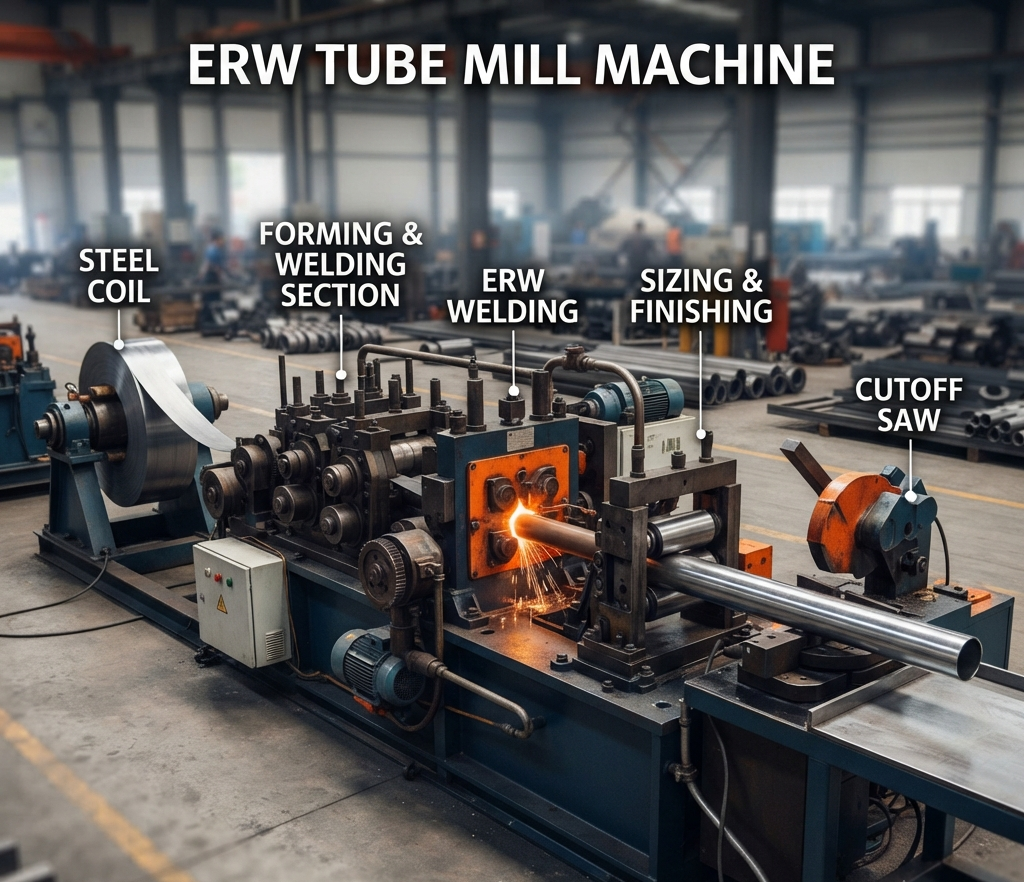
An ERW Tube Mill Machine uses electrical energy to generate heat at the edges of the formed strip. Pressure is applied as the edges are joined, creating a continuous longitudinal weld.
Because the welding process takes place while the strip moves through the mill, production can continue without repeatedly stopping for individual welding operations.
A modern ERW line may include:
- Coil loading equipment
- Uncoiling systems
- Strip preparation
- Forming stands
- Resistance welding
- Weld bead removal
- Sizing rolls
- Cutting equipment
- Straightening
- Online inspection
The integration of these operations has made ERW technology highly relevant to industrial tube production.
Why the Modern Tube Mill Is Different
Today’s Tube Mill Machine is not simply a mechanical forming system.
It can combine mechanical engineering, electrical controls, sensors, software, automated drives, welding technology, and inspection systems.
Modern control systems can monitor production conditions and provide operators with information about the manufacturing process.
Important parameters may include:
- Line speed
- Welding power
- Strip alignment
- Roll position
- Motor load
- Cutting length
- Tube dimensions
- Machine condition
The ability to monitor these factors helps manufacturers identify deviations more quickly.
Automation Changes Production Management
Automation has become one of the defining characteristics of modern tube manufacturing.
Earlier systems depended heavily on operator experience for setup and adjustment. Advanced machines can now use programmed production parameters and automated controls.
This can reduce repetitive manual work while improving production consistency.
Automation can also help manufacturers maintain standardized production settings when switching between different product specifications.
The benefits may include:
- Improved repeatability
- Reduced setup errors
- Faster production adjustments
- Better process visibility
- Lower manual intervention
- More consistent manufacturing
The Growing Importance of Digital Quality Control
Manufacturing high-quality tubes requires continuous attention to dimensions and weld performance.
Traditional inspection methods may involve checking finished products after production. Modern systems increasingly bring inspection closer to the production process.
Sensors and measurement equipment can monitor product characteristics while the tube is being manufactured.
Machine vision is another emerging technology. Cameras can inspect surfaces and identify visible irregularities, while software can analyze the collected information.
Future AI-based inspection systems may become capable of recognizing patterns associated with recurring production problems.
Predictive Maintenance Could Reduce Downtime
A tube mill can contain many components that operate continuously under demanding conditions.
Unexpected failure of a motor, bearing, forming component, welding unit, or cutting system can interrupt the entire production process.
Predictive maintenance offers a different approach.
Sensors can monitor machine behavior and identify changes in vibration, temperature, electrical performance, or other parameters.
If the data indicates abnormal behavior, maintenance teams can investigate before a major failure occurs.
For future ERW Tube Mill Machine systems, predictive maintenance could become an integral part of production management rather than a separate maintenance activity.
Energy Efficiency and Material Utilization
The future of manufacturing is increasingly focused on resource efficiency.
Energy consumption affects production costs, while material waste affects both profitability and environmental performance.
Future tube mills are likely to use more efficient motors, advanced drives, optimized welding systems, and intelligent controls to reduce unnecessary energy consumption.
Better process control can also reduce scrap.
If forming, welding, sizing, and cutting remain within the required parameters, fewer products may need to be rejected.
This means that improving efficiency can support both business performance and sustainability objectives.
Flexible Manufacturing Is the Next Challenge
Customer demand is rarely static.
Manufacturers may need to produce different tube diameters, wall thicknesses, materials, and profiles for different customers.
Traditional production systems can require significant setup time when changing products.
Future Tube Mill Machine technology is expected to focus on flexibility through automated adjustments, digital recipes, improved tooling systems, and faster changeovers.
This could allow manufacturers to produce a wider range of products while maintaining efficient production.
The Role of Industry 4.0
Industry 4.0 is influencing manufacturing by connecting machines, data, software, and people.
A future tube mill could become part of a connected factory where production information is automatically exchanged between the manufacturing line, quality-control system, maintenance platform, and production-management software.
Such connectivity could allow manufacturers to understand:
- How efficiently the line is operating
- Where production losses occur
- When equipment requires maintenance
- Which products generate more waste
- How quality changes over time
The result would be a more data-driven approach to tube manufacturing.
Comparing Tube Mill and ERW Tube Mill Technology
| Aspect | Tube Mill Machine | ERW Tube Mill Machine |
| Scope | General tube manufacturing equipment | Specific electrically welded tube mill |
| Main process | Forming and related operations | Forming plus resistance welding |
| Production method | Depends on design | Continuous |
| Automation | Varies | Commonly advanced |
| Product range | Depends on tooling | Suitable for many welded tube applications |
| Main advantage | Flexible tube production concept | Efficient continuous welded-tube production |
The right choice depends on the manufacturer’s product range, material requirements, production capacity, and quality expectations.
What Manufacturers Should Look for in Future Equipment
When evaluating a new mill, manufacturers should consider more than production speed.
A detailed evaluation should cover:
- Material compatibility
- Tube diameter
- Wall thickness
- Production capacity
- Welding requirements
- Tooling flexibility
- Automation
- Inspection systems
- Energy efficiency
- Maintenance requirements
- Technical support
- Future upgrade potential
A machine that can adapt to changing requirements may provide greater long-term value than equipment designed only for today’s production targets.
Frequently Asked Questions
What is a Tube Mill Machine?
A Tube Mill Machine is equipment used to continuously form metal strip into tubular products and may include welding, sizing, cutting, straightening, and inspection operations.
What is an ERW Tube Mill Machine?
An ERW Tube Mill Machine uses Electrical Resistance Welding to join the edges of formed metal strip during continuous tube production.
Why was continuous tube production developed?
It was developed to meet increasing industrial demand for larger quantities of standardized and consistently manufactured tubes.
What is the main advantage of ERW technology?
Its continuous forming and welding process supports efficient production of welded tubes at industrial scale.
Are ERW tubes used outside construction?
Yes. They are also used in automotive, furniture, agriculture, infrastructure, machinery, and engineering applications.
How does automation improve a tube mill?
Automation can improve repeatability, process monitoring, setup consistency, and production efficiency.
What does predictive maintenance mean?
It means using equipment data to identify potential failures before they result in unexpected downtime.
Can AI improve tube inspection?
AI can potentially analyze visual and production data to identify defects and recognize recurring manufacturing patterns.
Will future tube mills be more energy efficient?
Energy efficiency is expected to become increasingly important through improved drives, motors, welding systems, and process optimization.
What is the future direction of tube mill technology?
The industry is moving toward connected, automated, flexible, intelligent, and increasingly sustainable production systems.
Read more – https://tandtlawassociates.com/past-and-future-of-erw-tube-mill-line-and-tube-mill-line/
https://newsgrow.blogspot.com/2026/08/erw-tube-mill-line-and-tube-mill-line.html
https://tandtlawassociates.com/tube-mill-machine-and-erw-tube-mill-machine-past-present-and-future/