Some architectural materials simply perform a function. Others have the ability to become part of a building’s personality. Iron belongs firmly in the second category. From impressive entrance gates to delicate balcony details, Wrought Iron Components give designers and fabricators the freedom to combine practical construction with artistic expression.
The growing variety of Decorative Iron Work also proves that ornamental metal is no longer limited to grand traditional properties. Today, it appears in contemporary homes, luxury hotels, landscaped gardens, commercial spaces, restaurants, offices, and interior design projects.
But what makes good ironwork different from an ordinary metal structure? The answer lies in component selection, proportion, craftsmanship, fabrication quality, and finishing.
Start with the Small Details That Create the Big Picture
Look closely at an ornamental gate and you will notice that its beauty comes from multiple smaller elements working together.
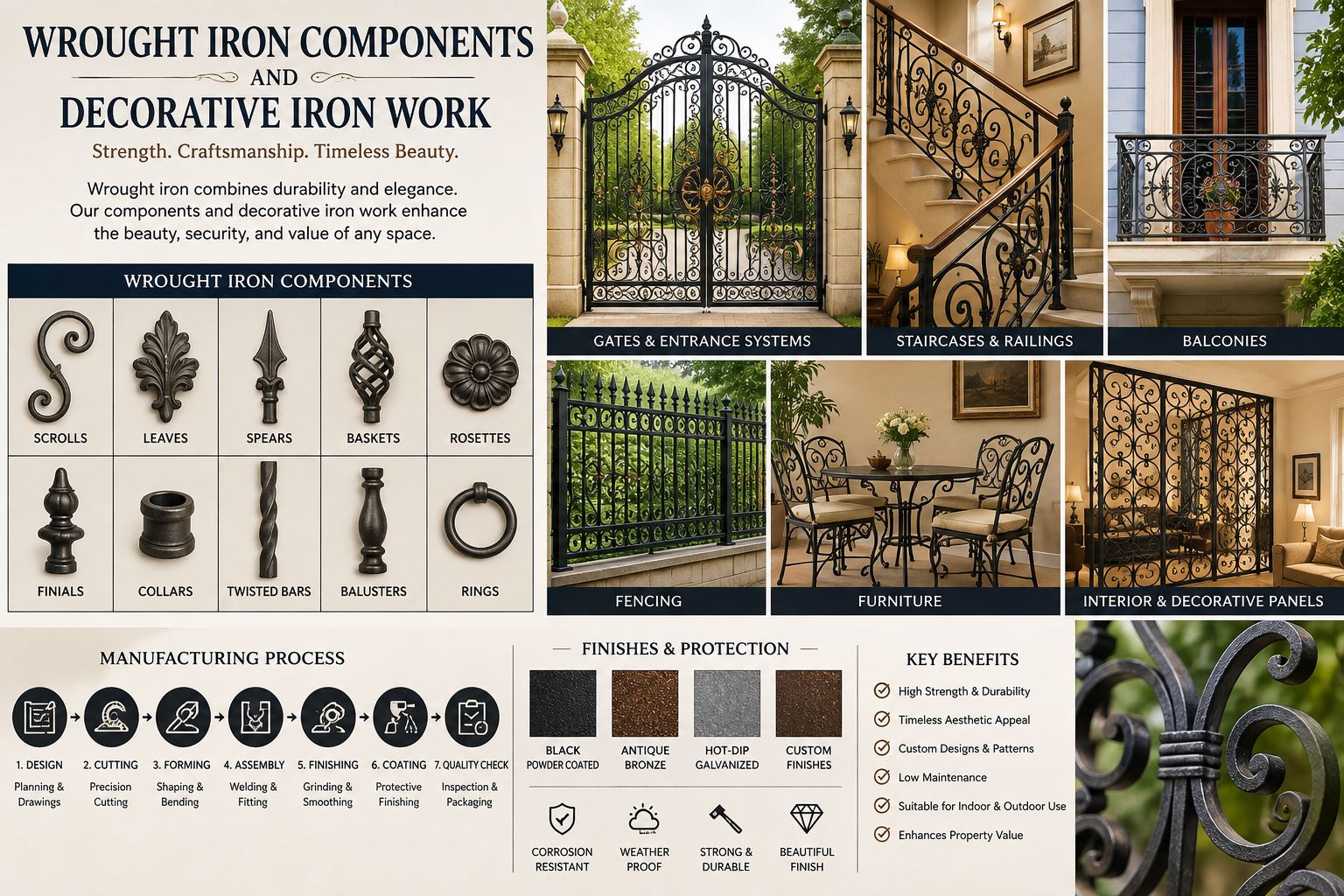
These individual Wrought Iron Components may include:
- Scrolls
- Balusters
- Rosettes
- Rings
- Collars
- Finials
- Spearheads
- Twisted bars
- Decorative baskets
- Leaves and flowers
- Medallions
- Ornamental panels
Each performs a visual role.
Scrolls create movement. Balusters establish repetition. Finials complete vertical lines. Rosettes provide focal points. Twisted bars introduce texture.
The skill lies in combining these elements without making the structure appear overloaded.
Why Decorative Iron Work Is About Balance
Successful Decorative Iron Work does not mean filling every available space with ornamentation.
In fact, empty space can be just as important as metal.
The relationship between solid material and open areas determines whether a design appears elegant, heavy, minimalist, traditional, or contemporary.
A good designer considers scale, repetition, symmetry, negative space, architectural surroundings, and viewing distance.
This explains why the same decorative component may look excellent on one project but unsuitable on another.
Ironwork Has Changed with Architecture
Traditional ornamental iron is typically associated with flowing curves, flowers, leaves, spearheads, and intricate scroll patterns.
Modern architecture has introduced a different visual language.
Contemporary Wrought Iron Components may use:
- Straight lines
- Repeated rectangles
- Circles
- Abstract geometry
- Minimal curves
- Open patterns
- Custom-cut panels
The result is decorative metalwork that retains the strength and versatility of iron without necessarily looking traditional.
The Most Popular Places to Use Decorative Iron
One reason Decorative Iron Work remains popular is the wide variety of applications available.
| Area | Typical Components | Design Objective |
| Gates | Scrolls, finials, rosettes | Create an impressive entrance |
| Railings | Balusters, rings, collars | Combine safety with style |
| Balconies | Scrolls, bars, panels | Enhance the building façade |
| Fences | Pickets, spearheads | Define and protect boundaries |
| Interiors | Panels, geometric elements | Create visual interest |
| Furniture | Twisted bars, scrolls | Add handcrafted character |
A coordinated approach can repeat selected motifs throughout a property without making every feature identical.
The Entrance Gate Sets the Design Tone
An entrance gate often creates the first architectural impression of a property.
For traditional homes, Wrought Iron Components such as S-scrolls, C-scrolls, rosettes, decorative baskets, leaves, and finials can create an elegant appearance.
Modern properties may require fewer components. Strong geometric patterns and carefully planned spacing can often create a more sophisticated result.
Think About the Building Behind the Gate
The gate should visually communicate with the architecture.
An extremely ornate gate in front of a minimalist building may feel disconnected. Similarly, a plain industrial-style gate might appear unsuitable for an elaborate classical villa.
Consider Functionality Early
Gate dimensions, opening direction, hinges, automation equipment, locks, pedestrian access, and installation conditions should be considered during design.
Decoration Should Support Function
Ornamentation should never interfere with safe and reliable gate operation.
Staircases Offer an Opportunity for Creativity
A staircase naturally attracts attention because it connects different levels while occupying significant visual space.
This makes it an ideal location for Decorative Iron Work.
Traditional staircases can incorporate curved balusters and flowing scroll patterns. Contemporary interiors may feature repetitive geometric arrangements or simplified metal profiles.
Combining iron with timber, marble, stone, or glass can produce particularly interesting results.
Balcony Ironwork Changes the Entire Façade
A small change to balcony railing design can have a surprisingly large impact on a building’s exterior.
Why?
Because balcony patterns are often repeated across several floors or sections of a façade.
Carefully selected Wrought Iron Components can create visual rhythm and consistency while adding depth to otherwise flat architectural surfaces.
However, balcony structures also have important safety responsibilities. Appropriate engineering, spacing, height, secure installation, and relevant building requirements should always take priority.
Decorative Fencing Can Offer More Than Security
Boundary fencing is often treated purely as a security requirement, but it occupies a large portion of many property exteriors.
That makes fencing another valuable design opportunity.
Vertical pickets can establish the main structure while finials, rings, scrolls, and other decorative details add character.
Coordinating the fence with the entrance gate helps create a unified exterior.
Interior Designers Are Rediscovering Iron
The use of Decorative Iron Work inside buildings has expanded significantly.
Iron can now be found in:
- Decorative partitions
- Room dividers
- Wine displays
- Bookshelves
- Console tables
- Bed frames
- Lighting structures
- Fireplace screens
- Mirror frames
- Wall installations
These applications work particularly well when metal is contrasted with warmer or softer materials.
For example, black decorative metal against natural timber can create a sophisticated combination of industrial and organic textures.
How Raw Metal Becomes a Decorative Component
Producing Wrought Iron Components requires controlled shaping.
Traditional methods involve heating metal and manipulating it through hammering, twisting, bending, and forging.
Modern manufacturing can use CNC machines, hydraulic equipment, presses, mechanical bending systems, and laser cutting.
A typical production process may involve:
- Selecting suitable material.
- Cutting the required section.
- Heating or mechanically forming it.
- Creating the required curves or patterns.
- Checking dimensions.
- Cleaning the component.
- Preparing it for fabrication or finishing.
Modern equipment is particularly valuable when hundreds of identical components are required.
Hand-Forged Versus Machine-Produced Components
Both manufacturing approaches have advantages.
| Feature | Hand-Forged | Machine-Produced |
| Individual character | High | Consistent |
| Repeatability | Moderate | High |
| Production speed | Lower | Higher |
| Large quantities | Less efficient | Highly practical |
| Bespoke designs | Excellent | Excellent with tooling |
Some of the most successful Decorative Iron Work combines machine-produced consistency with selective handcrafted details.
Why Surface Preparation Cannot Be an Afterthought
Outdoor metal is exposed to changing weather, moisture, atmospheric contaminants, and other environmental conditions.
Protective treatment therefore plays an essential role in longevity.
Galvanising
Galvanising introduces a protective zinc layer and is commonly considered for exterior metalwork requiring enhanced corrosion resistance.
Powder Coating
Powder coating provides a durable decorative surface and offers a wide range of textures and appearances.
Protective Painting Systems
Properly prepared metal can be treated with anti-corrosion primer followed by compatible finishing coats.
Regular Inspection
Owners should periodically check Decorative Iron Work for scratches, coating damage, corrosion, or loose connections.
Addressing minor problems early can help prevent more extensive deterioration.
Standard Components Can Make Custom Designs Easier
Custom ironwork does not necessarily require every component to be individually manufactured.
Ready-made Wrought Iron Components can provide an efficient starting point.
Fabricators can select standard scrolls, balusters, baskets, rings, or rosettes and arrange them into original patterns.
Custom pieces can then be introduced selectively to create uniqueness.
This hybrid approach can offer a useful balance between production efficiency and design freedom.
Choosing Iron Components with Confidence
Before purchasing decorative components, consider more than photographs or catalogue designs.
Important factors include:
- Component dimensions
- Material thickness
- Weight
- Surface condition
- Manufacturing consistency
- Welding compatibility
- Installation requirements
- Interior or exterior use
- Finishing requirements
- Architectural style
Components should be practical for fabrication as well as visually suitable.
What Makes Professional Decorative Iron Work Stand Out?
Quality becomes visible through details.
Consistent curves, accurate spacing, clean connections, balanced patterns, properly finished welds, and smooth surfaces can distinguish professional fabrication.
High-quality Decorative Iron Work should also appear integrated with its surroundings.
The goal is not for people to notice how many components were used. The goal is for the finished installation to feel naturally connected to the architecture.
FAQ About Wrought Iron Components and Decorative Iron Work
What are wrought iron components?
They are decorative or functional metal elements used for gates, fences, balconies, staircases, railings, furniture, and architectural projects.
What are the most popular decorative iron components?
Scrolls, balusters, finials, rosettes, collars, rings, baskets, spearheads, leaves, and twisted bars are popular options.
Can wrought iron components be customised?
Yes. Dimensions, patterns, decorative details, shapes, and finishes can be customised according to project requirements.
Is decorative iron work only traditional?
No. Contemporary ironwork frequently incorporates geometric patterns, simple profiles, clean lines, and minimalist designs.
Can decorative iron be used outdoors?
Yes. Appropriate corrosion protection, finishing, installation, and maintenance should be considered for exterior applications.
What finishes are available for ironwork?
Common options include galvanising, powder coating, protective painting, and various decorative or antique-effect finishes.
Can ironwork be used inside homes?
Yes. Popular applications include staircases, furniture, screens, partitions, shelving, lighting features, and wall decorations.
Are ready-made components useful?
Yes. They can improve production efficiency and consistency while still allowing fabricators to develop customised patterns.
Can iron be combined with other materials?
Yes. Iron works effectively with glass, timber, stone, marble, concrete, and several other architectural materials.
What should I consider when designing an iron gate?
Consider architecture, dimensions, security, opening mechanism, component proportions, automation, finishing, and installation conditions.
How do I maintain exterior decorative iron?
Inspect it regularly, clean surfaces appropriately, and repair scratches or coating damage before corrosion spreads.
How can I identify good-quality ironwork?
Look for accurate fabrication, consistent patterns, clean connections, appropriate materials, professional finishing, and secure installation.
https://gosarkarijobs.com/why-wrought-iron-components-are-redefining-modern-decorative-iron-work/