Leisure and entertainment businesses are paying closer attention to foodservice as part of the overall visitor experience. Indoor entertainment centers, cinemas, amusement venues, event spaces, sports facilities, and family-oriented attractions increasingly need menus that combine practical everyday food with visually engaging treats.
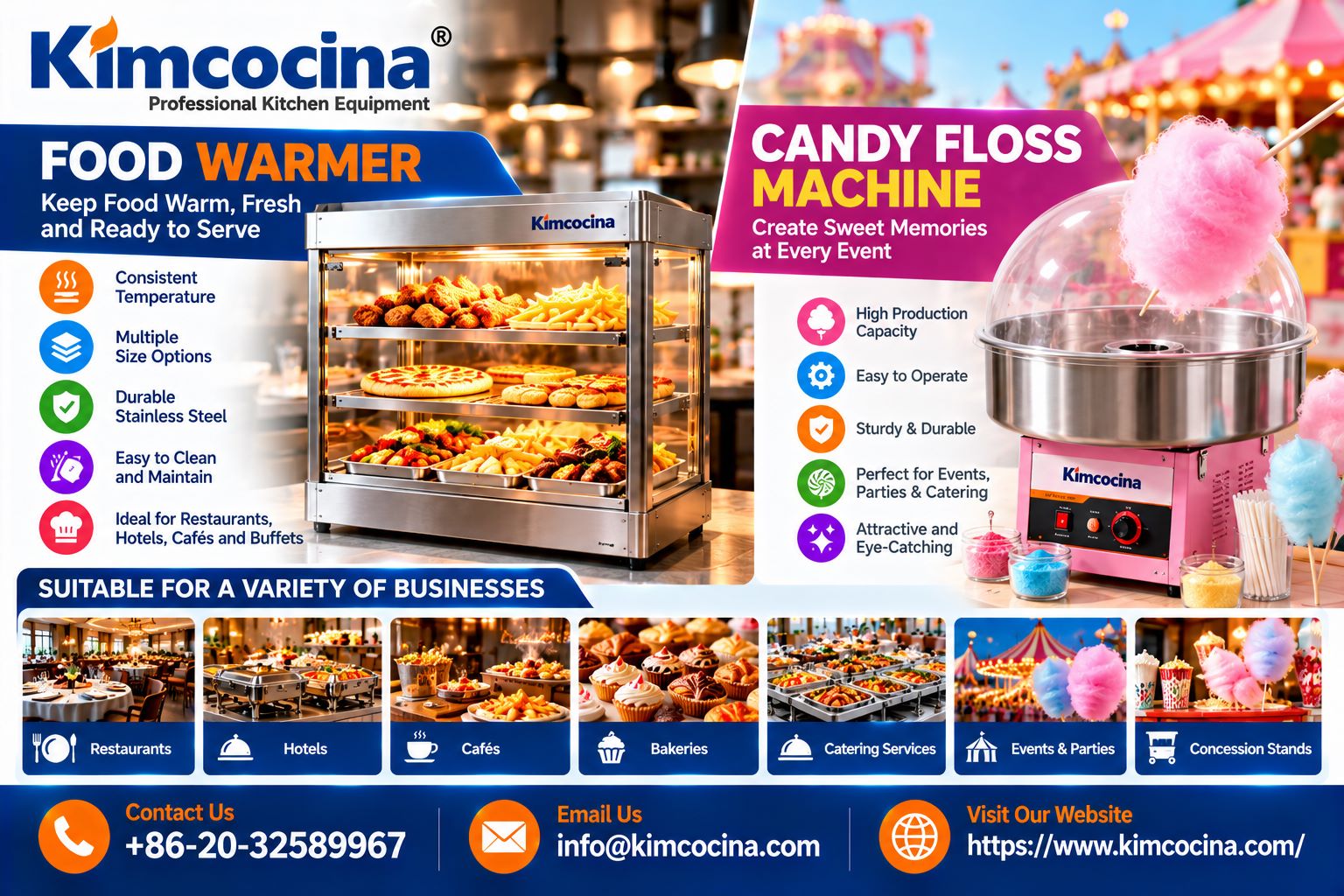
This trend is creating an interesting role for two very different types of equipment: the food warmer, which can support suitable ready-to-serve menu items, and the candy floss machine, which brings an interactive element to concession service.
Rather than treating these machines as unrelated purchases, operators can consider how they fit into a broader concession strategy built around different customer occasions, queue patterns, menu zones, and peak periods.
Concession Menus Need More Than One Type of Product
Customers visiting entertainment and leisure venues do not necessarily want the same thing at the same time.
Some may look for a convenient hot snack or meal, while others may prefer a novelty treat. Groups can also contain customers with very different purchasing preferences.
A food warmer can form part of the practical hot-food side of the operation, depending on the foods being served and the equipment design.
A candy floss machine, meanwhile, can provide a distinctive sweet offering that is strongly associated with entertainment-style environments.
Combining functional and experiential menu categories can help businesses create a more diverse concession offer without making every workstation perform the same task.
Food Warmer Can Support Planned Service Availability
Preparing food is only one stage of foodservice.
Businesses also need to coordinate production with customer demand.
For suitable applications, a food warmer can be incorporated into a planned holding and service workflow so appropriate prepared items are available during busy periods.
Capacity should be based on realistic sales patterns rather than simply choosing the largest available equipment.
Operators can study which products sell most frequently, when demand increases, and how quickly the kitchen can replenish the service area.
This helps connect food preparation with actual customer traffic.
Candy Floss Machine Adds Theatre to the Counter
Some products attract attention before customers even decide to buy them.
Candy floss can provide this visual element.
A strategically positioned candy floss machine may allow the preparation process itself to become part of the concession experience.
Visibility is particularly useful in environments where customers walk past multiple food or retail options.
However, presentation should not compromise practical operation. Employees still require sufficient workspace, ingredients, serving materials, cleaning access, and a safe operating arrangement based on manufacturer instructions.
The strongest workstation combines visual appeal with efficient staff movement.
Queue Design Can Influence Concession Sales
Long or confusing queues can reduce the effectiveness of even an attractive menu.
Operators should consider how customers approach the counter, read the menu, place orders, pay, and collect products.
If a food warmer is incorporated into a fast-service zone, suitable ready-to-serve items can be positioned within a logical customer journey.
The candy floss machine may work better in a dedicated treat zone, particularly when preparation is visible and requires a different service rhythm.
Separating menu categories can prevent one slower or more interactive product from unnecessarily delaying customers purchasing quicker items.
Peak Traffic Should Guide Capacity Decisions
Entertainment venues can experience dramatic changes in customer volume.
A cinema may become busy shortly before scheduled screenings. An event venue can face sudden demand during intervals. Leisure attractions may experience concentrated lunchtime or weekend traffic.
Equipment planning should reflect these peaks.
When selecting a food warmer, operators can estimate how much suitable product needs to be available during the busiest period while also considering replenishment capability.
For a candy floss machine, businesses can assess expected order frequency, preparation workflow, staffing, and the time required to serve customers during high-demand periods.
Peak-hour planning provides a more useful capacity benchmark than daily averages alone.
Menu Boards Can Connect Practical and Novelty Products
Good merchandising can make a concession menu easier to navigate.
Instead of presenting every product as an individual item, businesses can organize menus around customer needs.
Hot-food selections can occupy one section, beverages another, and treats another.
The food warmer station can correspond with the hot-food section, while products from the candy floss machine can be promoted within a clearly identifiable treat category.
Businesses can also test combination offers where appropriate.
The objective is not simply to add more choices but to make existing choices easier for customers to understand.
Staff Roles Matter During Busy Periods
A concession counter can become inefficient when every employee tries to perform every task.
Defined station responsibilities may provide greater consistency.
One employee might focus on order taking, another on hot-food service, and another on specialty preparation during peak periods.
The employee responsible for the candy floss machine should understand correct operation, portion procedures, workstation organization, and cleaning requirements.
Likewise, employees using a food warmer should understand the intended application, operating procedures, and applicable food-handling practices.
Cross-training can still be valuable so employees can change positions when customer demand shifts.
Counter Layout Should Consider Impulse Purchases
Concession environments often benefit from products customers can recognize quickly.
A customer who originally planned to buy only a drink may notice a visible treat or hot-food option while waiting.
Equipment positioning can therefore influence product discovery.
A candy floss machine may benefit from an appropriate visible location where its preparation process can attract attention without blocking customer movement.
A food warmer should be positioned according to the service model, employee access, and the route from food preparation to customer handover.
Equipment should support the counter layout rather than dictate it.
Cleaning Must Be Included in Daily Operations
Visually appealing foodservice stations need consistent housekeeping.
Sugar residue around a candy floss machine can affect the appearance and practicality of the workstation if cleaning procedures are not established.
Similarly, a food warmer and surrounding service surfaces require appropriate routine cleaning according to the specific equipment instructions and relevant operating procedures.
Businesses can assign cleaning responsibilities at opening, during quieter service periods, and at closing.
The workstation should also provide enough access for staff to carry out these tasks effectively.
Mobility and Temporary Events Create Additional Considerations
Some concession businesses operate beyond a permanent counter.
Festivals, temporary events, exhibitions, corporate functions, and outdoor entertainment can require equipment to be moved or set up in different environments.
Operators considering portable applications should check equipment dimensions, power requirements, transport arrangements, operating clearances, and installation guidance.
Both a food warmer and a candy floss machine should be used only in conditions appropriate for the individual equipment.
Planning transportation and setup before the event can reduce operational surprises on service day.
Frequently Asked Questions
What is a food warmer?
A food warmer is commercial foodservice equipment designed to support the holding of suitable prepared foods according to the equipment’s intended application.
What is a candy floss machine?
A candy floss machine is equipment that spins heated sugar into fine strands that are collected and served as candy floss.
Where can these machines be used?
Depending on the equipment, potential applications include concession stands, entertainment venues, cinemas, events, cafés, hotels, leisure facilities, and catering operations.
Why is candy floss suitable for entertainment environments?
Its recognizable appearance and visible preparation process can make it an engaging concession product.
How should food warmer capacity be selected?
Consider peak demand, menu type, replenishment frequency, available counter space, and the manufacturer’s specifications.
Can both machines be used in one concession business?
Yes. They can serve different menu categories, with one supporting suitable hot-food service and the other providing a specialty sweet product.
Where should a candy floss station be positioned?
It should be located where staff have adequate operating space and customers can access the service area without creating unnecessary congestion.
Why is peak-hour planning important?
Short periods of intense demand can place more pressure on equipment and staff than average daily sales figures suggest.
Does concession equipment require regular cleaning?
Yes. Cleaning and maintenance should follow the instructions provided for each specific machine and the business’s applicable hygiene procedures.
What should operators consider before purchasing equipment?
They should evaluate capacity, intended use, dimensions, utilities, workstation layout, customer flow, cleaning access, staffing, maintenance, and manufacturer requirements.
Media Contact
Commercial Foodservice Equipment Enquiries
Phone: +86-20-32589967
Email: info@kimcocina.com
Official Website: kimcocina.com