Quality-focused industries are becoming more selective about where their ingredients come from. Pharmaceutical companies, biotechnology developers, food processors, and nutraceutical brands no longer evaluate raw materials only by price and basic specifications. They increasingly look at manufacturing controls, consistency, traceability, analytical capabilities, and long-term supply reliability.
This is especially relevant when sourcing specialized ingredients such as dextran and L-malic acid.
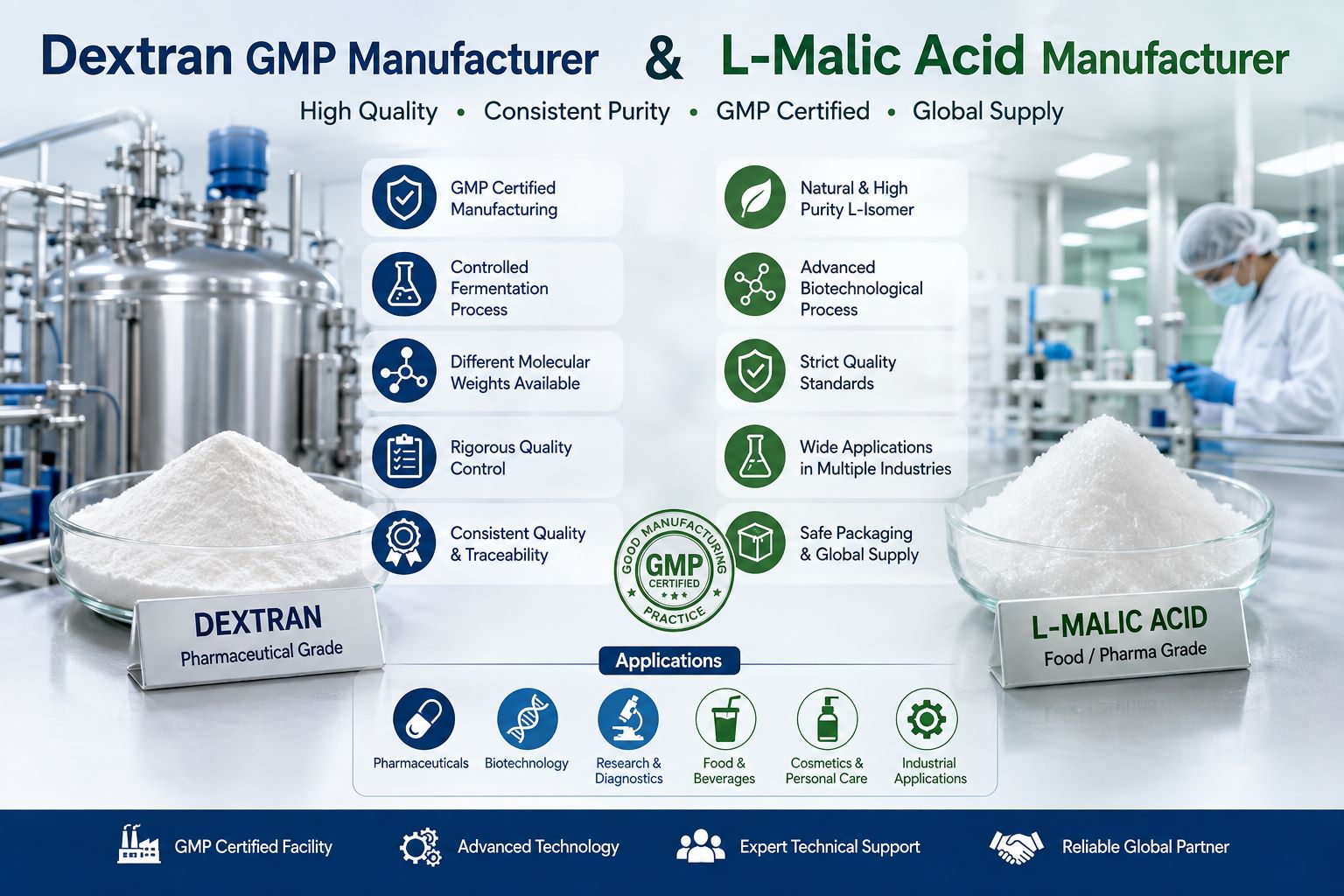
Working with a qualified dextran GMP manufacturer can help organizations obtain dextran with controlled molecular characteristics and documented production standards. Similarly, selecting a dependable L-malic acid manufacturer is important for businesses that need predictable purity, stereochemical identity, and processing performance.
Understanding how these manufacturers operate can make supplier selection significantly more effective.
Why Ingredient Manufacturing Deserves More Attention
A raw material represents only a small part of a finished formulation by appearance, but its quality can influence the entire production process.
Variation between batches can affect dissolution, viscosity, acidity, stability, processing efficiency, or finished-product characteristics.
That is why experienced procurement teams evaluate several areas before approving suppliers:
- Manufacturing technology
- Raw-material controls
- Quality-management systems
- Analytical testing
- Process consistency
- Documentation
- Traceability
- Packaging
- Production capacity
- Technical support
The objective is not simply to find a supplier capable of producing the ingredient. It is to find one capable of reproducing the required quality consistently.
Dextran Manufacturing Starts With Biological Precision
Dextran is a polysaccharide mainly composed of glucose units. Unlike many conventional chemical ingredients, commercial dextran is commonly manufactured through microbial fermentation.
This biological production route creates both opportunities and challenges.
A dextran GMP manufacturer needs to manage fermentation conditions carefully because biological systems can respond to relatively small changes in their environment.
What Happens Inside Dextran Fermentation?
The process generally uses suitable microorganisms and carbohydrate-containing substrates.
Manufacturing teams control conditions that may include:
- Temperature
- pH
- Nutrient availability
- Substrate concentration
- Fermentation time
- Microbial activity
- Process cleanliness
The objective is to create controlled conditions for reproducible dextran production.
However, successful fermentation represents only the beginning of the manufacturing journey.
Purification Turns Raw Dextran Into a Usable Ingredient
Material produced during fermentation contains more than the desired dextran.
Microbial components, residual substrates, and process-related impurities need to be separated through downstream processing.
A typical manufacturing sequence may involve:
- Fermentation preparation
- Controlled microbial processing
- Separation of unwanted biological materials
- Dextran recovery
- Purification
- Fractionation
- Filtration
- Concentration
- Drying
- Quality testing and release
A professional dextran GMP manufacturer establishes defined procedures around these stages to minimize uncontrolled variation.
Why Dextran Molecular Weight Cannot Be Ignored
One of dextran’s most important characteristics is molecular weight.
Different molecular-weight ranges can exhibit different functional behavior. This makes molecular characterization particularly relevant when selecting dextran for specialized applications.
Molecular Characteristics Can Influence Performance
Differences may affect:
- Viscosity
- Solubility
- Diffusion
- Solution behavior
- Processing conditions
- Application performance
For this reason, procurement teams should avoid selecting dextran based purely on chemical name.
| Quality Attribute | Why It Matters |
| Molecular weight | Influences functional properties |
| Molecular distribution | Supports consistency |
| Purity | Reflects impurity control |
| Moisture | Affects storage and handling |
| Solubility | Influences formulation processing |
| Microbial quality | Relevant for sensitive applications |
The correct grade should always be matched to its intended use.
What Does GMP Actually Mean for Dextran Buyers?
GMP is valuable because it focuses on controlling manufacturing systematically.
Rather than producing material first and checking quality afterward, GMP-oriented operations aim to build controls into the entire production process.
A dextran GMP manufacturer may maintain systems covering personnel training, equipment, cleaning, raw materials, production records, testing, deviations, change control, storage, and product release.
GMP-Focused Controls Can Include
- Standard operating procedures
- Equipment qualification
- Cleaning documentation
- Material identification
- In-process controls
- Laboratory testing
- Batch records
- Deviation investigations
- Change management
- Product-release procedures
These controls create a more complete quality picture than final-product testing alone.
L-Malic Acid Brings a Different Manufacturing Challenge
L-malic acid is fundamentally different from dextran.
It is an organic acid valued for its acidity and formulation properties. Applications can extend across food, beverages, confectionery, pharmaceuticals, nutraceuticals, cosmetics, personal care, and specialty formulations.
For an L-malic acid manufacturer, producing high-quality material requires attention to chemical identity, purity, physical characteristics, and stereochemistry.
Why the L-Form Matters
Malic acid can exist in different stereochemical forms.
L-malic acid specifically represents the L-form. When customers require this particular ingredient, manufacturers need suitable controls for confirming identity and applicable stereochemical characteristics.
This distinguishes specialized L-malic acid production from simply supplying unspecified malic acid.
From Production to Crystal: How L-Malic Acid Is Refined
After primary production, L-malic acid needs downstream purification and finishing.
Depending on the manufacturing process, these operations can involve:
- Separation
- Purification
- Filtration
- Concentration
- Crystallization
- Drying
- Particle preparation
- Laboratory testing
- Packaging
- Batch release
An experienced L-malic acid manufacturer controls these stages to achieve predictable commercial material.
Why Crystal Quality Can Affect Industrial Production
Customers often focus almost entirely on chemical purity when evaluating ingredients.
Physical characteristics can be equally relevant.
Crystal size and particle properties can influence how material behaves during transportation, storage, dissolution, mixing, and automated processing.
Important Physical Considerations Include
- Powder flow
- Crystal consistency
- Particle distribution
- Dissolution characteristics
- Moisture behavior
- Storage performance
Consistent physical characteristics can become particularly valuable when customers manufacture products continuously at commercial scale.
Quality Testing Provides Evidence, Not Just Numbers
Analytical testing is an essential part of both manufacturing processes.
For dextran, testing may focus on molecular characteristics, purity, moisture, solubility, identity, and relevant microbiological requirements.
An L-malic acid manufacturer may evaluate identity, assay, optical characteristics, moisture, related substances, residue, heavy metals, and appearance.
| Manufacturing Factor | Dextran | L-Malic Acid |
| Material class | Polysaccharide | Organic acid |
| Main process | Fermentation | Controlled production |
| Critical property | Molecular characteristics | Purity/stereochemistry |
| Important finishing stage | Fractionation | Crystallization |
| Key physical concern | Solution behavior | Powder behavior |
| Major markets | Pharma/biotechnology | Food/pharma/nutraceutical |
Although manufacturing technologies differ, consistent quality remains the common objective.
Why Manufacturer and Supplier Are Not Always the Same
When purchasing specialty ingredients, companies should determine who actually manufactures the material.
A distributor can provide valuable logistics and customer support, but technical qualification often requires information directly connected to the production facility.
Buyers evaluating a dextran GMP manufacturer or L-malic acid manufacturer should therefore ask about:
- Manufacturing location
- Production capabilities
- Quality systems
- Laboratory facilities
- Available certifications
- Batch traceability
- Production capacity
- Change-control procedures
- Documentation availability
- Technical expertise
Transparency can significantly simplify long-term supplier management.
Supplier Qualification Should Look Beyond Price
The cheapest raw material does not necessarily create the lowest manufacturing cost.
Inconsistent ingredients may result in additional testing, production downtime, rejected batches, reformulation, delayed shipments, or urgent supplier changes.
A better sourcing strategy considers total supplier value.
Buyers should evaluate:
- Product consistency
- Technical expertise
- Quality-management systems
- Analytical capabilities
- Documentation quality
- Production capacity
- Packaging options
- Lead times
- Supply continuity
- Customer support
A strong manufacturer should be able to support both initial qualification and future commercial requirements.
FAQ
What is a dextran GMP manufacturer?
A dextran GMP manufacturer produces dextran using controlled processes supported by appropriate quality, testing, documentation, and traceability systems.
How is dextran generally manufactured?
Dextran is commonly produced through microbial fermentation followed by recovery, purification, fractionation, filtration, drying, and quality testing.
Why does molecular weight matter in dextran?
Molecular weight can affect viscosity, solubility, diffusion, processing behavior, and suitability for different applications.
Where can dextran be used?
Different dextran grades can be used in pharmaceutical, biotechnology, diagnostic, laboratory, research, and specialized technical applications.
What is L-malic acid?
L-malic acid is the L-form of malic acid, an organic acid used in various food, pharmaceutical, and formulation applications.
What should an L-malic acid manufacturer control?
An L-malic acid manufacturer should control production, purification, stereochemical characteristics, impurities, crystallization, testing, and packaging.
Why does stereochemistry matter?
Stereochemistry helps distinguish L-malic acid from other forms and supports correct material identification.
Why are physical properties important?
Particle characteristics can affect flow, mixing, dissolution, storage, transportation, and industrial processing efficiency.
What documents should buyers request?
Useful documents may include product specifications, Certificates of Analysis, safety information, quality certificates, and applicable technical documentation.
How can companies identify a suitable manufacturer?
Assess manufacturing experience, technical capabilities, quality systems, analytical testing, consistency, traceability, documentation, capacity, and supply reliability.