Modern chemical manufacturing depends increasingly on ingredients that perform highly specific jobs. A polymer additive may be selected to influence molecular architecture, while a cosmetic ingredient may need to improve skin feel and simultaneously support product preservation. 2,3-dimethyl-2,3-diphenylbutane and 1,2-octanediol provide excellent examples of these two different approaches.
Despite appearing together in discussions about specialty chemicals, their practical roles are substantially different. 2,3-dimethyl-2,3-diphenylbutane is particularly interesting in radical and polymer chemistry. 1,2-octanediol, widely recognized as caprylyl glycol in personal care, is valued as a multifunctional formulation ingredient.
A closer look at their chemistry explains where each compound fits and why industries use them.
Why Molecular Structure Determines Chemical Performance
Two chemicals can look similar on a product catalogue yet behave completely differently during manufacturing. Their molecular structures determine characteristics such as polarity, reactivity, solubility, thermal behavior, and compatibility.
For industrial users, understanding these relationships can improve raw-material selection.
Important questions include:
- What happens when the chemical is heated?
- How does it interact with other ingredients?
- Does it participate in chemical reactions?
- Can it influence product stability?
- What concentration is appropriate?
- Which processing conditions affect performance?
These considerations are particularly relevant when working with specialty chemicals rather than simple commodity materials.
Inside the Chemistry of 2,3-Dimethyl-2,3-Diphenylbutane
2,3-dimethyl-2,3-diphenylbutane is a substituted organic compound containing aromatic phenyl groups attached to a highly substituted carbon framework.
One reason the molecule is technically interesting is its ability to undergo bond cleavage under appropriate thermal conditions. This process can produce radical species.
Radicals are highly reactive chemical intermediates. In carefully controlled industrial processes, this reactivity can be useful rather than undesirable.
Polymer scientists can take advantage of radical chemistry to initiate reactions or modify existing polymer structures.
How Radical Generation Can Change Polymers
A polymer is not defined only by the monomers used to produce it. Chain length, branching, molecular weight, crosslink density, and chemical modifications can dramatically change final performance.
Radical-generating chemistry may be employed to influence some of these characteristics.
Applications associated with 2,3-dimethyl-2,3-diphenylbutane can include:
- Polymerization initiation
- Crosslinking reactions
- Polymer grafting
- Copolymer modification
- Molecular-weight adjustment
- Specialty polymer processing
However, performance is application-specific. The same concentration and processing temperature should not automatically be applied across different polymer systems.
Crosslinking Creates a Different Molecular Network
Crosslinking is one of the most important concepts in polymer engineering.
Imagine polymer chains as individual strands. Creating chemical connections between these strands produces a network that may behave differently from the original uncrosslinked material.
Controlled crosslinking can potentially influence:
- Thermal behavior
- Mechanical characteristics
- Dimensional stability
- Resistance to deformation
- Material durability
Why Process Optimization Matters
Crosslinking must be controlled carefully.
The desired result depends on the base polymer, reaction temperature, radical concentration, residence time, additives, and final application. Laboratory testing is therefore essential before moving to commercial production.
An Additional Role in Flame-Retardant Technology
2,3-dimethyl-2,3-diphenylbutane also has relevance in selected flame-retardant polymer systems.
In such applications, it may function as a synergist rather than the primary flame-retardant ingredient.
Synergistic systems are interesting because one chemical can enhance the performance of another, helping formulators optimize overall additive packages.
Potential advantages may include:
- Better flame-retardant efficiency
- Optimized additive levels
- Improved formulation flexibility
- Balanced polymer properties
- Support for specialized material development
Actual fire performance should always be established through relevant standardized testing.
Why 1,2-Octanediol Tells a Very Different Chemical Story
Move from polymer processing into cosmetic formulation and the priorities change considerably.
Here, 1,2-octanediol becomes particularly interesting.
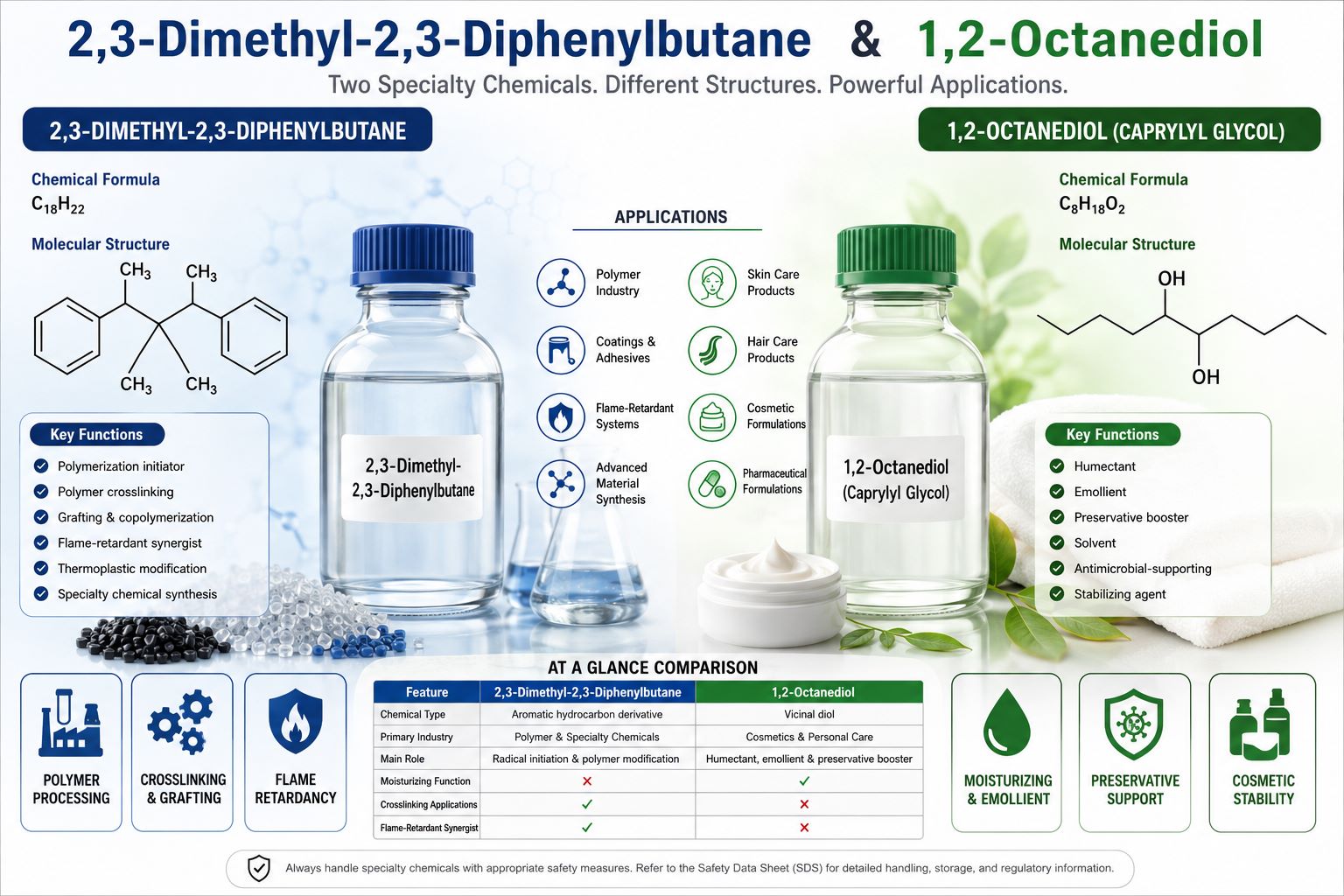
The compound has an eight-carbon chain and two hydroxyl groups positioned on adjacent carbon atoms. Its molecular formula is C8H18O2.
In cosmetic terminology, 1,2-octanediol is commonly associated with caprylyl glycol.
The combination of a hydrocarbon portion and hydroxyl functionality gives the molecule characteristics useful in sophisticated personal-care formulations.
One Ingredient Can Perform Several Formulation Functions
Modern cosmetic formulas can contain many components. Each may contribute to moisturization, texture, preservation, fragrance, stability, cleansing, or sensory performance.
Formulators increasingly value multifunctional ingredients because they can support several objectives simultaneously.
1,2-octanediol may be found in:
- Moisturizers
- Facial creams
- Body lotions
- Skin serums
- Cleansing products
- Hair-care formulations
- Cosmetic emulsions
- Specialized personal-care products
Its precise concentration depends on the product formulation, desired function, and applicable regulatory requirements.
Moisture Management Is an Important Advantage
Healthy-feeling skin is closely connected with adequate moisture management, making humectant and emollient ingredients important components of many cosmetic products.
1,2-octanediol can contribute both humectant-type and emollient properties.
Humectants help support moisture retention, while emollients contribute to smoother and softer skin feel.
Formulation Is About Experience as Well as Chemistry
Consumers do not evaluate a moisturizer by examining its molecular structure. They experience it through:
- Spreadability
- Texture
- Absorption
- Softness
- Hydration
- After-feel
Consequently, ingredients that support both functional performance and sensory characteristics can provide significant formulation value.
Preservation Support Gives 1,2-Octanediol Another Function
Water-containing cosmetics require effective microbial protection throughout manufacturing, storage, and normal consumer use.
1,2-octanediol can provide antimicrobial-supporting activity and is often considered a preservative booster within a broader preservation system.
Its effectiveness depends on the complete formulation.
Important variables include:
- Ingredient concentration
- Product pH
- Water activity
- Other preservation ingredients
- Surfactants and emulsifiers
- Packaging
- Manufacturing hygiene
- Storage conditions
Why a Preservative Booster Is Not a Complete Guarantee
Adding 1,2-octanediol does not automatically make a cosmetic product microbiologically stable.
The entire preservation system must be evaluated through suitable microbiological challenge testing and stability studies before commercialization.
Comparing Two Very Different Specialty Chemicals
| Property | 2,3-Dimethyl-2,3-Diphenylbutane | 1,2-Octanediol |
| Main application area | Polymer engineering | Personal care |
| Chemical character | Substituted hydrocarbon | Aliphatic diol |
| Radical chemistry | Important | Not primary |
| Polymer crosslinking | Relevant | Not typical |
| Grafting applications | Relevant | Not typical |
| Flame-retardant synergy | Potential use | Limited relevance |
| Humectant function | Not typical | Yes |
| Emollient properties | Not typical | Yes |
| Preservation support | Not typical | Yes |
| Cosmetic applications | Limited | Significant |
This distinction is important for buyers searching for specialty chemical solutions. The compounds should be evaluated according to their intended functions rather than compared as alternatives.
Quality Can Be as Important as Chemical Identity
Purchasing the correct chemical name does not necessarily guarantee consistent industrial results.
Purity, impurities, moisture, batch consistency, packaging, storage, and manufacturing quality can all influence performance.
Buyers should consider checking:
- Certificate of Analysis
- Safety Data Sheet
- Technical Data Sheet
- Purity specification
- Batch traceability
- Storage recommendations
- Regulatory documentation
- Packaging options
Reliable technical documentation is particularly important when scaling from laboratory development to commercial manufacturing.
Frequently Asked Questions
What is 2,3-dimethyl-2,3-diphenylbutane?
It is a specialty organic compound associated with radical generation and selected polymer-processing applications.
Why is it useful in polymer chemistry?
Its thermal behavior can generate radicals capable of initiating or influencing certain polymer reactions.
What is polymer grafting?
Polymer grafting introduces new molecular branches or chemical functionality onto an existing polymer backbone.
Can 2,3-dimethyl-2,3-diphenylbutane support crosslinking?
Yes, it can have relevance in selected radical-driven polymer crosslinking systems.
What is 1,2-octanediol also called?
It is commonly associated with the cosmetic ingredient name caprylyl glycol.
Why is 1,2-octanediol used in cosmetics?
It can support moisturization, emolliency, skin conditioning, sensory performance, and preservation strategies.
Does 1,2-octanediol retain moisture?
Its humectant characteristics can contribute to moisture management in appropriately designed formulations.
Does it have antimicrobial properties?
It can provide antimicrobial-supporting activity and enhance broader preservation systems.
Can these two chemicals replace each other?
No. They have fundamentally different molecular characteristics, functions, and industrial applications.
How should manufacturers choose a supplier?
They should consider purity, consistency, documentation, technical capability, packaging, traceability, and application support.
https://newsgrow.blogspot.com/2026/08/ethylhexylglycerin-emerges-as-key.html
https://newsgrow.blogspot.com/2026/08/inside-modern-formulations-science-and.html