
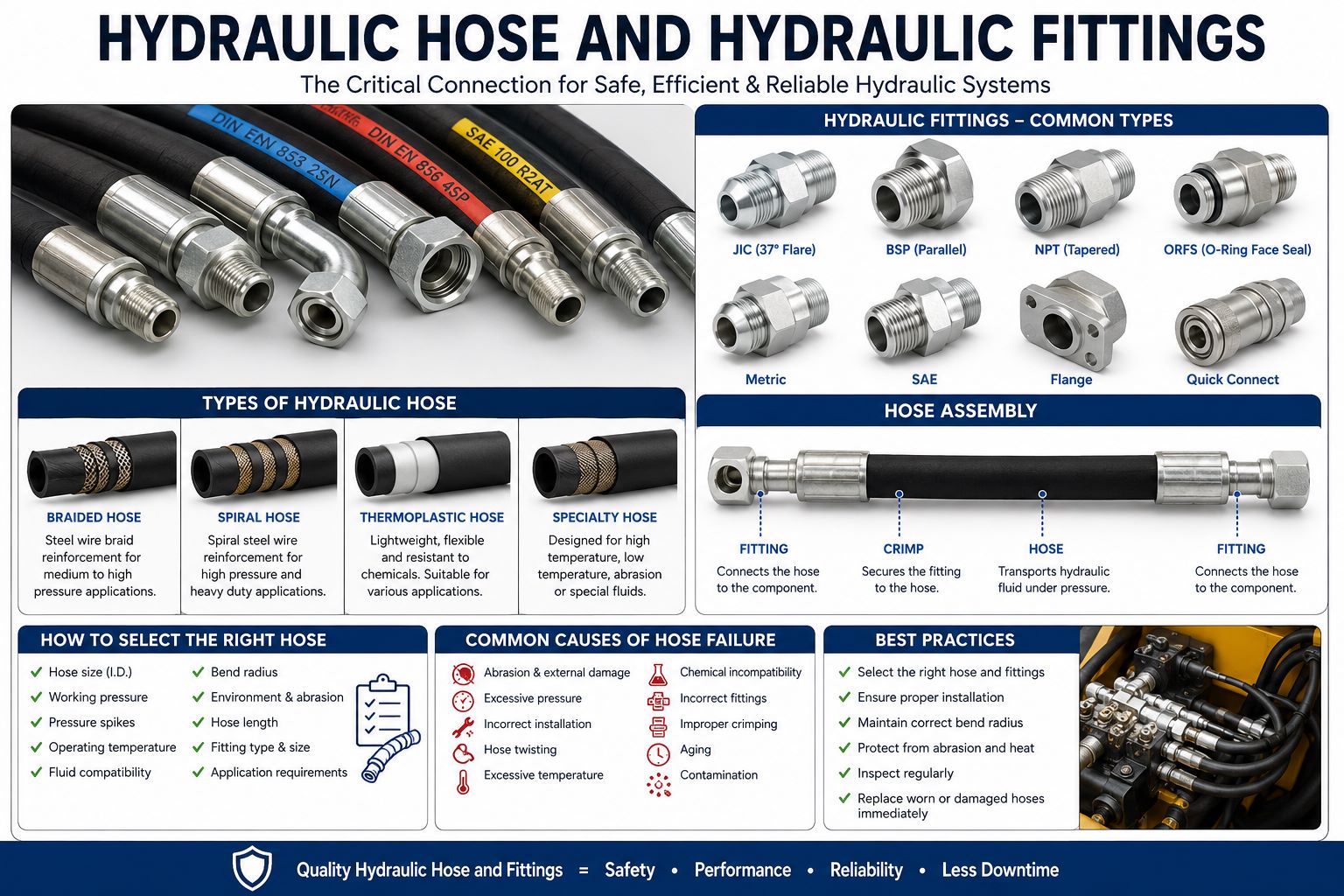
The growing use of high-performance machinery across construction, manufacturing, agriculture, mining, logistics, and infrastructure is increasing attention on one of the less visible parts of industrial equipment: Hydraulic Hose and Hydraulic Fittings.
As businesses push machinery to operate for longer hours and under demanding conditions, reliable hydraulic fluid transmission has become increasingly important. Hydraulic hoses and fittings connect critical components and allow pressurized fluid to move throughout equipment, making their performance closely connected to machine reliability, maintenance requirements, and operational safety.
For maintenance teams and equipment operators, choosing the correct hydraulic connection is no longer simply a replacement decision. It is becoming an important part of preventive maintenance and equipment management.
Heavy Machinery Continues to Depend on Hydraulic Power
Hydraulic systems remain widely used because they can generate substantial force while allowing controlled movement.
Construction excavators, loaders, cranes, agricultural machinery, industrial presses, forklifts, mining equipment, and manufacturing systems all demonstrate the versatility of hydraulic technology.
Within these machines, Hydraulic Hose transports pressurized fluid between components where flexible connections are required.
Hydraulic Fittings secure these hoses to components such as pumps, valves, cylinders, motors, manifolds, and filters.
Without dependable connections, even sophisticated hydraulic equipment can experience fluid loss, pressure problems, or unexpected shutdowns.
Hydraulic Hose Technology Is Designed for Difficult Conditions
Modern hydraulic hoses are engineered differently from ordinary flexible tubing.
Their construction generally consists of three major elements.
The inner tube provides fluid compatibility and containment. The reinforcement layer helps the hose withstand internal pressure. The external cover protects the reinforcement against abrasion, oil, weather, and environmental exposure.
Depending on operating requirements, manufacturers may use:
- Textile reinforcement
- Single or multiple wire braids
- Spiral steel-wire reinforcement
- Thermoplastic materials
- Specialized synthetic reinforcement
The correct construction depends on the pressure, temperature, movement, fluid, and environment encountered by the equipment.
Different Machines Create Different Hose Requirements
A hose operating inside stationary factory equipment faces different challenges from one installed on a moving excavator.
Construction machinery may experience constant movement, vibration, dirt, weather exposure, and abrasion. Manufacturing equipment may operate through repeated pressure cycles. Mining machinery can combine severe pressure with harsh environmental conditions.
This explains why selecting Hydraulic Hose according to application requirements is essential.
A hose should not be chosen merely because its dimensions appear similar to the component being replaced.
Hydraulic Fitting Standards Remain a Critical Selection Factor
The variety of Hydraulic Fittings available in the global equipment market can make replacement challenging.
JIC, BSP, NPT, ORFS, SAE, metric, flange, and quick-connect systems are among the commonly encountered configurations.
The differences go beyond thread dimensions.
Various fitting systems may seal through:
- Flared surfaces
- O-rings
- Tapered threads
- Flat sealing faces
- Flanges
Incorrectly identifying the connection can result in poor sealing or damaged components.
Maintenance professionals should therefore verify thread type, pitch, sealing method, size, and pressure capability before installing replacement fittings.
Complete Hydraulic Assemblies Need Compatible Components
Industry maintenance practices increasingly emphasize evaluating the complete hose assembly rather than individual components.
A high-pressure hose combined with an incorrectly rated fitting does not create a high-pressure assembly.
Likewise, the correct fitting cannot compensate for unsuitable hose material.
| Requirement | Hose Consideration | Fitting Consideration |
| Pressure | Working-pressure rating | Connection pressure capability |
| Flow | Internal diameter | Correct port size |
| Temperature | Tube and cover limits | Seal and material limits |
| Fluid | Inner-tube compatibility | Seal compatibility |
| Movement | Flexibility and bend radius | Correct fitting orientation |
| Environment | Abrasion resistance | Corrosion resistance |
All components should therefore be selected as part of one compatible fluid-transfer solution.
Incorrect Hose Size Can Reduce Hydraulic Efficiency
Industry technicians frequently consider internal diameter when troubleshooting hydraulic performance.
When the hose is too small for the required flow, fluid velocity can increase substantially.
Higher velocity can contribute to pressure losses and additional heat generation.
An excessively large hose may introduce other disadvantages, including greater weight, higher material costs, and increased space requirements.
Correct Hydraulic Hose sizing requires consideration of flow rate, recommended fluid velocity, hose length, pressure conditions, and equipment specifications.
High Pressure Brings Additional Engineering Challenges
Hydraulic systems can operate under considerable pressure, and some applications experience frequent pressure fluctuations.
Sudden changes in load or valve operation can create pressure impulses that place repeated stress on hoses and fittings.
The assembly must therefore be suitable for the maximum intended working conditions.
A critical distinction must also be made between working pressure and burst pressure.
Burst pressure is not an operating target. Hydraulic equipment should remain within the specified working-pressure limitations established for the components and assembly.
Temperature Is Emerging as an Important Maintenance Consideration
Heat can accelerate deterioration in hydraulic systems.
High-temperature fluid can affect hose inner-tube materials, while external sources such as engines, exhaust systems, furnaces, and production equipment can damage hose covers.
Cold environments can present different challenges by affecting flexibility.
When specifying Hydraulic Hose, technicians should consider both the temperature of the transported fluid and surrounding operating conditions.
Protective heat shielding or revised routing may be appropriate where excessive external heat cannot be avoided.
Hydraulic Fluid Changes Can Affect Hose Compatibility
Another potential source of trouble appears when businesses change hydraulic fluids without reviewing hose and seal compatibility.
Equipment can operate using petroleum-based hydraulic oils, synthetic fluids, biodegradable alternatives, water-glycol formulations, and other specialized media.
A material suitable for one fluid may not necessarily perform correctly with another.
Possible symptoms of incompatibility include:
- Swollen hose material
- Inner-tube deterioration
- Softening
- Hardening
- Cracking
- Seal damage
- Premature leakage
Compatibility should be verified against manufacturer technical information whenever fluid specifications change.
Abrasion Remains One of the Most Visible Threats
On mobile machinery, hoses frequently move as equipment operates.
Repeated contact with brackets, machine frames, other hoses, or surrounding structures can gradually damage the protective outer cover.
Once reinforcement becomes exposed, the hose requires careful evaluation.
Preventive measures can include improved routing, suitable clamps, abrasion-resistant covers, protective sleeves, and adequate clearance between moving components.
Proper installation can therefore have a substantial effect on hose service life.
Hydraulic Hose Routing Receives Greater Attention
Routing determines how a hose reacts when machinery moves.
A Hydraulic Hose should generally avoid unnecessary twisting, sharp bending, excessive stretching, and continuous rubbing.
Minimum bend-radius specifications are particularly important.
Forcing a hose through a bend tighter than its recommended limit can create excessive stress and reduce its expected service performance.
Installers should also provide sufficient length to accommodate normal machine movement without creating unnecessary slack.
Fitting Leaks May Signal Deeper Problems
A small leak around Hydraulic Fittings may appear to require nothing more than tightening, but technicians are increasingly encouraged to investigate the actual cause.
Possible issues include:
- Damaged O-rings
- Incorrect thread selection
- Worn sealing surfaces
- Contamination
- Corrosion
- Incorrect assembly
- Excessive vibration
- Mechanical damage
Additional tightening may not correct these problems.
In certain cases, overtightening can damage threads or sealing surfaces and make the situation worse.
Preventive Inspection Becomes a Cost-Control Strategy
For businesses operating fleets or production machinery, hydraulic maintenance can directly influence productivity.
An unexpected hose failure may stop equipment, release hydraulic fluid, interrupt production, and require emergency repair.
Routine inspection can help maintenance teams identify developing problems before failure.
Important warning signs include:
- Cracking
- Severe abrasion
- Exposed reinforcement
- Oil around connections
- Blisters
- Hose deformation
- Corroded fittings
- Damaged protective covers
- Unusual hose movement
- Evidence of overheating
Inspection frequency should be based on equipment usage, operating environment, manufacturer guidance, and the severity of the application.
Safety Concerns Remain Central to Hydraulic Maintenance
Hydraulic pressure creates hazards that may not always be immediately visible.
A tiny pinhole in a hose can release an extremely fine stream of pressurized fluid.
Workers should never use their hands to search for hydraulic leaks. High-pressure fluid can penetrate skin and cause a serious injection injury.
Machinery should be safely isolated and depressurized before maintenance according to appropriate procedures.
Repairs to critical hydraulic assemblies should be completed by qualified personnel using compatible components and correct assembly practices.
Frequently Asked Questions
1. Why is Hydraulic Hose important in machinery?
Hydraulic Hose provides flexible fluid transmission between components while accommodating machine movement and vibration.
2. What are Hydraulic Fittings designed to do?
Hydraulic Fittings connect hoses securely with pumps, valves, cylinders, motors, manifolds, and other components.
3. Which industries use hydraulic hoses?
Construction, manufacturing, mining, agriculture, logistics, material handling, transportation, and industrial automation are major users.
4. Are hydraulic hoses suitable for every hydraulic fluid?
No. Hose materials must be checked for compatibility with the specific fluid being transported.
5. What causes premature hydraulic hose failure?
Abrasion, excessive pressure, heat, poor routing, incorrect installation, fluid incompatibility, and aging are common factors.
6. Can hydraulic fitting standards be mixed?
Different standards should not be directly mixed unless an appropriate compatible adapter is specified.
7. What is the importance of working pressure?
Working pressure indicates the maximum specified pressure for normal operation under defined conditions.
8. How can abrasion damage be reduced?
Correct routing, proper hose supports, protective sleeves, and avoiding unnecessary surface contact can help.
9. Should a leaking hydraulic fitting always be tightened?
No. Damaged seals, incorrect threads, contamination, or damaged sealing surfaces may be the real cause.
10. When should hydraulic hoses be inspected?
Inspection intervals should reflect equipment usage, application severity, environment, and manufacturer maintenance recommendations.
https://newsgrow.blogspot.com/2026/08/industrial-hose-technology-evolves-as.html