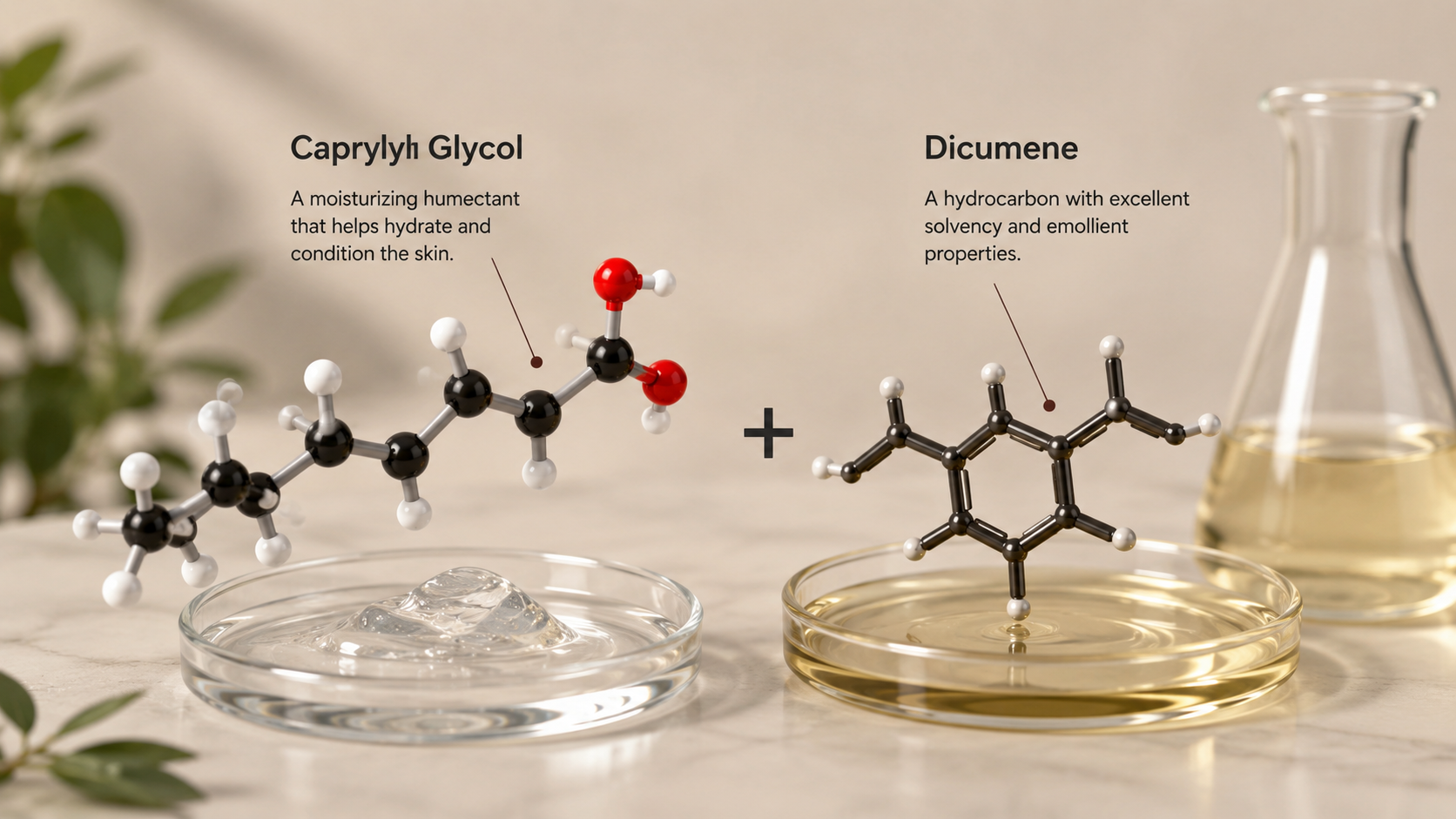
As manufacturers place greater emphasis on formulation efficiency, material performance, and consistent product quality, specialty chemicals are becoming increasingly important across global supply chains. Caprylyl Glycol and Dicumene represent two distinct examples of chemicals designed to meet specialized requirements in cosmetics, personal care, plastics, and polymer processing.
The two materials serve very different markets. Caprylyl Glycol is widely recognized as a multifunctional ingredient in cosmetic formulations, while Dicumene, chemically identified as 2,3-dimethyl-2,3-diphenylbutane, is primarily associated with polymer modification and certain flame-retardant technologies.
Their applications demonstrate how modern industries are moving toward chemicals selected for precise functional performance rather than basic formulation requirements alone.
Performance-Based Formulation Reshapes Chemical Selection
Manufacturers today must satisfy increasingly demanding expectations.
Cosmetic companies need formulations that deliver desirable texture, moisture management, stability, and protection against microbial deterioration. Polymer manufacturers need materials that can meet processing, mechanical, thermal, and application-specific performance targets.
This changing environment is increasing the importance of functional additives.
Rather than viewing specialty chemicals simply as additional ingredients, manufacturers increasingly evaluate the measurable role each material plays within the finished formulation.
Caprylyl Glycol Responds to Changing Cosmetic Requirements
Consumer expectations have transformed cosmetic product development.
Today’s skincare customer may expect a moisturizer to hydrate effectively, spread smoothly, feel comfortable, remain stable during storage, and maintain quality throughout its intended lifespan.
Caprylyl Glycol can support several of these formulation objectives.
It is valued for its humectant and skin-conditioning characteristics while also contributing to appropriately designed preservation systems.
Multifunctionality Becomes an Advantage for Formulators
One ingredient capable of performing multiple supporting functions can offer significant formulation flexibility.
Potential benefits associated with Caprylyl Glycol include:
- Moisture retention support
- Skin-conditioning properties
- Improved sensory characteristics
- Preservation-system enhancement
- Compatibility with diverse personal-care concepts
This multifunctionality has made the ingredient relevant to formulators seeking efficient ingredient combinations.
Hydration Remains Central to Modern Skincare
Moisture management continues to influence skincare innovation.
Humectants help support moisture retention and are therefore commonly incorporated into products intended to provide a conditioned skin feel.
Caprylyl Glycol offers humectant functionality that can contribute to this objective.
Consumer Expectations Extend Beyond Hydration
Effective moisturization alone does not guarantee commercial success.
Consumers often judge products immediately according to texture, spreadability, absorption, residue, and after-feel.
Sensory Quality Influences Repeat Purchases
A moisturizer that performs technically but feels unpleasant may struggle to build consumer loyalty.
Consequently, formulators increasingly consider the complete sensory experience when selecting functional ingredients.
Preservation Support Expands Caprylyl Glycol Applications
Preservation represents another important area of cosmetic development.
Water-based formulations can provide conditions where unwanted microorganisms may grow if an effective preservation strategy is absent.
Caprylyl Glycol is frequently incorporated as a preservative-supporting ingredient or booster.
It may complement other antimicrobial components rather than automatically serving as a universal standalone preservation solution.
Cosmetic Safety Requires Complete Formulation Evaluation
Manufacturers need to evaluate preservation within the context of the complete finished product.
Important factors include:
- Formulation pH
- Water activity
- Packaging system
- Ingredient interactions
- Manufacturing hygiene
- Storage environment
- Consumer usage patterns
Appropriate stability and microbiological testing should therefore remain fundamental parts of product development.
Personal-Care Applications Continue to Diversify
The versatility of Caprylyl Glycol allows its consideration across multiple cosmetic categories.
Applications can include:
- Facial moisturizers
- Body lotions
- Facial serums
- Cleansers
- Shampoos
- Conditioners
- Deodorants
- Sunscreen formulations
- Makeup products
- Body-care preparations
Actual usage levels depend on formulation design, compatibility, desired performance, and applicable regulatory requirements.
Dicumene Addresses the Needs of Advanced Polymer Manufacturing
While Caprylyl Glycol supports cosmetic development, Dicumene operates within a very different industrial environment.
Polymer manufacturers continually modify plastic materials to achieve particular processing and end-use characteristics.
Dicumene is a specialty organic compound relevant to certain polymer additive systems.
Its industrial significance is particularly associated with flame-retardant synergy and specialized polymer-modification processes.
Dicumene Supports Specialized Flame-Retardant Systems
Plastic materials are used in applications ranging from consumer products and packaging to electrical components and industrial equipment.
Depending on intended use, manufacturers may need to address specific fire-performance requirements.
Dicumene can act as a synergistic component in certain flame-retardant polymer systems.
Synergy Can Improve Additive-System Efficiency
In specialty chemistry, synergy refers to components working together to improve the performance of a complete system.
Instead of simply increasing one additive, polymer formulators may combine different components to achieve targeted characteristics.
Performance Depends on the Complete Polymer System
The effectiveness of Dicumene can depend on several variables, including polymer type, processing temperature, other additives, concentration, and targeted performance.
Technical evaluation is therefore essential before commercial implementation.
Dicumene Offers Relevance Across Multiple Polymers
Potential polymer applications associated with Dicumene include:
- Polypropylene
- Polyethylene
- Polystyrene
- High-impact polystyrene
- Expandable polystyrene
- ABS
- SAN
- Polymer masterbatches
- Specialty thermoplastic compounds
Each application requires its own formulation strategy and processing evaluation.
Polymer Modification Creates New Development Possibilities
The properties of a base polymer do not necessarily represent the limits of what manufacturers can achieve.
Through polymer modification, manufacturers can target specific material characteristics for specialized applications.
Dicumene has relevance to certain radical-driven processes, including applications involving grafting, initiation, and cross-linking.
Why Modify Existing Polymers?
Manufacturers may investigate polymer modification to influence:
- Processing performance
- Material compatibility
- Thermal behavior
- Mechanical characteristics
- Functional performance
This ability to tailor existing materials has become increasingly important in performance-oriented plastics manufacturing.
Two Chemicals Highlight the Diversity of Specialty Chemistry
| Comparison | Caprylyl Glycol | Dicumene |
| Main industry | Cosmetics and personal care | Plastics and polymers |
| Core functionality | Humectant and preservation support | Synergistic polymer additive |
| Typical materials | Creams, serums, shampoos | PP, PE, PS, ABS |
| Primary objective | Formulation and sensory performance | Polymer performance |
| Typical user | Cosmetic formulator | Polymer compounder |
| Development focus | Moisture and product stability | Modification and flame performance |
Despite being discussed within the same specialty chemical market, Caprylyl Glycol and Dicumene should not be considered substitutes.
Each addresses fundamentally different technical requirements.
Quality Assurance Becomes More Important for Chemical Buyers
As formulations become increasingly technical, raw-material consistency becomes a strategic purchasing consideration.
Buyers evaluating Caprylyl Glycol or Dicumene should consider:
- Product purity
- Technical specifications
- Certificate of Analysis
- Safety Data Sheet
- Batch-to-batch consistency
- Packaging standards
- Storage recommendations
- Regulatory documentation
- Technical support
- Supply continuity
A reliable supply chain can help manufacturers reduce variability and maintain more predictable production performance.
Frequently Asked Questions
What is Caprylyl Glycol?
Caprylyl Glycol is a multifunctional ingredient widely associated with cosmetic and personal-care formulations.
Why is Caprylyl Glycol used in cosmetics?
It provides humectant and conditioning functionality while supporting appropriately designed preservation systems.
Can Caprylyl Glycol help retain moisture?
Yes. Its humectant characteristics make it useful in formulations focused on moisture management.
Is Caprylyl Glycol a preservative booster?
Yes. It is commonly incorporated to complement suitable cosmetic preservation systems.
Which products can use Caprylyl Glycol?
Potential applications include moisturizers, serums, cleansers, shampoos, conditioners, deodorants, sunscreens, and makeup.
What is Dicumene?
Dicumene is 2,3-dimethyl-2,3-diphenylbutane, an organic specialty chemical associated mainly with polymer applications.
What is the main purpose of Dicumene?
It is particularly relevant to certain flame-retardant synergistic systems and specialized polymer-modification processes.
Which polymers are associated with Dicumene?
Applications can include polypropylene, polyethylene, polystyrene, ABS, SAN, and related polymer compounds.
Is Dicumene used for flame-retardant applications?
Yes. It can function as a synergistic component in appropriately designed flame-retardant polymer systems.
Are Caprylyl Glycol and Dicumene similar?
No. Their chemistry, functions, applications, and target markets are substantially different.
What should buyers check before purchasing specialty chemicals?
Buyers should examine specifications, purity, documentation, consistency, packaging, regulatory requirements, and supplier reliability.
https://newsgrow.blogspot.com/2026/08/ethylhexylglycerin-emerges-as-key.html