
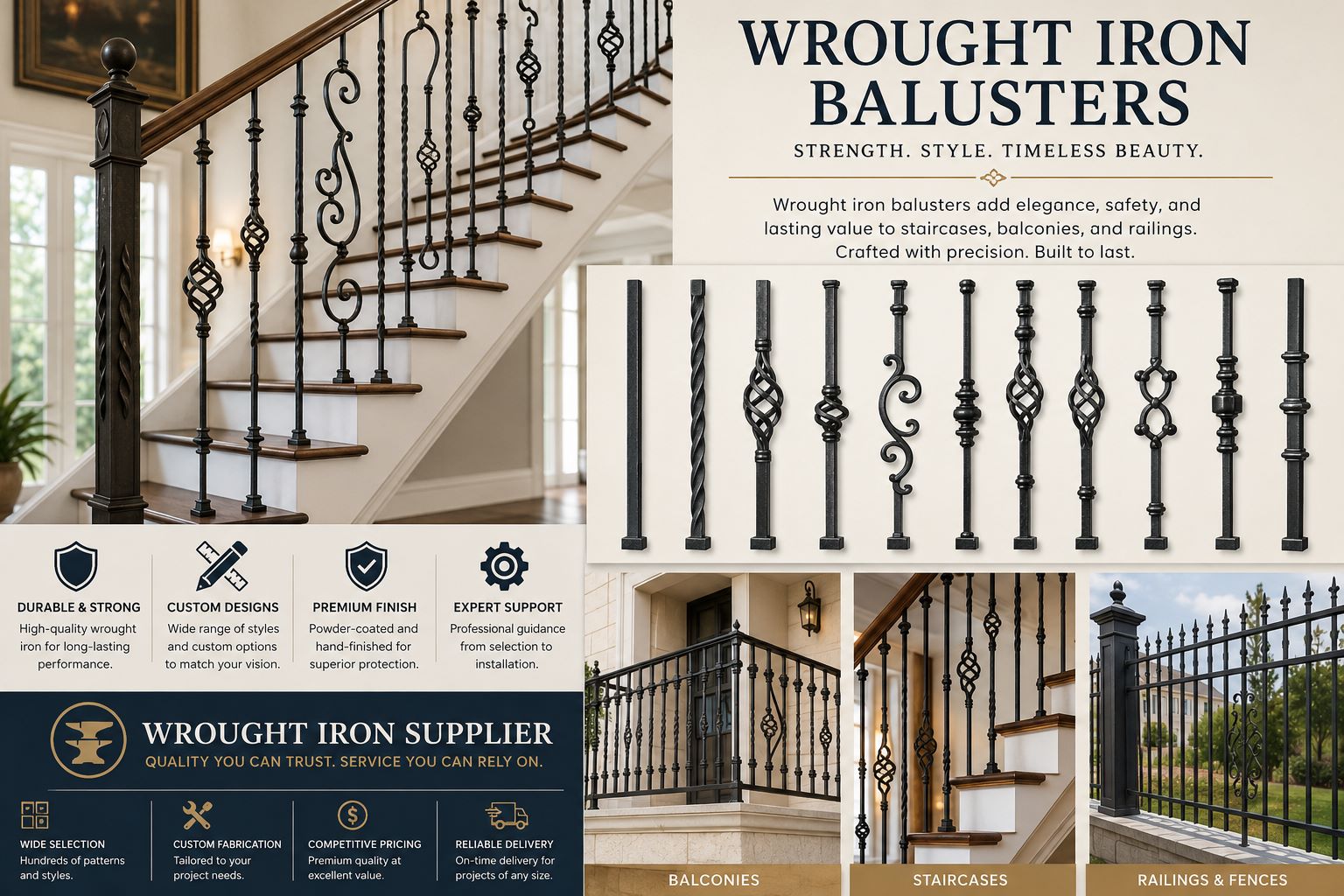
The architectural metalwork sector is experiencing a noticeable shift as builders, designers, contractors, and property developers look beyond purely functional railing systems. Decorative metal components are increasingly being considered an integral part of architectural planning, creating new opportunities for Wrought Iron Balusters across residential, hospitality, commercial, and renovation projects.
The development is also placing greater emphasis on the role of a professional Wrought Iron Supplier. Buyers today expect more than product availability. Consistent dimensions, dependable finishes, customization capabilities, bulk supply, and technical understanding have become important considerations when sourcing architectural ironwork.
Architectural Railings Move From Functional Elements to Design Features
Staircases and railings were traditionally planned primarily around access and safety. Contemporary architectural thinking gives these structures a broader purpose.
A staircase positioned in an entrance hall, hotel lobby, villa, or commercial property can become one of the first architectural features visitors notice.
Wrought Iron Balusters provide vertical definition within these railing systems while allowing designers to introduce distinctive patterns and details.
Common configurations include:
- Straight vertical profiles
- Twisted ironwork
- Basket patterns
- Scroll elements
- Hammered surfaces
- Decorative knuckles
- Geometric forms
- Custom ornamental designs
The ability to move between simple and elaborate styles helps explain why ironwork continues to remain relevant.
Changing Design Preferences Create New Opportunities
Modern architectural trends have expanded the perception of wrought iron.
Decorative iron is no longer limited to heavily ornamental traditional staircases. Minimalist profiles are now being incorporated into contemporary properties where clean lines and material contrast are priorities.
Contemporary Applications Favor Simplicity
Straight Wrought Iron Balusters with dark, understated finishes can complement neutral interiors, open floor plans, timber staircases, and modern lighting.
Instead of becoming the dominant decorative feature, the ironwork provides structure and visual rhythm.
Traditional Projects Preserve Detailed Craftsmanship
Traditional architecture continues to create demand for scrolls, baskets, twists, and ornamental profiles.
These designs remain particularly relevant for luxury residences, villas, boutique hotels, heritage renovations, and classical interiors.
Mixed-Material Railings Influence Current Design Direction
One development shaping railing design is the growing use of multiple materials within a single installation.
Iron can provide a visual bridge between otherwise contrasting architectural surfaces.
Iron and Timber
Natural timber combined with Wrought Iron Balusters creates contrast between the warmth of wood and the defined appearance of metal.
Iron and Natural Stone
Stone staircases paired with ironwork can support classical, rustic, Mediterranean, or luxury architectural concepts.
Iron and Marble
Decorative iron and marble remain a recognizable combination in premium residences, hotels, and formal entrance spaces.
Iron and Glass
Contemporary designers may combine selected iron components with glass where both transparency and structural definition are desired.
Product Quality Receives Greater Attention
As railing systems become more visible within architectural design, manufacturing inconsistencies become harder to overlook.
Professional buyers are consequently evaluating products according to more than their initial appearance.
Important considerations include material dimensions, straightness, decorative accuracy, surface condition, welding quality where applicable, and finishing consistency.
A reliable Wrought Iron Supplier can play an important role in ensuring that components supplied for the same project maintain compatible specifications.
Consistency Becomes Critical for Large Projects
Consider a hotel staircase containing hundreds of individual balusters.
If basket positions vary slightly or twists differ from one component to another, those differences may become clearly visible after installation.
The same principle applies to apartment developments and commercial projects where identical railing designs may be repeated across multiple areas.
For this reason, production consistency has become an important purchasing factor alongside design and price.
Exterior Applications Increase Demand for Protective Finishes
Outdoor architectural ironwork operates under very different conditions from an indoor staircase.
| Factor | Indoor Ironwork | Outdoor Ironwork |
| Rain exposure | Minimal | Frequent |
| Humidity impact | Usually limited | Potentially significant |
| Corrosion risk | Lower | Higher |
| Finish requirement | Primarily decorative | Decorative and protective |
| Inspection needs | Occasional | Periodic |
Exterior Wrought Iron Balusters used on balconies, terraces, entrance stairs, or outdoor railings require appropriate protection against environmental exposure.
Depending on project conditions, finishing solutions may include primers, powder coating, galvanizing, or specialized protective coating systems.
Wrought Iron Supplier Selection Becomes a Strategic Decision
For professional buyers, choosing a supplier can influence project schedules, installation efficiency, and final quality.
An experienced Wrought Iron Supplier should be evaluated across several areas.
Manufacturing Capability
The ability to provide repeatable product specifications is particularly important for bulk projects.
Product Diversity
A wider catalogue gives architects greater freedom to combine plain and decorative elements.
Customization
Custom dimensions, patterns, finishes, and other project-specific requirements may be necessary when standard products cannot achieve the intended design.
Supply Reliability
Architectural projects frequently operate according to strict schedules. Delayed components can affect fabrication and installation activities.
Technical Understanding
A knowledgeable supplier should be capable of discussing dimensions, surface treatments, available configurations, and intended applications clearly.
Customization Is Becoming More Important
Individuality has become an important objective in premium architecture.
Rather than selecting a complete railing directly from a standard catalogue, designers increasingly combine components to create their own patterns.
One approach involves positioning decorative Wrought Iron Balusters between simpler profiles. For example, a basket or twisted baluster may appear after every two or three straight pieces.
This produces a repeating pattern while preventing excessive decoration.
Custom finishes can further differentiate the railing and help coordinate ironwork with surrounding architectural materials.
Installation Remains Essential to Final Performance
Even accurately manufactured ironwork cannot compensate for poor installation.
Railing contractors must consider vertical alignment, spacing, mounting methods, staircase angles, handrail positioning, and structural stability.
Applicable local building requirements should also be checked because regulations concerning guardrail height and openings can vary between locations and project types.
Professional planning before installation can reduce modifications and improve the overall appearance of the finished railing.
Maintenance Supports Long-Term Architectural Value
One advantage of properly finished Wrought Iron Balusters is relatively manageable maintenance.
Indoor railings can generally be maintained through routine cleaning and occasional inspection.
Outdoor installations should be monitored more carefully.
Important warning signs include:
- Scratched protective finishes
- Paint deterioration
- Small rust spots
- Loose fittings
- Moisture around connections
- Surface coating damage
Addressing small defects early can help prevent moisture from reaching larger areas of exposed metal.
Buyers Increasingly Consider Total Value Instead of Initial Price
The cheapest component does not necessarily create the lowest project cost.
Inconsistent dimensions can require additional fabrication work. Poor finishes may need correction, while unreliable supply can delay installation.
A professional Wrought Iron Supplier can contribute value by providing consistent specifications, suitable finishes, coordinated components, predictable quantities, and support for repeat orders.
For contractors and developers managing multiple projects, these advantages can be especially important.
Frequently Asked Questions
What are wrought iron balusters?
They are vertical metal components installed within staircase, balcony, terrace, landing, and other railing systems.
Why are wrought iron balusters used in architecture?
They provide structural definition while offering extensive decorative and stylistic possibilities.
Are wrought iron balusters only for traditional properties?
No. Simple and geometric profiles can complement modern and minimalist architecture effectively.
Can wrought iron balusters be installed outdoors?
Yes. Exterior applications require suitable protective treatments based on environmental exposure.
Which designs are currently popular?
Straight, twisted, basket, scroll, hammered, knuckle, and geometric designs remain widely used.
Why is choosing a wrought iron supplier important?
Supplier capability influences quality consistency, customization, finishing, availability, and overall project efficiency.
Can wrought iron designs be customized?
Yes, depending on the manufacturer’s capabilities, project specifications, quantities, and required design.
What materials can be combined with wrought iron?
Timber, marble, natural stone, glass, and other metals can complement architectural ironwork.
How can buyers evaluate product quality?
Check dimensions, surface preparation, decorative consistency, finishing quality, and overall manufacturing accuracy.
Does wrought iron require maintenance?
Yes. Periodic inspection and timely repair of damaged protective finishes can support long-term performance.
https://gosarkarijobs.com/why-wrought-iron-components-are-redefining-modern-decorative-iron-work/
https://shopnets.com/a-complete-guide-to-wrought-iron-components-for-beautiful-decorative-iron-work/
https://newsgrow.blogspot.com/2026/08/wrought-iron-components-see-renewed.html