
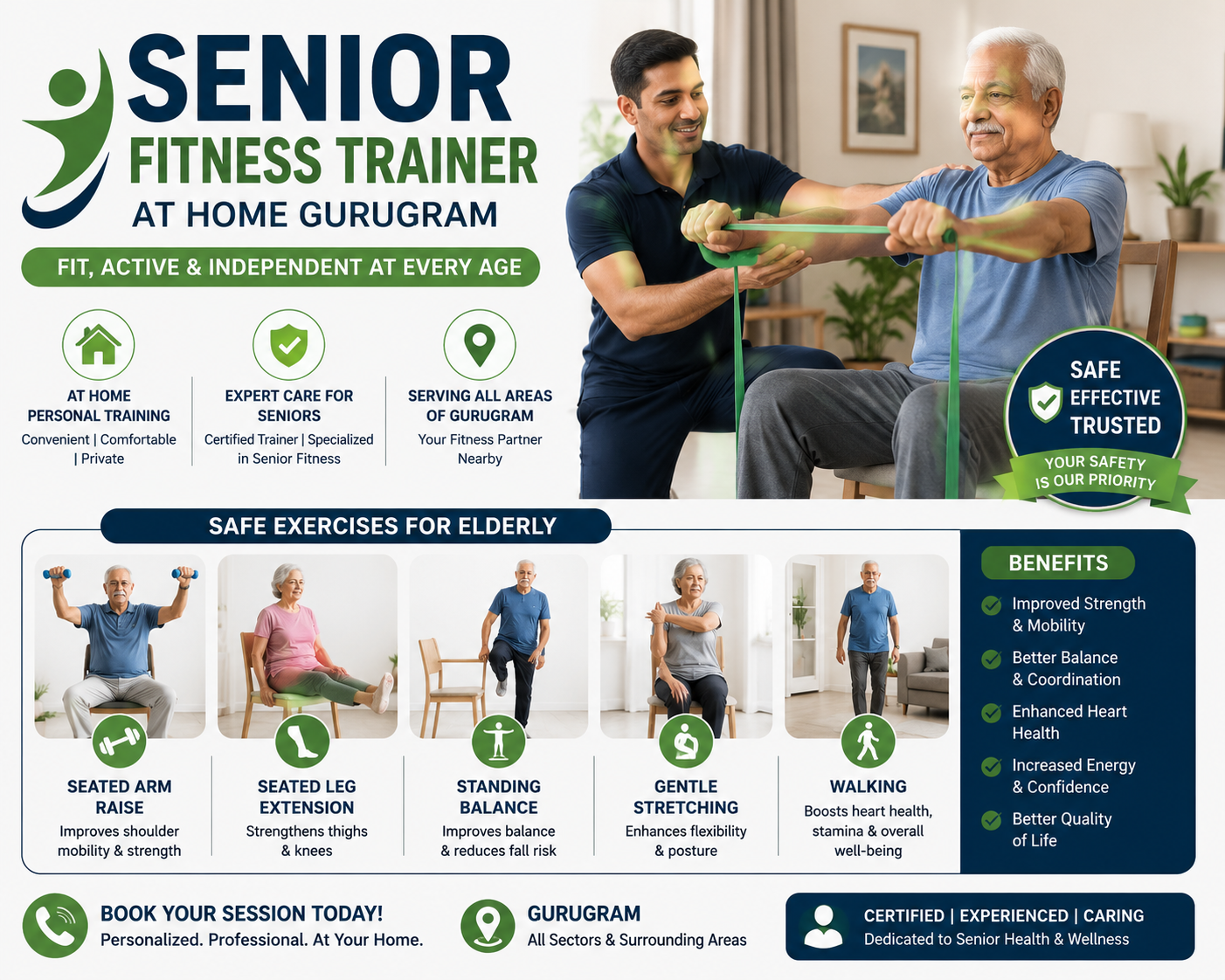
Staying physically active becomes increasingly important with age, but the right type of exercise matters just as much as staying active. For older adults, a well-planned fitness routine can support mobility, strength, balance, flexibility and confidence in everyday movement.
For families in Gurugram, hiring a Senior fitness trainer at home Gurugram can be a practical option for older adults who prefer personalised guidance without travelling to a gym or fitness centre.
A home-based trainer can adapt exercises to an individual’s fitness level, mobility, experience and comfort. This is particularly useful when an older adult needs a slower progression, balance-focused training or assistance with exercises.
What Is Senior Fitness Training?
Senior fitness training is a personalised exercise approach designed around the changing physical needs of older adults.
Rather than focusing only on intense workouts or weight loss, a senior-friendly programme generally prioritises functional fitness. This can include:
- Strength and resistance exercises
- Balance and stability training
- Mobility and flexibility work
- Low-impact cardiovascular activity
- Posture and movement exercises
- Core strengthening
- Functional movements used in daily life
The objective is to help an older person move safely and confidently while maintaining an appropriate level of physical activity.
Why Choose a Senior Fitness Trainer at Home in Gurugram?
Travelling to a gym is not always convenient for older adults. Some may prefer exercising in familiar surroundings, while others may find busy fitness centres uncomfortable.
A home trainer can provide one-to-one attention in a familiar environment.
1. Personalised Exercise Sessions
A trainer can modify exercises according to the individual’s current abilities rather than expecting them to follow a standard class.
For example, one person may be comfortable performing bodyweight squats, while another may initially need supported sit-to-stand exercises using a sturdy chair.
2. Greater Convenience
Home sessions eliminate the need to travel to a gym. This can make it easier for older adults to maintain a consistent exercise routine.
For families with busy schedules, having a trainer visit the home can also make fitness easier to organise.
3. Focus on Functional Fitness
Senior training should have a practical purpose.
Exercises can be selected to support everyday movements such as:
- Standing up from a chair
- Walking comfortably
- Reaching for objects
- Climbing steps
- Maintaining balance
- Carrying light household items
- Getting up and down safely
This approach makes exercise more relevant to daily independence.
4. Individual Attention
In a one-to-one session, the trainer can observe technique and adjust the exercise when necessary.
This is especially important for beginners who may not know how to perform strength or balance exercises correctly.
Safe Exercises for Elderly Adults
When people search for safe exercises for elderly adults, the most important consideration is not simply whether an exercise is popular. It is whether the exercise is appropriate for that individual’s abilities and circumstances.
A senior fitness routine may include the following exercises when they are suitable for the person.
Chair Sit-to-Stand
Sit on a stable chair and stand up in a controlled manner before sitting down again.
This simple movement can be used to practise a functional action that older adults perform frequently in everyday life.
A trainer can adjust the difficulty by changing the chair height, repetitions or level of support.
Supported Heel Raises
While holding a stable support, slowly raise the heels and return them to the floor.
This is a simple lower-leg exercise that can be incorporated into a broader strength and balance programme.
Wall Push-Ups
Wall push-ups can provide a gentler alternative to floor-based push-ups.
The distance between the feet and wall can be adjusted to change the difficulty, provided the individual can maintain comfortable and controlled movement.
Seated Knee Extensions
While sitting securely on a chair, gently straighten one knee and return the leg to its starting position.
This can be useful as part of a lower-body strengthening routine when appropriate.
Gentle Mobility Exercises
Controlled movements for the shoulders, ankles, hips and upper back can help maintain general mobility.
The range of motion should remain comfortable rather than forcing a joint into an uncomfortable position.
Walking
Walking is one of the simplest ways to incorporate physical activity into a senior’s routine.
Depending on the individual’s ability and environment, walking can take place indoors, around the home or outdoors.
For someone with balance concerns, a professional should first determine whether independent walking exercise is appropriate.
How Should a Senior Exercise Safely?
Older adults should not assume that every exercise is suitable simply because it is labelled “beginner” or “senior-friendly.”
A safer approach involves starting at an appropriate level and progressing gradually.
Important considerations include:
- Start slowly: Begin with manageable movements and allow the body to adapt.
- Prioritise technique: Controlled movement is generally more useful than rushing through repetitions.
- Use stable support: Balance exercises should be performed in an environment where appropriate support is available.
- Avoid exercising through significant pain: Discomfort that is unusual, severe or persistent should not simply be ignored.
- Allow recovery: Older adults may need appropriate recovery between demanding sessions.
- Keep the environment clear: Remove loose rugs, clutter and other potential trip hazards.
- Consider medical advice: People with significant health concerns or new symptoms should discuss exercise suitability with their healthcare professional.
What Should a Senior Fitness Programme Include?
A well-rounded programme does not need to be complicated.
For many older adults, a balanced routine can combine several areas of fitness:
| Fitness area | Examples |
| Strength | Chair exercises, resistance bands, supported movements |
| Balance | Supported single-leg exercises, controlled weight shifting |
| Mobility | Gentle joint and range-of-motion movements |
| Cardio | Walking or other suitable low-impact activities |
| Flexibility | Gentle stretching within a comfortable range |
| Functional fitness | Sit-to-stand, step practice and movement patterns |
The exact combination should depend on the individual’s current fitness, goals and limitations.
How a Home Trainer Can Adapt Exercises
One of the biggest advantages of one-to-one senior training is adaptability.
Suppose an older adult finds conventional squats difficult. Instead of removing strength training altogether, a trainer might introduce:
Chair sit-to-stand → supported squat → controlled bodyweight squat
The progression can be adjusted according to how confidently and comfortably the person performs each movement.
Similarly, balance training may begin with both hands supported before progressing to lighter support, depending on the individual’s capability.
This gradual approach is generally more appropriate than immediately introducing challenging exercises.
Who Can Benefit From Home-Based Senior Fitness Training?
A home-based programme may be worth considering for older adults who:
- Want personalised exercise guidance
- Prefer not to visit a gym
- Are new to structured exercise
- Want to maintain general strength and mobility
- Need a routine adapted to their current ability
- Prefer one-to-one coaching
- Want to work on balance and functional movement
- Find travelling to a fitness centre inconvenient
However, fitness training is not a substitute for medical care. If an individual has a significant medical condition, recent injury, unexplained symptoms or specific rehabilitation needs, appropriate healthcare guidance should be obtained before starting or changing an exercise programme.
How to Choose a Senior Fitness Trainer in Gurugram
Choosing the right trainer is more important than simply selecting the closest available professional.
Before booking a session, ask:
Does the trainer have experience working with older adults?
Senior fitness requires a different approach from training a healthy young adult. Ask about previous experience with older clients and the types of programmes they typically provide.
Does the trainer assess the client first?
A good programme should not begin with a generic workout.
The trainer should understand the person’s current activity level, goals, movement abilities and relevant considerations before deciding how to structure sessions.
Is the programme progressive?
Exercise should generally be adjusted as the client becomes more capable. Ask how the trainer plans to monitor progress and modify exercises.
Does the trainer prioritise safety?
A senior-focused trainer should pay attention to exercise technique, fatigue, balance and the home environment rather than pushing intensity for its own sake.
Can sessions be adapted?
Older adults can have very different needs. The ability to modify exercises is an important part of personalised training.
Questions to Ask Before Booking a Home Fitness Session
If you are arranging training for a parent or older family member, consider asking:
- What experience do you have with senior clients?
- How do you assess a new client?
- Can exercises be modified for different fitness levels?
- How do you structure the first session?
- How do you monitor progress?
- What equipment is required at home?
- Can sessions focus on strength, mobility and balance?
- What happens if the client feels uncomfortable during an exercise?
- How often would you recommend training?
These questions can help you determine whether the trainer’s approach matches the senior’s needs.
Frequently Asked Questions
What is the best exercise for elderly people?
There is no single best exercise for every older adult. A suitable programme usually combines appropriate strength, balance, mobility and aerobic activity according to the individual’s abilities and circumstances.
What are some safe exercises for elderly beginners?
Depending on the individual’s capabilities, beginner-friendly options can include supported sit-to-stands, wall push-ups, gentle mobility exercises, seated movements and walking. A qualified professional can help determine which exercises are appropriate.
Is home personal training suitable for seniors?
Yes, home personal training can be a convenient option for older adults who prefer personalised guidance in familiar surroundings. The programme should be adapted to the individual’s fitness level and needs.
How often should seniors exercise?
The appropriate frequency depends on the person’s current fitness, goals, recovery and overall circumstances. A trainer can help create a manageable routine rather than starting with an unnecessarily demanding schedule.
Can seniors do strength training?
Many older adults can participate in appropriately designed strength training. Exercises should be selected and progressed according to individual ability, with proper technique and suitable resistance.
Should an elderly person exercise if they have health concerns?
Not every exercise programme is appropriate for every person. Older adults with significant health concerns, recent injuries, new symptoms or specific medical restrictions should seek appropriate professional guidance before beginning or changing an exercise routine.