Glass processing has moved well beyond simple cutting and polishing. Today, manufacturers, architectural glass processors, furniture companies and decorative glass businesses need equipment that can produce consistent finishes while handling different glass sizes, thicknesses and design requirements.
A Glass Sandblasting Machine is designed for precisely this purpose. It uses abrasive media under controlled pressure to create frosted, matte, etched or patterned surfaces on glass. Depending on the machine configuration, the process can be used for decorative designs, privacy glass, signage, partitions, doors and other architectural applications.
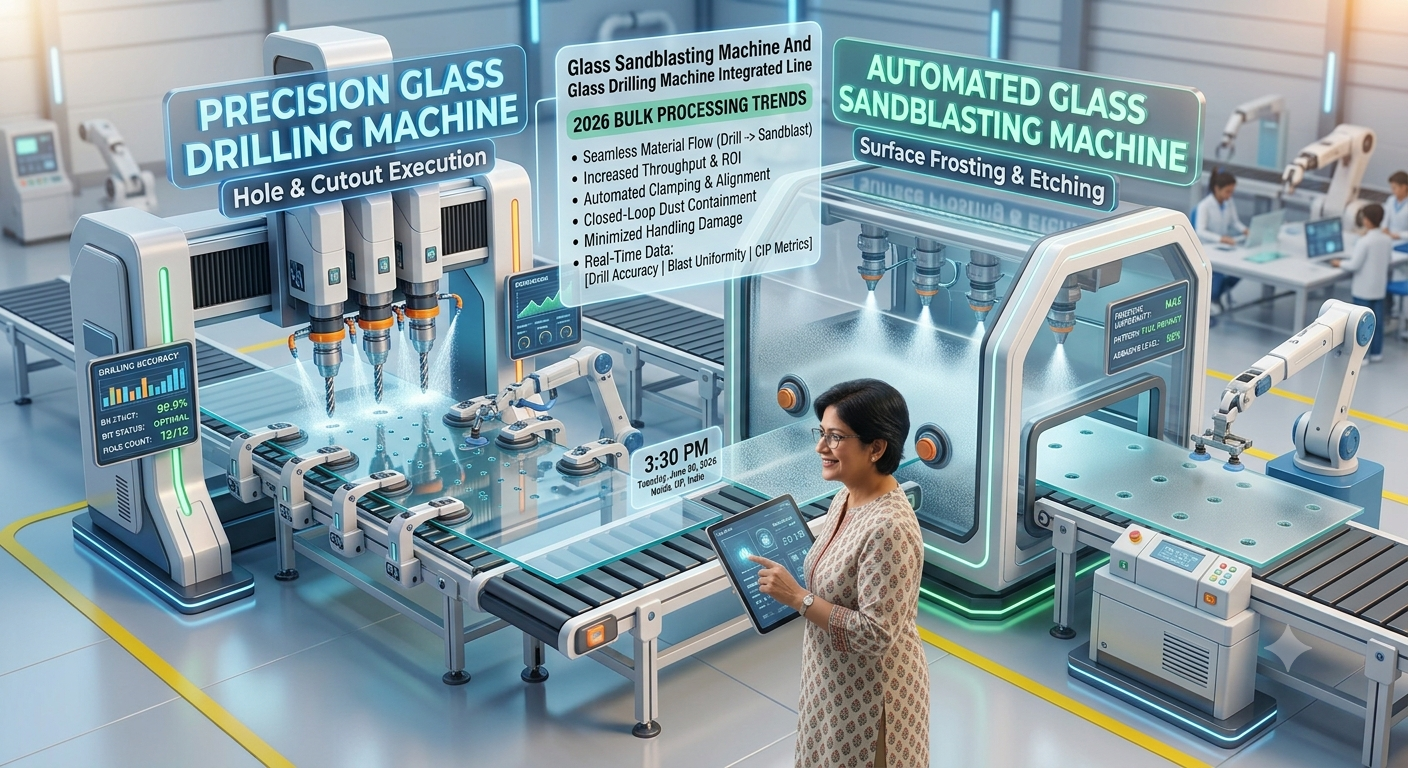
For businesses comparing glass processing equipment, it is also important to understand how sandblasting fits alongside operations such as drilling, cutting, edging and polishing. A Glass Drilling Machine, for example, serves a different purpose but can be an important part of the same production workflow.
What Is a Glass Sandblasting Machine?
A Glass Sandblasting Machine is industrial equipment used to treat the surface of glass by projecting abrasive particles at controlled pressure.
The abrasive action removes or roughens the glass surface to produce a specific visual or functional effect. Depending on the abrasive material, pressure, nozzle configuration and processing method, manufacturers can achieve different levels of opacity, texture and surface uniformity.
Modern glass sandblasting equipment may include features such as:
- Automatic or semi-automatic glass handling
- Adjustable blasting pressure
- Controlled abrasive flow
- Multiple blasting nozzles
- Conveyor-based movement
- Digital control systems
- Safety enclosures
- Dust collection systems
- Programmable blasting patterns
The right configuration depends on whether the machine is intended for occasional decorative work, regular architectural glass production or higher-volume industrial processing.
How Does a Glass Sandblasting Machine Work?
The basic working principle is straightforward:
- The glass sheet is positioned securely inside the machine.
- Abrasive material is delivered through a blasting nozzle.
- Compressed air propels the abrasive towards the glass surface.
- Controlled abrasion changes the surface texture and transparency.
- The treated glass is cleaned and inspected before further processing.
The final result depends on several variables, including blasting pressure, abrasive type, nozzle distance, processing speed, exposure time and the characteristics of the glass.
This is why machine control and operator experience matter. Excessive or inconsistent blasting can produce uneven finishes, while insufficient treatment may not achieve the required opacity or texture.
Where Is Glass Sandblasting Used?
Sandblasted glass is widely used where appearance, privacy or surface decoration is important.
1. Architectural Glass
Architectural glass manufacturers use sandblasting to create privacy panels, decorative partitions, entrance doors, stairway panels and interior glazing.
2. Shower Enclosures
Frosted and patterned glass can provide privacy while maintaining a clean, modern appearance.
3. Glass Doors and Partitions
Offices, hotels, homes and commercial buildings often use etched or frosted glass for doors and partitions.
4. Decorative Glass
Glass processors can create logos, geometric patterns, borders and customised decorative designs.
5. Signage and Branding
Businesses can use blasted glass surfaces for branded panels, reception areas and architectural signs.
6. Furniture Glass
Tables, cabinets, shelves and display furniture may incorporate textured or frosted glass for aesthetic purposes.
7. Interior Design
Designers often specify sandblasted glass for privacy screens, room dividers and feature walls.
What Are the Advantages of a Glass Sandblasting Machine?
Investing in the appropriate equipment can provide several practical benefits.
Consistent surface finishing: Controlled machine parameters can produce more uniform results than manual blasting.
Repeatable production: Once suitable settings are established, similar glass pieces can be processed using the same operating parameters.
Decorative flexibility: Different blasting techniques can create frosted surfaces, patterns, gradients and customised designs.
Improved productivity: Automated material handling and controlled blasting can reduce manual intervention in suitable production environments.
Better process control: Operators can manage parameters such as pressure, blasting speed and exposure more consistently.
However, productivity and finish quality depend on the machine specification, glass characteristics, abrasive media, maintenance and operator training.
Automatic vs Manual Glass Sandblasting Machines
Choosing between manual, semi-automatic and automatic equipment depends primarily on production requirements.
| Machine Type | Suitable For | Main Consideration |
| Manual | Small batches and customised work | Higher operator involvement |
| Semi-automatic | Regular production | Balance between flexibility and productivity |
| Automatic | Higher-volume production | Greater process consistency and automation |
A small decorative glass workshop may not need a fully automated production line. Conversely, a manufacturer processing large quantities of architectural glass may benefit from automated handling and programmable controls.
The best choice is therefore not necessarily the machine with the highest automation level. It is the machine that matches the company’s actual production volume, glass dimensions, finish requirements and available workspace.
Glass Sandblasting vs Acid Etching
Both processes can create frosted or decorative glass, but they work differently.
Sandblasting mechanically alters the glass surface using abrasive particles. Acid etching uses chemical treatment to create a translucent surface.
Sandblasting can be particularly useful where customised patterns, controlled surface treatment or mechanical engraving effects are required. The appropriate method depends on the application, production environment, desired appearance and process controls available.
What Should You Consider Before Buying a Glass Sandblasting Machine?
Buying industrial glass machinery should be approached as a production decision rather than simply a price comparison.
Glass Size and Thickness
Determine the minimum and maximum glass dimensions your business regularly processes. Check the machine’s supported glass thickness range and handling capacity.
Production Volume
Estimate daily and monthly production requirements. A machine designed for low-volume work may not be appropriate for continuous industrial production.
Surface Finish
Clarify the type of finish you need: light frosting, heavy frosting, decorative patterns, privacy treatment or another surface effect.
Automation Level
Consider whether manual loading is practical or whether automatic glass handling would improve your workflow.
Abrasive System
Understand which abrasive media the machine is designed to use and how the abrasive is collected, filtered and recycled where applicable.
Dust Management
Effective dust extraction and appropriate workplace safety controls are essential considerations when selecting abrasive-processing equipment.
Maintenance and Spare Parts
Ask about wear components, nozzle replacement, filters, abrasive handling components and availability of technical support.
Installation and Training
A reliable supplier should be able to explain installation requirements, operating procedures, maintenance schedules and safety considerations.
After-Sales Support
Technical assistance can become particularly important when machinery is integrated into a larger glass-processing line.
What Is a Glass Drilling Machine?
A Glass Drilling Machine is used to create precise holes in glass without relying on conventional metal drilling methods.
Glass drilling requires specialised equipment because glass is brittle and can crack or chip when subjected to uncontrolled mechanical stress.
Depending on the machine design, glass drilling systems may be used for:
- Shower glass
- Furniture glass
- Architectural glazing
- Shelving
- Doors
- Hardware fittings
- Display systems
- Industrial glass components
The drilling process commonly involves specialised diamond tools and controlled cooling to manage heat and reduce the risk of glass damage.
Glass Sandblasting Machine vs Glass Drilling Machine
These machines perform completely different operations.
| Feature | Glass Sandblasting Machine | Glass Drilling Machine |
| Primary function | Surface treatment | Hole creation |
| Typical result | Frosted, matte or decorative surface | Precise hole |
| Main process | Abrasive blasting | Mechanical drilling |
| Common applications | Privacy and decorative glass | Hardware and fitting holes |
| Production role | Surface finishing | Glass fabrication |
For many glass processors, these machines can complement rather than replace each other.
For example, a manufacturer producing decorative shower enclosures might drill holes for hinges and fittings and then use sandblasting to create a privacy pattern.
Common Applications for a Combined Glass Processing Workflow
A typical glass fabrication workflow may include several stages:
Glass cutting → edge processing → drilling → washing → sandblasting/decoration → inspection → final assembly
The exact sequence varies according to the product.
For a decorative glass door, for instance, holes may need to be produced for handles or hinges, while selected areas of the surface may be blasted to create a frosted design.
Planning equipment around the complete workflow can therefore be more effective than evaluating each machine independently.
Common Mistakes When Choosing Glass Processing Equipment
Buying Based Only on Price
The cheapest machine may not offer the required working size, automation, finish consistency or technical support.
Ignoring Future Production Requirements
If production is expected to grow, consider whether the equipment can accommodate higher workloads.
Not Checking Glass Specifications
Always match machine capacity with the glass thicknesses and dimensions you actually process.
Overlooking Dust and Safety Requirements
Abrasive blasting requires appropriate containment, extraction and workplace safety procedures.
Focusing Only on Machine Features
A long feature list does not automatically mean better production. Evaluate how each feature contributes to your actual manufacturing process.
Not Asking About Support
Machine availability is only one part of the purchase decision. Installation, training, spare parts and technical assistance can affect long-term operating efficiency.
How Much Does a Glass Sandblasting Machine Cost?
The price of a Glass Sandblasting Machine varies significantly according to its specifications.
Factors affecting the cost can include:
- Manual or automatic operation
- Maximum glass dimensions
- Glass thickness range
- Number and configuration of blasting nozzles
- Conveyor and material-handling system
- Control technology
- Dust collection system
- Production capacity
- Customisation requirements
- Installation and service arrangements
For this reason, a supplier should normally quote based on your specific production requirements rather than providing a generic machine price.
If you are requesting quotations, provide the supplier with your typical glass dimensions, thicknesses, required finish, expected production volume and preferred automation level. This makes it easier to compare technically suitable machines.
How to Choose the Right Glass Sandblasting Machine Supplier
The machine itself is only part of the investment. Supplier capability should also be assessed.
Look for a manufacturer or machinery supplier that can provide:
- Clear technical specifications
- Suitable machine configurations
- Demonstration or sample processing where available
- Installation guidance
- Operator training
- Spare parts support
- Maintenance information
- Responsive technical assistance
- Transparent commercial terms
If possible, ask the supplier how the machine performs with glass similar to yours. A sample test can be particularly useful when the final surface appearance is critical.
Practical Example: Choosing Equipment for a Glass Workshop
Suppose a glass processor produces customised shower doors and office partitions.
The company may need to:
- Drill holes for handles and fittings
- Create frosted privacy areas
- Process different glass thicknesses
- Handle both standard and customised orders
- Maintain consistent decorative finishes
In this situation, a Glass Drilling Machine can handle the required holes, while a Glass Sandblasting Machine can provide the decorative or privacy finish.
Instead of choosing equipment based solely on individual specifications, the business should consider how both machines will fit into its production workflow, available floor space and expected order volume.
Frequently Asked Questions
What is a Glass Sandblasting Machine used for?
A Glass Sandblasting Machine is used to create frosted, matte, textured or decorative finishes on glass through controlled abrasive blasting.
Can a Glass Sandblasting Machine create patterns?
Yes. Depending on the machine and process, masked or programmed areas can be treated to create decorative patterns, logos, borders and other designs.
What is the difference between sandblasted and frosted glass?
“Frosted glass” describes the translucent appearance, while sandblasting is one method used to create that appearance. Frosted effects can also be produced using other manufacturing techniques.
Is sandblasting suitable for architectural glass?
Yes, sandblasting is commonly used for decorative and privacy applications in architectural glass, provided the equipment and process are appropriate for the glass specification.
What does a Glass Drilling Machine do?
A Glass Drilling Machine creates accurately positioned holes in glass for applications such as doors, shower enclosures, furniture and architectural fittings.
How do I select the right machine?
Start with your glass dimensions, thickness range, production volume, required finish, automation needs and available workspace. Then compare machines and suppliers against those requirements.
Should I buy manual or automatic glass processing equipment?
Manual equipment may suit lower-volume or highly customised work, while automated machinery can be appropriate for more repetitive production. The correct choice depends on workload and process requirements.