
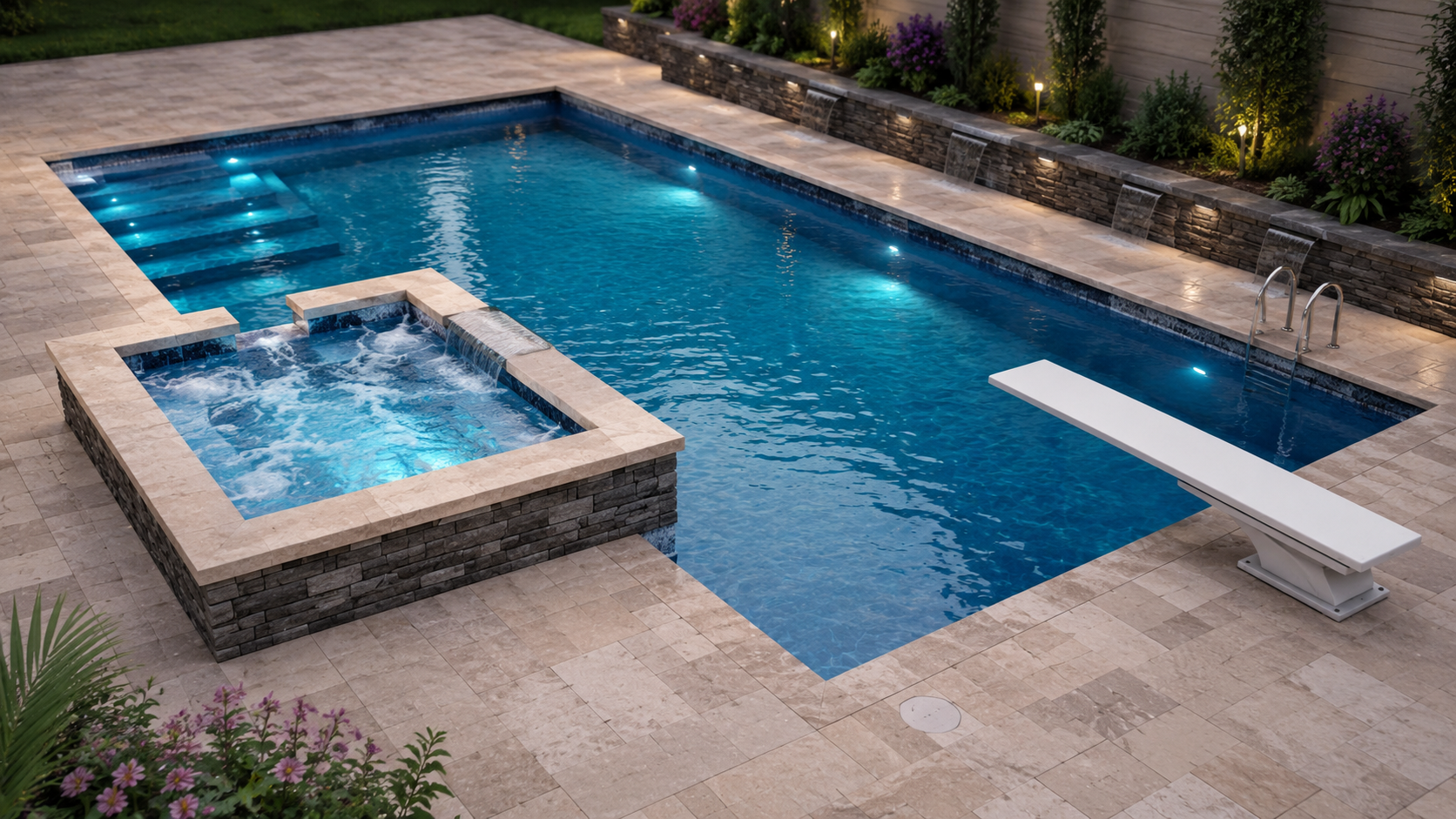
The best pool areas are designed around experiences rather than features. A quiet evening in warm bubbling water requires a completely different environment from an afternoon of swimming and diving. This is why combining a custom jacuzzi with a diving board for inground pool can be such an interesting design approach. One creates a dedicated wellness space, while the other brings movement and recreation to the pool.
Getting both right requires more than selecting attractive products. The jacuzzi must deliver comfortable seating, effective water circulation and controlled heating. The diving area must provide appropriate depth, clearance and structural support. When these requirements are considered together, the result can be a more functional and enjoyable outdoor space.
Start With How You Want to Use the Pool
Before discussing tiles, jets or diving-board styles, think about how people will actually use the area.
Is the pool mainly intended for family entertainment? Do you want a quiet spa for evening relaxation? Will children and adults regularly use the diving area? Do you frequently entertain guests?
These questions influence everything from pool dimensions to equipment placement.
A well-planned layout might divide the space into three zones:
- A deep-water diving and swimming area
- An open social or recreational section
- A separate custom jacuzzi for relaxation
Creating defined zones reduces interference between different activities and makes the entire pool environment easier to use.
A Custom Jacuzzi Should Fit the Space, Not the Other Way Around
One of the biggest advantages of a custom jacuzzi is flexibility.
Instead of purchasing a fixed-size spa and finding somewhere to place it, a customised design can respond to the architecture of the property.
For example, a narrow garden might suit a compact rectangular jacuzzi positioned along one side of the pool. A larger luxury property could accommodate a raised circular spa overlooking the swimming area.
Customisation can cover:
- Jacuzzi dimensions
- Number of users
- Seat height and depth
- Hydrotherapy jets
- Entry steps
- Lighting
- Water temperature controls
- Interior finishes
- Spillover features
- Automation
The objective is to create a spa that feels intentionally designed rather than added as an afterthought.
Think About the Experience Inside the Jacuzzi
Visual appearance matters, but the real quality of a custom jacuzzi becomes apparent when you use it.
Comfortable seating is fundamental. Seats should support natural body positions while allowing users to enjoy different jet configurations.
Hydrotherapy jets can be positioned around areas such as the shoulders, upper back, lower back, calves and feet. However, simply increasing the number of jets does not guarantee a better experience. Water pressure, pump performance and jet positioning must work together.
A carefully engineered system can deliver a more consistent experience than one designed around jet quantity alone.
Heating, Pumps and Filtration Work Behind the Scenes
The most attractive jacuzzi will still disappoint if its mechanical system is poorly designed.
A custom jacuzzi normally requires coordinated heating, circulation, filtration and hydrotherapy systems. Depending on the design, these may operate independently from the main swimming pool.
Important considerations include:
| Component | Main Function |
| Heater | Maintains comfortable water temperature |
| Circulation pump | Moves water through the system |
| Filter | Removes suspended contaminants |
| Jet pump | Supplies water to hydrotherapy jets |
| Air blower | Adds air to selected jet systems |
| Controller | Manages temperature and functions |
Equipment should be appropriately sized for the spa rather than selected purely on price.
A Diving Board Changes the Way the Deep End Is Designed
Adding a diving board for inground pool should influence pool design from the earliest planning stage.
The critical issue is the diving envelope—the clear underwater area a diver needs after entering the water.
This means designers must evaluate more than maximum depth.
Pool length, width, floor configuration, board position and transition towards shallower water can all affect suitability.
For an existing swimming pool, professional assessment should therefore come before purchasing a board.
Why a Deep Pool Is Not Automatically a Diving Pool
It is easy to assume that a sufficiently deep section makes diving safe. In practice, diving involves forward movement as well as downward movement.
A diving board for inground pool therefore requires adequate space beyond the point where the diver enters the water.
Important factors can include:
- Depth beneath and beyond the board
- Distance to the opposite wall
- Width of the deep-water area
- Pool floor profile
- Transition slope
- Board projection
- Board height
- Manufacturer requirements
Applicable local regulations and recognised safety requirements should always be considered.
Choosing a Diving Board That Matches the Pool
Diving boards vary considerably.
Some provide noticeable flex, while others offer a firmer take-off. There are also rigid diving platforms that provide an elevated entry point without traditional spring action.
| Option | Typical Characteristic | Best Consideration |
| Flexible diving board | Controlled board movement | Suitable pool geometry |
| Low-profile board | Streamlined appearance | Residential pool compatibility |
| Diving platform | Rigid surface | Appropriate deep-water area |
The correct diving board for inground pool is the one compatible with the specific pool and mounting system—not necessarily the longest or most flexible option available.
Keep Diving and Jacuzzi Areas Separate
When incorporating both features, zoning becomes particularly important.
A custom jacuzzi naturally encourages people to sit, talk and remain in one location. A diving area requires clear water and sufficient surrounding space.
Placing these activities too close together can create unnecessary congestion.
A better layout could position the jacuzzi beside the shallow or social section while keeping the diving board at the opposite deep end.
This arrangement allows swimmers, spa users and divers to enjoy the pool simultaneously with less interference.
Connect Both Areas Through Good Design
Although the two zones should remain functionally separate, they can still look like parts of the same project.
Design continuity can be created through matching materials, landscaping and lighting.
For example, the swimming pool and custom jacuzzi could share the same interior tile. The surrounding deck could use one consistent slip-resistant material, while coordinated underwater lighting visually connects both areas after dark.
A raised spa can also incorporate a spillover edge, creating a gentle water feature between the jacuzzi and pool.
Do Not Overlook the Pool Deck
The deck connects every feature and deserves the same attention as the water.
Wet areas require surfaces with appropriate slip resistance. Drainage should prevent water from collecting around spa entrances and high-traffic areas.
Around a diving board for inground pool, the deck also needs to accommodate the manufacturer’s mounting requirements and structural loads.
Decorative elements should never compromise practical movement around the pool.
Plan for Maintenance Before Construction
Equipment access is frequently overlooked during visually focused pool design.
Pumps, heaters, filters, valves and controls will eventually require servicing. Designing sufficient access from the beginning can make long-term ownership significantly easier.
A custom jacuzzi generally requires regular attention to:
- Water chemistry
- Filters
- Jet operation
- Heating performance
- Pumps and valves
- Interior surfaces
- Controls
The diving board should also be periodically checked for surface damage, loose components, corrosion and deterioration around its mounting points.
Which Feature Adds More Value to the Pool Experience?
There is no universal answer because they solve different needs.
A custom jacuzzi is primarily about comfort, relaxation and socialising. A diving board for inground pool focuses on active recreation.
For households wanting both experiences, combining them may make more sense than choosing one over the other.
The decision should ultimately reflect who will use the pool and how frequently each feature will be enjoyed.
Frequently Asked Questions
Can a Custom Jacuzzi Be Built Beside an Existing Pool?
Yes, depending on available space, structural conditions and access to suitable plumbing and electrical systems.
Can the Jacuzzi and Swimming Pool Share Water?
Some integrated configurations allow water interaction, while other spas operate as separate systems.
How Many People Can a Custom Jacuzzi Accommodate?
Capacity depends on its dimensions and seating configuration. Customisation allows the design to reflect expected usage.
Can Every Inground Pool Have a Diving Board?
No. Pool dimensions and the complete diving envelope must be suitable.
How Deep Should the Pool Be for Diving?
There is no universal depth applicable to every board. Pool geometry, board specifications and applicable standards must be evaluated together.
Is a Diving Board Different From a Diving Platform?
Yes. Traditional boards usually provide some flexibility, while platforms are generally rigid.
Can a Jacuzzi Be Raised Above the Swimming Pool?
Yes. Raised spas are commonly used to create visual separation and can incorporate spillover features.
What Is the Best Location for a Diving Board?
The diving board for inground pool should be positioned within a properly designed deep-water diving zone.
What Materials Can Be Used Inside a Jacuzzi?
Depending on the construction system, options can include specialist pool finishes, porcelain tiles and glass mosaics.
Does a Jacuzzi Require Its Own Pump?
Many designs use dedicated pumps for circulation or hydrotherapy jets, although equipment configurations vary.
Should a Diving Board Be Inspected Regularly?
Yes. Mounting components, surfaces and hardware should be maintained according to manufacturer guidance.
Can Both Features Be Included During Pool Renovation?
Potentially. A professional assessment can determine whether the existing structure, dimensions and mechanical systems can support the proposed upgrades.
Read more – https://gosarkarijobs.com/how-swimming-pool-manufacturers-in-india-are-redefining-the-modern-designer-pool/
https://newsgrow.blogspot.com/2026/08/swimming-pool-manufacturers-in-india.html
https://newsgrow.blogspot.com/2026/08/frp-swimming-pool-manufacturers-in.html
https://newsgrow.blogspot.com/2026/08/fiberglass-pool-manufacturers-near-me.html
https://blogstream.net/why-a-readymade-fiberglass-pool-is-becoming-a-smart-choice-for-modern-homes/
https://newsgrow.blogspot.com/2026/08/fiberglass-inground-pools-and-readymade.html
https://newsgrow.blogspot.com/2026/08/terrace-readymade-swimming-pool-and.html
https://newsgrow.blogspot.com/2026/08/hydrotherapy-swimming-pool-manufacturer.html
https://newsgrow.blogspot.com/2026/08/deep-information-about-swimming-pool.html
https://newsgrow.blogspot.com/2026/08/custom-jacuzzi-and-diving-board-for.html