Walk through almost any supermarket today and one packaging trend is difficult to miss. Coffee, dry fruits, pet treats, protein powders, snacks and even household products are increasingly appearing in flexible pouches rather than conventional boxes and rigid containers.
The reason is practical. Modern packaging needs to protect the product, look attractive on a shelf, remain convenient for customers and support efficient storage and transportation. The zipper stand up pouch and Stand Up Pouch address many of these requirements within one adaptable packaging format.
But there is more to these pouches than their appearance. Material construction, barrier properties, closures and printing all determine whether a pouch is genuinely suitable for a particular product.
What Makes a Stand Up Pouch Different from an Ordinary Bag?
A traditional flat bag usually needs support to remain upright. A Stand Up Pouch, on the other hand, has an expandable bottom gusset.
Once the package is filled, the gusset opens to create a wider base. This allows the pouch to stand independently on a shelf when its dimensions, contents and construction are appropriate.
This design gives manufacturers several advantages:
- Better product presentation
- More visible branding space
- Compact storage before filling
- Flexible sizing possibilities
- Multiple closure options
- Compatibility with many product categories
- Convenient handling for consumers
These characteristics have made stand-up packaging particularly useful for brands seeking an alternative to certain rigid packaging formats.
Why Is the Zipper Stand Up Pouch Becoming Popular?
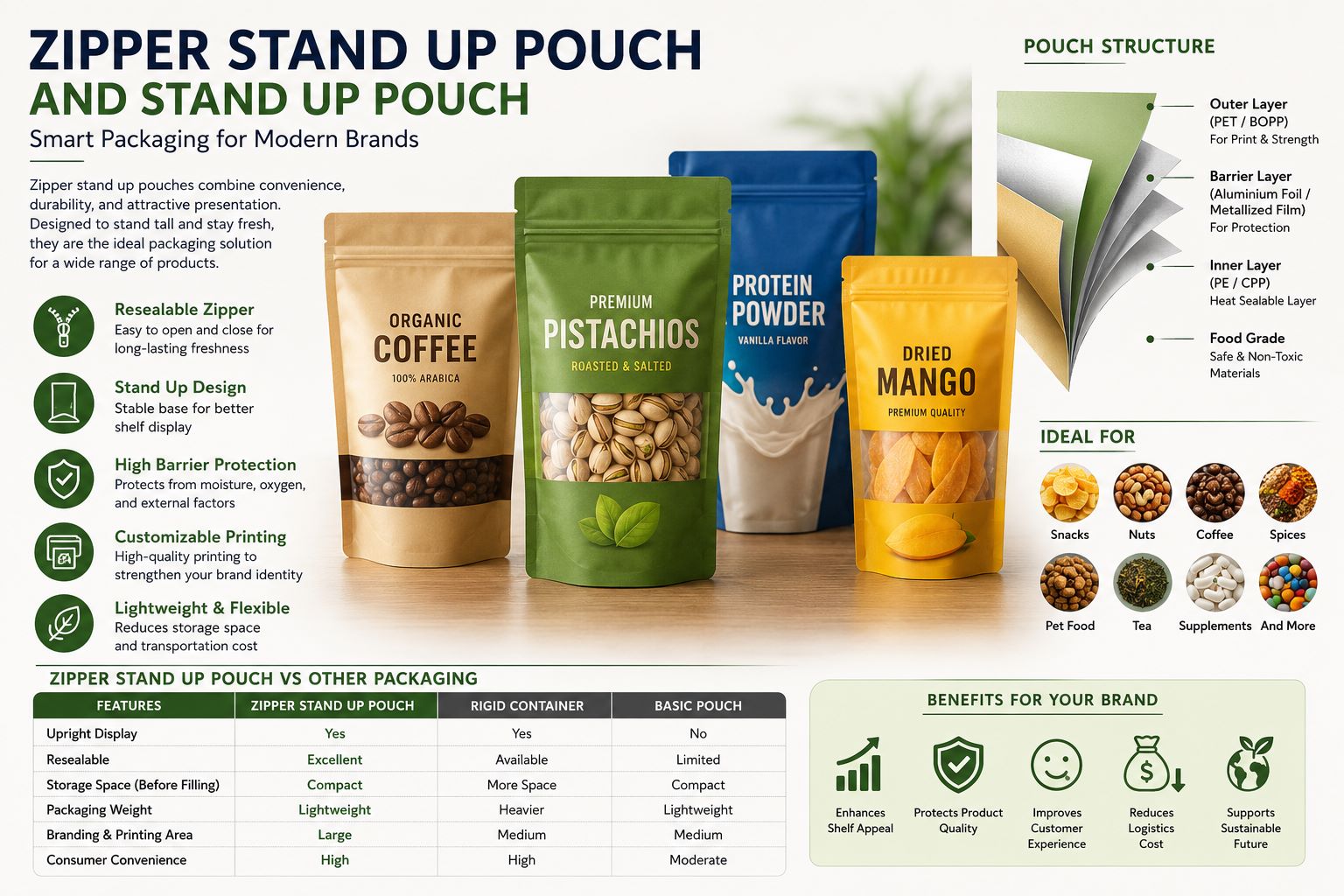
A zipper stand up pouch adds another important feature: resealability.
Consider a customer buying a 500-gram pack of roasted coffee beans. The entire package is unlikely to be consumed immediately. After opening it, the customer needs a practical way to close the remaining product.
A built-in zipper provides that convenience.
The same principle applies to nuts, cereal, dried fruit, pet treats, spices and other products intended for repeated use.
Instead of requiring the consumer to find another storage container, the original package can continue serving as a convenient storage format.
Zipper Stand Up Pouch vs Stand Up Pouch
Although the terms are sometimes used interchangeably, there is an important distinction.
| Feature | Zipper Stand Up Pouch | Stand Up Pouch |
| Upright shelf display | Yes | Yes |
| Bottom gusset | Yes | Yes |
| Resealable | Yes | Optional |
| Repeated opening | Convenient | Depends on closure |
| Custom printing | Yes | Yes |
| Transparent window | Optional | Optional |
| Tear notch | Common | Optional |
| Spout availability | Possible depending on design | Common for liquid formats |
| Best suited to | Multi-use products | Single or multi-use products |
A zipper is therefore a feature within the wider stand-up pouch category rather than a completely separate packaging concept.
Packaging Material Can Determine Product Performance
One of the biggest mistakes businesses can make is choosing a pouch primarily because of its appearance.
A visually attractive package is valuable for marketing, but the material must first protect the contents.
Flexible pouch structures can incorporate materials such as:
- PET
- PE
- BOPP
- CPP
- Nylon
- Metallised films
- Aluminium foil
- Selected mono-material films
Different combinations provide different properties.
For example, a snack product may require strong moisture protection to help maintain its intended characteristics. Coffee may require a structure designed to limit oxygen exposure, while certain light-sensitive products may benefit from opaque or metallised packaging.
There is consequently no single material structure that can be described as the best Stand Up Pouch for every application.
Barrier Protection Should Never Be an Afterthought
The packaging surrounding a product acts as a protective interface between the contents and the outside environment.
Depending on the application, manufacturers may need to consider protection against:
- Moisture
- Oxygen
- Light
- External odours
- Aroma loss
- Puncture
- Leakage
- Contamination
The required level of protection depends on the characteristics and expected shelf life of the product.
A zipper stand up pouch used for coffee, for instance, can require very different barrier characteristics from one designed for non-sensitive household items.
Packaging development should therefore begin with the question, “What does this product need?” rather than simply, “Which pouch looks best?”
A Small Zipper Can Make a Significant Difference
The zipper may occupy only a small section of a package, but it can significantly influence usability.
A typical consumer experience involves:
- Opening the original tamper-evident or heat-sealed section.
- Accessing the zipper underneath.
- Removing the required amount.
- Aligning the zipper tracks.
- Pressing them together to close the pouch.
- Repeating the process whenever necessary.
This makes a zipper stand up pouch particularly relevant to products consumed gradually.
However, resealability should not be confused with the original hermetic seal. The packaging manufacturer must still specify suitable materials and sealing conditions for the product.
Where Are Stand-Up Pouches Commonly Used?
The adaptability of flexible packaging allows a Stand Up Pouch to serve numerous sectors.
Food and Snacks
Chips, nuts, dried fruits, confectionery, cereals and other dry foods can use customised stand-up packaging.
Coffee and Tea
Coffee and tea brands often value resealable closures, strong branding surfaces and appropriate barrier structures. Coffee packaging may also incorporate a degassing valve when technically required.
Spices and Powders
Powdered products can benefit from moisture protection and convenient resealing.
Pet Products
Pet treats and selected dry pet foods are frequently sold in larger zipper pouches because customers may use the product over an extended period.
Personal Care and Household Products
Flexible pouches can also be developed for refill products, powders, concentrates and suitable liquid formulations.
Customisation Goes Beyond Printing a Logo
A modern Stand Up Pouch can be engineered with numerous functional and decorative options.
Common customisation choices include:
- Resealable zipper
- Tear notch
- Transparent product window
- Rounded corners
- Hang hole
- Matte finish
- Gloss finish
- Metallic appearance
- Degassing valve
- Spout and cap
- Laser scoring
- Custom dimensions
- Printed front and rear panels
The right features depend on the product and customer journey.
For example, a transparent window may help customers inspect dried fruit before purchasing. A matte finish can support a premium visual direction, while a spout is generally more practical for certain liquids.
Why Printing Matters in Competitive Retail Markets
Packaging often has only a few seconds to attract attention on a busy shelf.
A professionally printed zipper stand up pouch can communicate the brand identity while also providing essential product information.
The front panel usually benefits from a simple visual hierarchy containing the brand name, product name, variant, important benefit and net quantity.
The rear panel can accommodate:
- Ingredients
- Nutritional information
- Usage instructions
- Storage recommendations
- Manufacturer details
- Barcode
- Batch information
- Regulatory declarations
The exact information required varies according to product category and market, so businesses should verify relevant labelling regulations before approving artwork.
How Should a Business Select the Correct Pouch?
Selecting a pouch should be treated as a structured packaging-development process.
Start by understanding the product itself.
Product Characteristics
Is it a liquid, powder, granule or solid product? Does it contain oil? Is it sensitive to humidity or oxygen?
Filling Quantity
A pouch must accommodate not only product weight but also volume and bulk density.
Consumer Behaviour
Will customers finish the product immediately or consume it over several days or weeks? If repeated use is expected, a zipper stand up pouch may offer greater convenience.
Distribution Conditions
Consider storage temperatures, transportation, stacking, handling and the possibility of puncture or impact.
Filling Equipment
The pouch should also be compatible with the filling and sealing machinery used during production.
Why Pouch Size Should Not Be Based on Weight Alone
Two products weighing exactly 500 grams can require completely different package dimensions.
Five hundred grams of dense granules occupies a different volume from the same weight of lightweight cereal.
When selecting a Stand Up Pouch, consider:
- Bulk density
- Product volume
- Bottom gusset depth
- Headspace
- Filling opening
- Zipper location
- Sealing allowance
- Product settling
Obtaining samples and conducting actual filling tests is generally more reliable than choosing dimensions solely from a size chart.
Quality Testing Can Prevent Expensive Packaging Problems
Ordering thousands of customised pouches without testing can create unnecessary commercial risk.
Before approving mass production, businesses should evaluate relevant aspects such as:
- Seal strength
- Zipper functionality
- Leakage resistance
- Drop resistance
- Puncture resistance
- Print alignment
- Colour consistency
- Pouch dimensions
- Filling performance
- Storage behaviour
Shelf-life and barrier testing may also be appropriate for products where environmental exposure significantly affects quality.
What About Sustainable Stand-Up Packaging?
Sustainability is influencing how flexible packaging is designed.
Traditional laminated pouches can combine multiple materials to achieve printing, barrier and sealing performance. However, some mixed-material structures can be challenging to recycle through existing collection systems.
As a result, packaging developers are exploring mono-material structures and other designs intended to improve recyclability where suitable infrastructure exists.
The environmental conversation should nevertheless go beyond material selection.
A package should also protect the product effectively. Packaging that performs poorly and causes product damage or food waste can undermine wider sustainability objectives.
Frequently Asked Questions
What is a zipper stand up pouch?
It is a flexible bottom-gusseted package incorporating a zipper that allows consumers to close the pouch again after opening.
What is the main purpose of a Stand Up Pouch?
It combines flexible packaging with an expandable base that enables upright display while providing space for branding and product information.
Are all stand-up pouches resealable?
No. Resealability depends on whether the pouch includes a zipper, spout, cap or another reclosure system.
Which products are suitable for zipper pouches?
Common examples include coffee, nuts, dried fruits, cereals, spices, powders, snacks and pet treats.
Can stand-up pouches hold liquids?
Yes, provided the film structure, seals, pouch construction and dispensing system are designed for the specific liquid.
Can I customise the pouch dimensions?
Yes. Manufacturers commonly offer custom widths, heights and gusset dimensions based on product and order requirements.
Can transparent windows be added?
Yes, although the window should be evaluated against the product’s light and barrier requirements.
What does a bottom gusset do?
It expands when filled to create the base that helps the pouch stand upright.
Is a thicker film automatically stronger?
Not necessarily. Strength depends on the complete material structure, film properties, seals and package design, not thickness alone.
Which printing method is best?
Digital, flexographic and rotogravure printing can all be suitable. The ideal method depends on quantity, artwork, cost and production requirements.
Why should samples be tested before ordering?
Samples help verify size, filling performance, zipper operation, appearance and compatibility with the actual product.
How do I choose between a regular and zipper pouch?
Consider how consumers use the product. If they frequently reopen the package, a zipper can provide valuable convenience.
Read more – https://newsgrow.blogspot.com/2026/08/foil-lid-and-stand-up-pouch.html
https://newsgrow.blogspot.com/2026/08/spout-pouch-and-stand-up-pouch-with.html
https://newsgrow.blogspot.com/2026/08/stand-up-pouch-filling-machines.html
https://newsgrow.blogspot.com/2026/08/why-zipper-stand-up-pouch-packaging-is.html
https://blogstream.net/standing-pouch-and-lidding-film-a-deep-guide-to-modern-flexible-packaging/
https://gosarkarijobs.com/how-standing-pouch-and-lidding-film-are-changing-modern-product-packaging/
https://newsgrow.blogspot.com/2026/08/shrink-sleeve-and-stand-up-pouch.html