
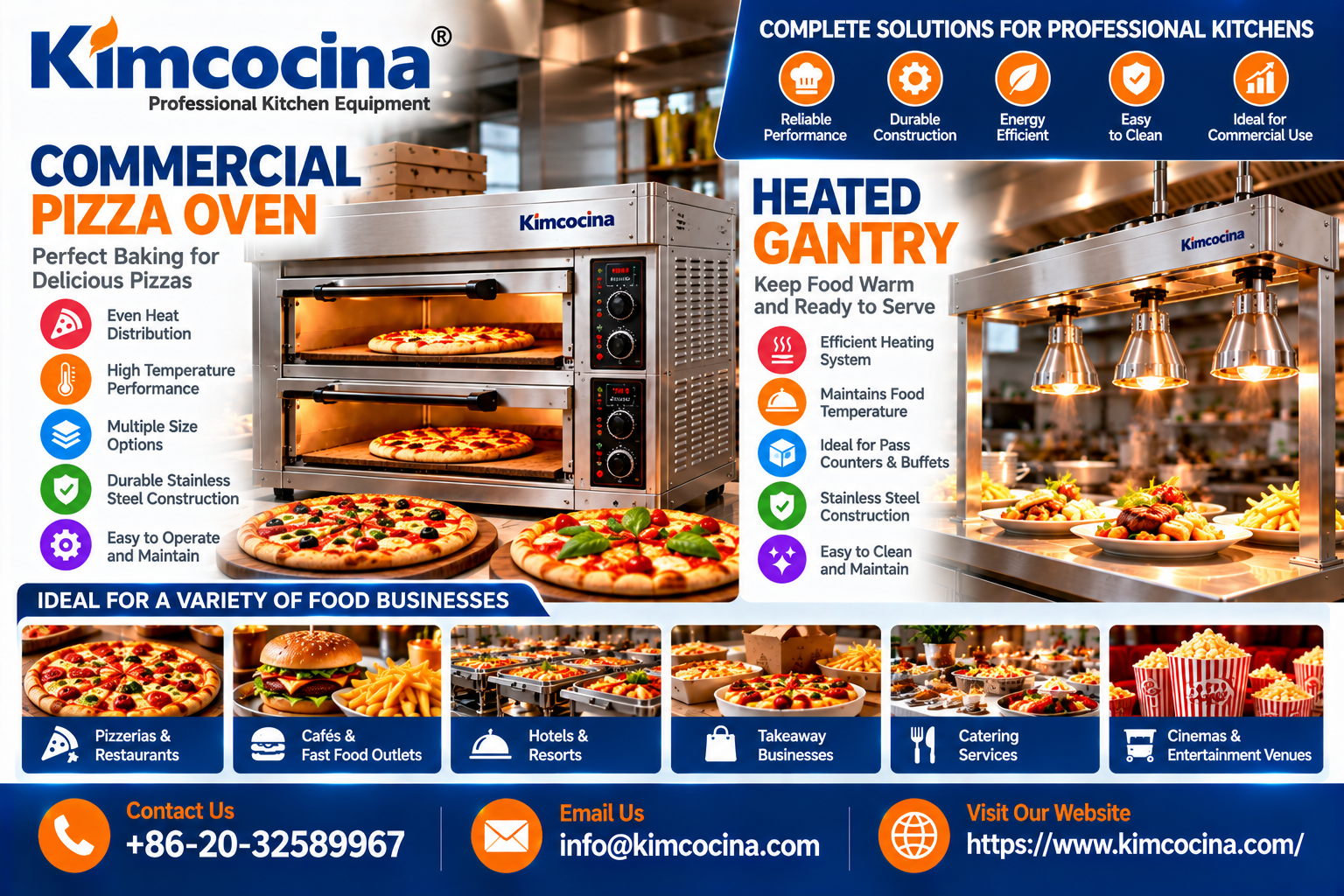
Pizza businesses are paying closer attention to what happens after cooking, not just what happens inside the oven. As restaurants, cafés, hotels, food courts, takeaway outlets, and catering kitchens handle higher order volumes, the transition from cooking to cutting, holding, packaging, and customer collection is becoming an important part of kitchen planning.
This change is putting the Commercial pizza oven at the center of a broader production system while increasing interest in the heated gantry for suitable pass and holding applications. Together, the two types of equipment can support a more organized pizza workflow when selected and installed according to actual service requirements.
Pizza Production Is Becoming a Complete Workflow
A pizza kitchen includes much more than an oven.
Ingredients need to be prepared and stored, dough must be handled, pizzas assembled, orders cooked, finished products checked, and meals transferred quickly to customers or delivery drivers.
The Commercial pizza oven is a critical point in this sequence, but its effectiveness can be reduced when surrounding workstations are poorly organized.
For example, if cooked pizzas leave the oven faster than employees can cut, package, and dispatch them, congestion can develop immediately after baking.
Modern kitchen planning therefore considers the complete production route rather than evaluating oven capacity in isolation.
Commercial Pizza Oven Selection Starts With the Business Model
Different pizza businesses require different equipment strategies.
A dedicated pizzeria with continuous evening demand may need a different oven arrangement from a hotel offering pizza as one part of a larger menu. A takeaway-focused operation may prioritize rapid order flow, while a restaurant may balance pizza production with dine-in service.
Choosing a Commercial pizza oven should therefore begin with questions about the business itself.
Expected order volume, pizza dimensions, cooking method, kitchen space, available utilities, production pattern, staff requirements, and peak service periods can all influence equipment selection.
Matching the oven to the menu and operating model can help businesses avoid both insufficient capacity and unnecessary investment.
Heated Gantry Adds Structure to the Service Pass
Once food leaves the cooking station, it may require a designated location before collection.
A heated gantry can provide overhead heat at an appropriate service or pass area, depending on the equipment design and intended application.
In a pizza-focused kitchen, this type of workstation can become part of the transition between cooking and final service.
The objective is not to keep products waiting unnecessarily. Instead, a properly planned pass gives staff a clear location for suitable completed orders while front-of-house employees, packaging staff, servers, or delivery teams prepare for collection.
This can become especially useful when several orders finish close together.
Takeaway and Delivery Are Changing Kitchen Layouts
The growth of takeaway and delivery has introduced additional movement into many commercial kitchens.
A single restaurant may simultaneously handle dine-in orders, customer collections, and third-party delivery pickups.
Without a clearly organized finishing area, completed meals can become difficult to identify or route correctly.
Positioning a heated gantry within a structured order-dispatch area can help create a defined handover point for appropriate products.
Order identification remains equally important. Tickets, labels, digital order screens, or other internal systems can help staff ensure the correct meal reaches the correct service channel.
Oven Capacity and Dispatch Capacity Need to Match
Increasing cooking capacity does not automatically increase the number of orders a restaurant can serve.
If the Commercial pizza oven produces food faster than employees can finish and dispatch it, the bottleneck simply moves to another part of the kitchen.
Operators should therefore evaluate production as a connected system.
Preparation capacity, oven throughput, finishing space, packaging availability, staffing, and collection processes should be considered together.
The same principle applies when adding a heated gantry. Its dimensions and intended capacity should reflect realistic service requirements rather than simply occupying the maximum available counter space.
Peak-Hour Planning Can Reveal Hidden Problems
Average daily sales do not always show where a kitchen struggles.
A restaurant may operate comfortably for most of the day but experience significant pressure during a concentrated dinner period.
Studying these peak periods can reveal whether delays originate in preparation, baking, cutting, packaging, or collection.
If oven production is the limitation, additional or different Commercial pizza oven capacity may be considered. If completed orders are becoming disorganized after cooking, the finishing and dispatch area may need attention instead.
This type of workflow analysis can help businesses invest in the equipment that addresses the actual constraint.
Kitchen Space Should Be Planned Around Movement
Commercial kitchen space is valuable, particularly in urban restaurants and takeaway outlets.
Equipment dimensions are important, but operators should also consider the working area employees need around each machine.
A pizza production line should allow ingredients and uncooked products to move toward the oven while completed orders move away from it.
Creating this directional workflow can reduce unnecessary crossing between employees.
When installing a heated gantry, businesses should also review counter dimensions, access, electrical requirements, cleaning clearance, and manufacturer installation instructions.
Cleaning and Maintenance Support Consistent Operations
Pizza production can create flour, crumbs, food residue, grease, and other material that requires routine cleaning.
A cleaning schedule should cover both equipment and surrounding workstations.
The Commercial pizza oven should be cleaned and maintained according to the manufacturer’s instructions and the requirements of the individual model.
A heated gantry and its surrounding service area should also receive appropriate routine care.
Preventive maintenance can further support equipment availability by allowing operators to identify wear or operating issues before they result in unexpected downtime.
Staff Training Connects the Production Stages
Equipment cannot create an efficient workflow unless employees understand how the different stations work together.
Pizza preparation teams should know how orders are prioritized. Oven operators need clear production information, while finishing and dispatch employees need a reliable system for identifying completed orders.
Training should also cover equipment operation, cleaning responsibilities, shutdown procedures, and responses to abnormal operating conditions.
A documented workflow can be particularly useful when new employees join or when multiple shifts share the same equipment.
Frequently Asked Questions
What is a Commercial pizza oven?
A Commercial pizza oven is professional cooking equipment designed for producing pizza in restaurants, pizzerias, hotels, cafés, catering kitchens, and other commercial foodservice environments.
What is a heated gantry?
A heated gantry is an overhead heating system used in suitable foodservice holding or pass areas to provide heat support for prepared food before service.
Can a heated gantry be used near a pizza service area?
Depending on the equipment design and installation requirements, it can form part of a finishing or service-pass arrangement for appropriate prepared foods.
How should pizza oven capacity be selected?
Businesses should consider expected peak orders, pizza size, cooking process, service format, kitchen space, available utilities, and production requirements.
Why is the area after the oven important?
Cooked pizzas still need to be checked, cut, finished, packaged or plated, identified, and transferred to the correct customer or server.
Can a larger oven automatically improve service speed?
Not necessarily. Other production stages can become bottlenecks if their capacity does not match oven output.
Why is a heated pass useful during busy service?
A defined pass can give suitable completed orders an organized location before collection and help staff coordinate handover.
What should operators check before installing equipment?
They should review dimensions, utility requirements, operating clearances, ventilation or other installation needs where applicable, cleaning access, and manufacturer instructions.
How important is equipment maintenance?
Routine maintenance can support reliability and reduce the risk of unexpected interruptions during service.
What should buyers consider when planning a pizza kitchen?
They should evaluate preparation, cooking capacity, finishing, packaging, holding, staff movement, cleaning, utilities, maintenance, and order dispatch as one connected system.
Media Contact
Commercial Kitchen Equipment Enquiries
Phone: +86-20-32589967
Email: info@kimcocina.com
Official Website: kimcocina.com