
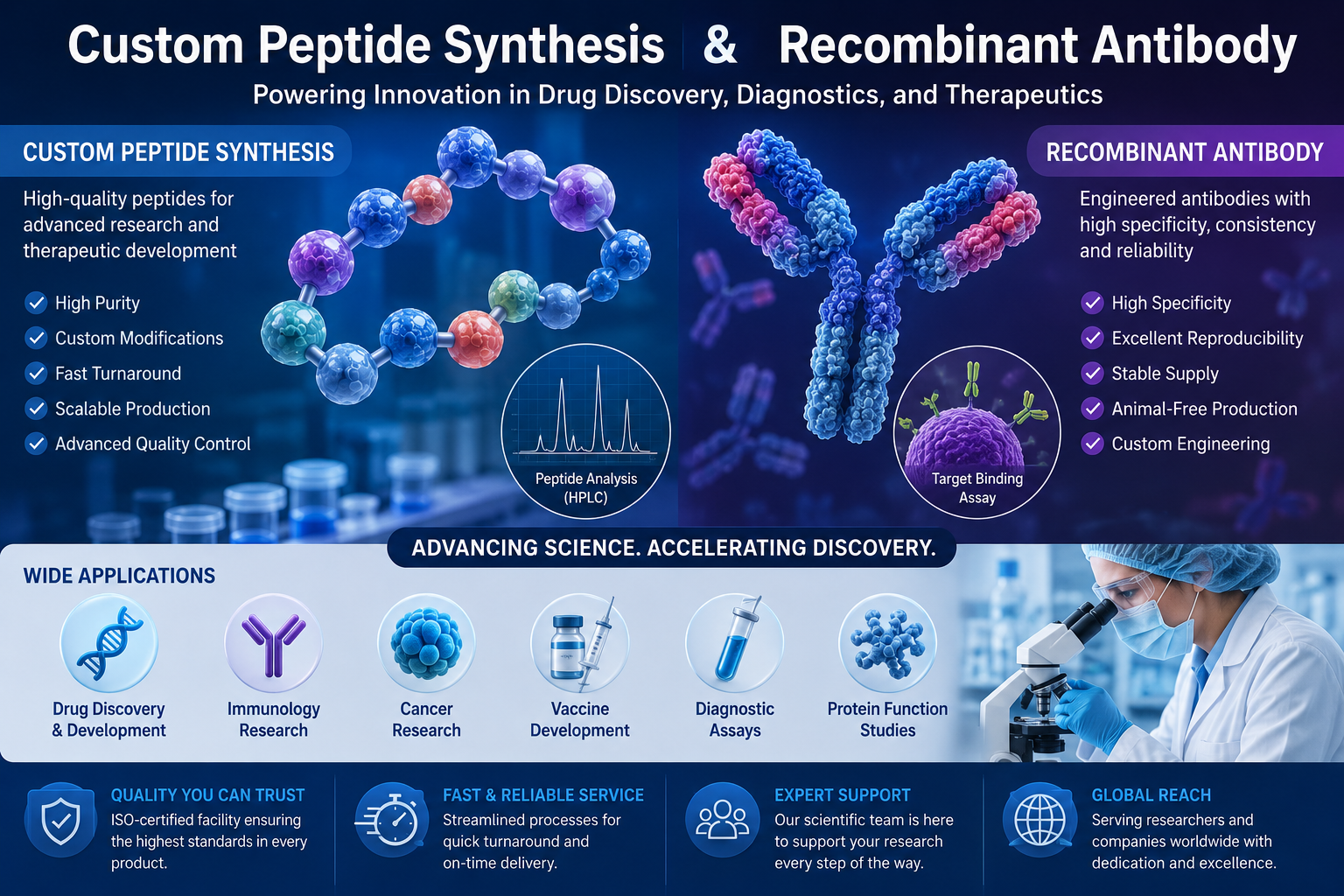
Biotechnology is moving at an extraordinary pace. What once required years of complex laboratory work can now be achieved through highly specialized technologies designed to create biological molecules with remarkable precision. From innovative drug discovery to advanced diagnostics, scientists are increasingly turning to custom peptide synthesis and recombinant antibody technologies to develop solutions tailored to specific research and therapeutic needs.
The shift is significant. Instead of relying solely on naturally occurring biological molecules, researchers can now design peptides, proteins, antibodies, and other biomolecules according to precise specifications. Combined with advanced purification, analytical characterization, automation, and molecular engineering, these technologies are opening new possibilities across pharmaceutical research, healthcare, biotechnology, food science, and medical diagnostics.
Why Custom Peptide Synthesis Is Transforming Modern Research
Peptides are short chains of amino acids that play important roles in biological processes. They are involved in cell signaling, immune responses, metabolism, and numerous physiological functions. However, naturally occurring peptides do not always meet the requirements of modern research.
This is where custom peptide synthesis becomes valuable.
Researchers can design peptide sequences for specific experimental objectives, allowing them to study biological pathways, develop potential therapeutics, investigate protein interactions, and create specialized diagnostic tools.
One of the most influential techniques in this field is solid-phase peptide synthesis, commonly known as SPPS. The method allows amino acids to be assembled sequentially on a solid resin support. Repeated cycles of coupling and deprotection enable scientists to construct specific peptide sequences with considerable control.
Modern automated synthesis platforms have made this process faster and more scalable. What once involved lengthy manual procedures can now be integrated into streamlined workflows, helping research teams obtain customized peptides more efficiently.
However, synthesis is only one part of the equation. The final quality of a peptide depends heavily on purification and analytical validation.
Advanced purification methods, including reversed-phase high-performance liquid chromatography, help separate the desired peptide from truncated sequences, residual reagents, and other impurities. Mass spectrometry and peptide mapping can then be used to confirm molecular identity and characterize the final product.
Together, synthesis, purification, and analytical testing create a comprehensive workflow for producing peptides suitable for demanding research applications.
From Peptide Design to Recombinant Antibody Innovation
The biotechnology revolution does not stop with peptides. Antibody engineering has also undergone a dramatic transformation.
Traditional antibody development often relied on immunizing animals and subsequently collecting antibodies from biological samples. While this approach contributed significantly to scientific progress, modern biotechnology has introduced more sophisticated strategies.
A recombinant antibody is produced using recombinant DNA technology rather than relying exclusively on conventional antibody generation methods. Scientists can engineer antibody sequences and express them through suitable biological systems, enabling greater control over antibody design and production.
This technology has become increasingly important because researchers often require antibodies with specific characteristics, including target specificity, binding affinity, reproducibility, and compatibility with particular applications.
Recombinant antibody technology can support the development of antibodies for:
- Research and laboratory assays
- Diagnostic applications
- Therapeutic discovery
- Biomarker identification
- Protein detection
- Cell biology studies
- Drug development
- Target validation
The ability to engineer antibodies for specific research objectives has expanded the possibilities for modern biomedical science.
How Custom Peptide Synthesis and Recombinant Antibody Technology Work Together
Although peptides and antibodies are distinct biological molecules, they can complement each other in many research workflows.
Custom peptides can be designed to represent specific regions of proteins or biological targets. These peptides may then be used in immunological research, antibody generation, assay development, or epitope mapping.
Meanwhile, recombinant antibody technologies allow researchers to develop highly specific molecular tools for recognizing target proteins or biomarkers.
This combination creates a powerful research ecosystem.
For example, a researcher investigating a disease-associated protein may use custom peptide synthesis to produce a specific peptide sequence for experimental studies. The resulting research can contribute to the identification of target regions, while recombinant antibody technology can help generate or optimize antibodies designed to recognize the target.
This integrated approach can support everything from early-stage discovery to diagnostic development.
The Science Behind Peptide Synthesis
Several approaches can be used to create peptides, but solid-phase peptide synthesis remains one of the most widely adopted techniques.
The general process involves:
- Selecting the desired amino acid sequence.
- Attaching the first amino acid to a solid resin.
- Removing the protecting group from the reactive site.
- Adding the next protected amino acid.
- Repeating coupling and deprotection cycles.
- Cleaving the completed peptide from the resin.
- Purifying the final product.
- Confirming identity and purity through analytical testing.
This systematic process enables researchers to create customized sequences for specific applications.
For more complex or longer peptide structures, alternative strategies may be considered, including fragment condensation and convergent synthesis. The appropriate method depends on factors such as sequence length, chemical complexity, structural characteristics, and intended application.
Purification: The Hidden Hero of Peptide Production
A synthesized peptide is not automatically a research-ready peptide.
Purification is essential for removing unwanted by-products and incomplete sequences that may appear during synthesis. The level of purification required depends on the intended application.
For exploratory laboratory research, a moderate purity level may be sufficient. For sensitive biological experiments or advanced pharmaceutical research, significantly higher purity and rigorous characterization may be necessary.
Reversed-phase HPLC is commonly used for peptide purification because it can separate molecules based on differences in hydrophobicity. Other chromatographic approaches may also be selected depending on the chemical and physical properties of the peptide.
Analytical testing can provide additional information about the final material. Mass spectrometry, for example, can help confirm molecular mass, while peptide mapping and related techniques provide deeper characterization.
In short, high-quality custom peptide synthesis is not simply about creating a sequence. It is about delivering a product that is accurately synthesized, appropriately purified, and properly characterized.
Key Applications of Custom Peptide Synthesis
The demand for customized peptides continues to grow because of their broad range of applications.
Drug Discovery and Development
Peptides are increasingly investigated as potential therapeutic candidates because they can interact with biological targets with high selectivity.
Researchers use custom peptides to explore:
- Protein-protein interactions
- Enzyme inhibition
- Receptor binding
- Cellular signaling
- Disease mechanisms
- Potential therapeutic targets
These studies can help researchers identify promising candidates for further drug development.
Vaccine and Immunology Research
Peptides can also play an important role in immunology research. Specific peptide sequences may be used to investigate immune responses and study antigenic regions.
In combination with advanced antibody technologies, peptide-based research can contribute to the development of new diagnostic and immunological strategies.
Protein Research
Because peptides can represent specific sections of larger proteins, they are valuable tools for studying protein structure and function.
Researchers can use customized peptides to investigate specific domains, binding sites, or functional regions of proteins.
Diagnostics
Highly specific biological molecules are essential for many diagnostic technologies. Peptides and antibodies can be incorporated into research assays designed to detect specific biomarkers or molecular targets.
A well-characterized recombinant antibody can provide valuable specificity in applications where reliable target recognition is critical.
Targeted Drug Delivery
Peptides can also be investigated as molecular carriers capable of interacting with specific cells or tissues. Their ability to bind selected biological targets makes them interesting candidates for targeted delivery research.
Scientists continue to explore how peptide engineering can improve the precision of therapeutic delivery systems.
The Growing Importance of Recombinant Antibody Development
The pharmaceutical and diagnostic industries are increasingly interested in engineered antibodies because of their potential to deliver highly specific molecular recognition.
A recombinant antibody can be engineered and produced using defined genetic sequences, supporting greater consistency between production batches.
This can be especially valuable for applications that require reproducibility and reliable performance.
Recombinant antibody research is contributing to areas such as:
- Targeted therapeutics
- Cancer research
- Infectious disease studies
- Autoimmune disease research
- Diagnostic assay development
- Biomarker detection
- Precision medicine
As researchers learn more about disease biology, the demand for highly specific molecular tools is expected to continue increasing.
Why Choosing the Right Biotechnology Partner Matters
Whether the project involves custom peptide synthesis, recombinant protein production, or recombinant antibody development, selecting the right service provider can have a major impact on research outcomes.
Researchers should consider several factors before choosing a partner:
- Experience with complex biological molecules
- Synthesis and expression capabilities
- Purification technologies
- Analytical characterization
- Quality control procedures
- Project scalability
- Technical support
- Customization options
- Documentation and transparency
A reliable biotechnology partner should understand that every research project is different. The right provider can help researchers select appropriate production and purification strategies based on their scientific objectives.
The Future of Custom Peptide and Antibody Engineering
The future of biotechnology is increasingly focused on precision.
Advances in automation, artificial intelligence, computational biology, protein engineering, and analytical technologies are expected to accelerate the discovery and development of new biological molecules.
For peptides, improved synthesis chemistry may enable increasingly complex sequences and structures. For antibodies, computational design and advanced engineering techniques could support the development of molecules with enhanced specificity and optimized characteristics.
The convergence of these technologies may create new opportunities for personalized medicine, targeted therapies, advanced diagnostics, and next-generation research tools.
https://newsgrow.blogspot.com/2026/06/custom-peptide-synthesis-and_0288721488.html