A ceramic plate on a restaurant table and a decorative planter in a modern living room may serve completely different purposes, but their manufacturing journeys begin in much the same place: carefully prepared ceramic material. What happens afterwards determines whether that raw material becomes elegant tableware or a durable home and garden accessory.
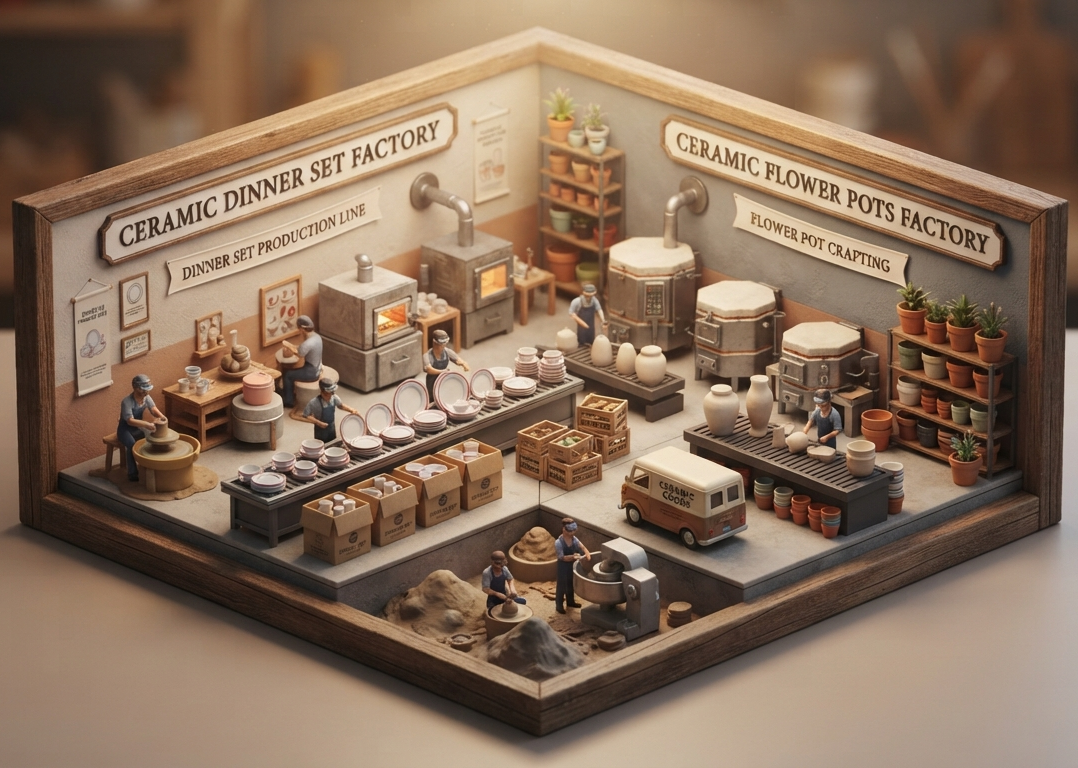
Today, a Ceramic Dinner Set Factory is not simply a facility producing plates and bowls. It is a manufacturing environment where material science, mould engineering, firing technology, glazing and design come together. In the same way, a Ceramic Flower Pots Factory must combine creative styling with structural considerations, drainage requirements and practical plant use.
For importers, wholesalers, retailers and private-label brands, understanding these manufacturing differences can make supplier selection considerably easier.
Why Ceramic Manufacturing Requires Technical Expertise
Ceramic manufacturing is unusual because many characteristics of the final product are determined during firing. A product that looks perfect before entering the kiln may shrink, change colour, warp or develop surface imperfections during heating.
Manufacturers must therefore control every stage carefully.
Raw materials are prepared according to the required ceramic composition. Moisture levels must support forming without creating unnecessary drying problems. Products must then be dried and fired according to carefully established conditions.
The process generally involves:
- Raw-material preparation
- Ceramic body formulation
- Forming or moulding
- Controlled drying
- Initial firing where applicable
- Glazing and decoration
- Final firing
- Quality inspection
- Packaging
The details vary significantly according to the type of ceramic product being manufactured.
How a Ceramic Dinner Set Factory Creates a Complete Collection
A Ceramic Dinner Set Factory may manufacture dozens of coordinated items within a single product range.
A typical collection could include dinner plates, side plates, cereal bowls, soup bowls, mugs, cups, saucers and serving dishes.
Producing these products as a coordinated family is more difficult than manufacturing individual pieces. Colours need to complement one another, proportions must remain consistent and products should maintain their intended dimensions after firing.
Factories commonly use pressing, roller forming, casting and other mould-based production methods.
Automation can improve repeatability for large orders, while manual techniques may still be used for specialised shapes and decorative finishes.
The Challenge of Maintaining Consistency
Consistency is one of the most important measures of manufacturing capability.
Imagine a restaurant purchasing hundreds of identical dinner plates. Significant differences in diameter, height, colour or curvature would immediately become noticeable when those plates are stacked and presented together.
A professional Ceramic Dinner Set Factory therefore monitors mould condition, ceramic body consistency, moisture, drying and firing conditions.
The challenge becomes even greater with repeat orders. Commercial customers may expect a collection ordered six months later to coordinate with the original shipment.
Manufacturers must therefore maintain reliable production records and carefully control materials and processes.
Glazing Changes the Character of Dinnerware
The ceramic body provides the structure, but glaze often provides the personality.
Manufacturers can create surfaces ranging from classic glossy white to sophisticated matt black, natural speckled finishes and dramatic reactive effects.
Decoration can include:
- Ceramic decals
- Digital printing
- Hand-painted details
- Underglaze patterns
- Embossed designs
- Textured surfaces
- Metallic-style decorative effects
- Multi-colour finishes
The Appeal of Handmade-Looking Ceramics
Contemporary dinnerware often celebrates slight visual variation rather than absolute uniformity.
Reactive glazes, irregular edges and textured surfaces can give commercially manufactured products a handcrafted character.
However, controlled variation and manufacturing defects are different things. Buyers should establish acceptable appearance standards during sample approval.
Dinnerware Must Balance Beauty with Practical Performance
Attractive design alone does not define good tableware.
Dinnerware must perform appropriately during normal use. Depending on the intended market, manufacturers may need to consider stacking, surface durability, thermal behaviour and applicable food-contact requirements.
When evaluating a Ceramic Dinner Set Factory, buyers should inspect samples for:
- Cracks and chips
- Rough edges
- Uneven glaze
- Excessive warping
- Dimensional differences
- Surface pinholes
- Colour inconsistency
- Poor stacking
Relevant product testing should also be discussed according to the intended destination market and application.
How a Ceramic Flower Pots Factory Approaches Manufacturing Differently
Walk into a Ceramic Flower Pots Factory and the manufacturing priorities begin to change.
A flower pot is not designed to hold food. Instead, it may need to contain soil, support a plant, accommodate water and remain visually attractive within a room or garden.
This introduces different engineering considerations.
Manufacturers can produce miniature succulent pots, desktop planters, hanging pots, indoor decorative containers, outdoor garden pots and substantial floor-standing planters.
Size alone can significantly influence manufacturing technique, wall thickness, drying time and packaging requirements.
Drainage Is a Small Detail with a Large Function
One of the most important differences between dinnerware and planter manufacturing is drainage.
Pots intended for direct planting commonly incorporate drainage holes so excess water can escape. Indoor products may also include matching ceramic saucers.
Other products are designed as decorative outer containers rather than direct-growing pots and may intentionally have no drainage opening.
A capable Ceramic Flower Pots Factory should therefore understand the intended use before finalising a design.
This is particularly important for private-label development because two visually similar planters can have completely different functional requirements.
Design Trends Are Transforming Ceramic Planters
Flower pots are increasingly treated as interior accessories rather than simple gardening products.
Consumers often select planters to coordinate with furniture, flooring, wall colours and other decorative elements.
Manufacturers have responded with diverse surface treatments, including:
- Natural clay textures
- Matt neutral finishes
- Glossy colours
- Geometric embossing
- Vertical ribbing
- Reactive glazing
- Rustic surfaces
- Speckled finishes
- Hand-painted patterns
This design flexibility gives retailers opportunities to develop seasonal and lifestyle-oriented collections.
Ceramic Dinnerware and Flower Pots Compared
| Area | Ceramic Dinner Set Factory | Ceramic Flower Pots Factory |
| Core Products | Plates, bowls, cups and mugs | Planters, pots and saucers |
| Main Application | Food serving and dining | Plants and decoration |
| Key Manufacturing Concern | Consistency | Structure and functionality |
| Drainage | Not required | Often required |
| Typical Sizes | Relatively standardised | Extremely varied |
| Surface Design | Glazes, decals and printing | Glazes, textures and embossing |
| Common Market | Retail and hospitality | Home, garden and landscaping |
Both sectors depend on accurate firing and quality control, but their performance expectations are clearly different.
Custom Manufacturing Opens Opportunities for Brands
Many buyers no longer want products that look identical to those sold by competitors.
OEM and private-label production allow brands to create more distinctive collections.
A Ceramic Dinner Set Factory may customise plate shapes, glaze colours, patterns, logos, decals and packaging.
A Ceramic Flower Pots Factory can potentially develop unique planter shapes, textures, dimensions, colours, drainage configurations and branded packaging.
Before requesting samples, buyers should create a clear product specification containing:
- Dimensions
- Material preference
- Colour
- Surface finish
- Logo requirements
- Packaging
- Order quantity
- Intended market
- Product application
- Quality expectations
The more precise the specification, the easier it becomes for the manufacturer to evaluate feasibility accurately.
Why Sample Development Should Never Be Rushed
A computer rendering cannot fully predict how a ceramic product will look after firing.
Colours may appear different. Glaze may behave unexpectedly around curves. Dimensions can change because of firing shrinkage.
Physical sampling therefore plays an important role in custom ceramic development.
Buyers should review samples carefully and document approved specifications before production begins.
If modifications are required, resolving them during sampling is usually preferable to discovering problems after thousands of units have been produced.
Quality Control Starts Before the Kiln
A common misconception is that ceramic quality control happens only after production.
Professional factories monitor quality much earlier.
Ceramic materials can be checked before forming. Moulded pieces can be inspected for dimensions. Dried pieces can be checked for cracks and deformation. Fired products can then undergo visual and dimensional inspection.
Typical problems include glaze bubbles, pinholes, cracks, rough edges, warping, colour differences and surface contamination.
Removing defective pieces at appropriate production stages can improve overall efficiency.
Why Ceramic Packaging Deserves Serious Attention
Manufacturing a beautiful ceramic product is pointless if it reaches the customer broken.
Dinnerware requires careful separation because ceramic pieces can strike one another during transportation. Flower pots present another challenge because large pieces can be heavy while remaining vulnerable to impact.
Packaging systems may incorporate:
- Protective wrapping
- Cardboard dividers
- Internal inserts
- Individual boxes
- Reinforced master cartons
- Palletisation
Packaging requirements should reflect product shape, weight, value and expected transportation conditions.
How Sustainability Is Influencing Ceramic Factories
Ceramic production is energy-intensive because kiln firing requires high temperatures.
Manufacturers are therefore increasingly interested in improving kiln utilisation, production yields and resource management.
Reducing rejected products is especially significant. A ceramic piece rejected after firing has already consumed raw materials, labour and energy.
Factories can also explore clay recovery, responsible water management and recyclable packaging.
For environmentally conscious buyers, these practices can become part of supplier evaluation.
What Buyers Should Ask Before Selecting a Factory
Choosing a supplier should involve more than requesting a quotation.
Ask manufacturers about their main product specialities, production capacity, minimum quantities, custom development process, quality controls and typical lead times.
Buyers should also request samples and discuss packaging before confirming substantial orders.
Where products are being imported, clarify relevant documentation and testing requirements.
A supplier offering an unusually low price but poor consistency can ultimately create higher costs through damaged products, customer complaints, returns and delayed deliveries.
Frequently Asked Questions
What is a Ceramic Dinner Set Factory?
A Ceramic Dinner Set Factory specialises in manufacturing ceramic tableware such as plates, bowls, cups, mugs and serving pieces.
What products does a Ceramic Flower Pots Factory manufacture?
A Ceramic Flower Pots Factory manufactures ceramic planters, decorative plant containers, garden pots and saucers.
Can manufacturers create custom ceramic dinnerware?
Yes. Many manufacturers provide custom shapes, colours, glazes, patterns, logos and packaging depending on order requirements.
Are custom ceramic flower pots available?
Yes. Size, shape, texture, colour, drainage and branding can often be customised.
Why do ceramics shrink during production?
Water loss and physical changes within ceramic materials during drying and firing can cause controlled shrinkage.
Why do ceramic colours sometimes vary?
Raw materials, glaze thickness, firing temperature and kiln conditions can influence finished colours.
What are drainage holes used for?
They allow excess water to escape from pots intended for direct planting.
What is the difference between matt and glossy glaze?
Matt glaze produces a softer, low-reflection appearance, while glossy glaze creates a smoother, more reflective finish.
Should buyers approve samples before production?
Yes. Sample approval helps establish expectations for dimensions, colour, finish and workmanship.
What should buyers consider besides ceramic product price?
Quality consistency, customisation, testing, packaging, production capacity, lead times and communication should all be evaluated.
https://newsgrow.blogspot.com/2026/08/ceramic-coaster-and-ceramic-canister.html
https://newsgrow.blogspot.com/2026/08/ceramic-butter-dish-and-ceramic-mug.html
https://newsgrow.blogspot.com/2026/08/ceramic-tea-pot-supplier-and-ceramic.html